
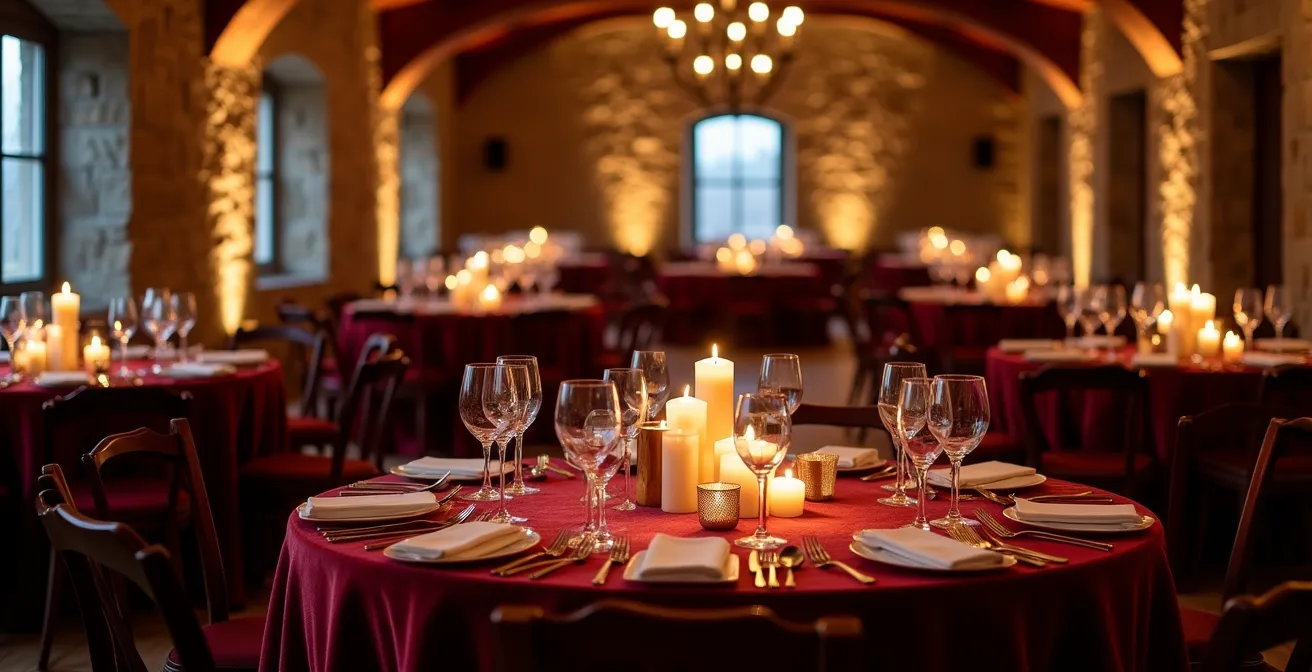
Velvet’s true value for a wedding is its power to solve the core atmospheric problems of large, impersonal venues: echo and a lack of warmth.
- It scientifically dampens sound by trapping soundwaves in its dense pile, reducing echo and making conversation easier.
- Its unique texture absorbs and scatters light, creating visual depth and eliminating the harsh glare common with flat fabrics.
Recommendation: Treat velvet as an engineering choice for your venue’s environment, not just a decorative one, to fundamentally transform the guest experience.
When designing a wedding, especially in a cavernous hall or a venue with hard surfaces, the goal is often to create a sense of intimacy and warmth. Couples are frequently advised to use soft lighting and rich colors, but these solutions only address the visual part of the equation. They overlook a critical, invisible factor that defines a room’s atmosphere: sound. An echo-prone hall can make even the most beautifully decorated space feel cold and disconnected, as conversations are swallowed by ambient noise. This is where the common perception of velvet as a purely aesthetic, “luxurious” fabric falls short.
The key to transforming these challenging spaces lies not just in what guests see, but in what they feel and hear. While polyester and cotton are functional, they are acoustically reflective. They do little to tame the clatter of cutlery or the reverberation of voices. The real solution is to think like an acoustic engineer and deploy materials designed to control the environment. This is the hidden genius of velvet. Its value isn’t merely in its visual richness; it’s a high-performance material engineered to manipulate both light and sound.
This article will deconstruct the science behind velvet’s effectiveness. We will explore how its physical structure fundamentally alters a room’s acoustics and lighting, why it’s more resilient than you think, and how to deploy it strategically—whether in full force or as a subtle accent—to create a scientifically cozier and more engaging atmosphere for your guests. We’ll move beyond the trend to understand the technique.
To fully understand how to leverage this unique material, this guide breaks down its properties, from its photographic qualities to its surprising practicality. Here is a look at what we will cover.
Summary: Why Velvet is the Ultimate Winter Wedding Texture Hack
- Why Velvet Photographs Differently Than Polyester or Cotton?
- How Does Velvet Handle Wine Spills Compared to Standard Poly?
- Full Velvet Tablecloth or Just Napkins: Which Is Overkill?
- The Heat Issue With Velvet Linens for Summer Outdoor Weddings
- How to Keep Black Velvet Clean During a 4-Hour Dinner Service?
- Why Silk Chiffon Drapes Better Than Polyester for Romantic Ceilings?
- Why Uplighting Works Best on Textured Brick or Stone Walls?
- How to Style Banquet Tables for a Communal “Feast” Atmosphere?
Why Velvet Photographs Differently Than Polyester or Cotton?
The unique photographic quality of velvet is not an accident of style; it’s a direct result of its physical structure. Unlike flat-weave fabrics like polyester or cotton that reflect light uniformly, velvet has a dense, three-dimensional pile. These upright fibers create a complex micro-texture of countless peaks and valleys. When light hits this surface, it doesn’t just bounce off. Instead, it is trapped, scattered, and absorbed within the pile. This process is the key to its signature look.
This light-trapping effect minimizes specular highlights—the harsh, mirror-like glare you often see on shiny polyester. The result is an incredibly deep, saturated color that appears rich and non-reflective in photographs. The light that does scatter creates soft, subtle highlights along the edges of the fibers, giving the fabric a gentle shimmer rather than a flat shine. This creates a high degree of visual depth and dimension that makes the fabric, and the entire tablescape, look more luxurious and dynamic on camera.
Professional photographers understand this principle and use it to their advantage. To truly capture velvet’s texture, they employ specific lighting techniques. Bounced or diffused light prevents flattening the pile, while grazing light—light that skims the surface at a low angle—is used to emphasize the texture by creating soft shadows in the fabric’s valleys. This interplay of light and shadow is what gives velvet its “living” quality in photos, a characteristic that smooth, two-dimensional fabrics can never replicate.
How Does Velvet Handle Wine Spills Compared to Standard Poly?
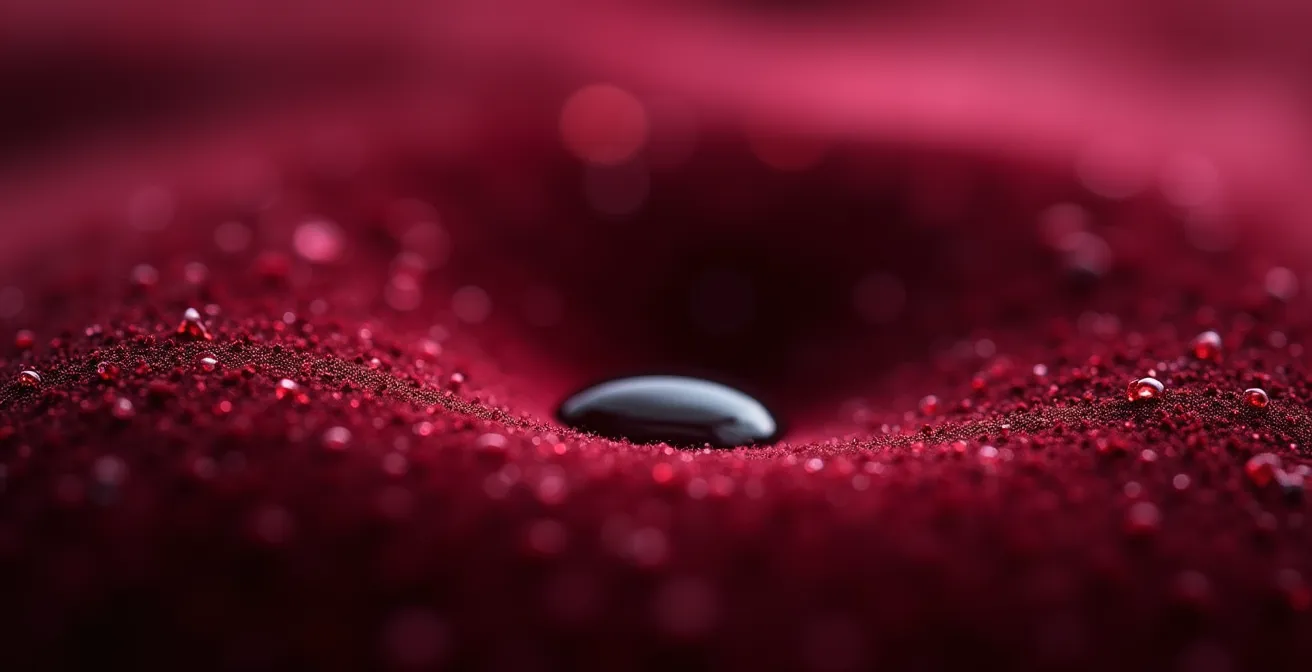
A common concern with using a perceived luxury fabric like velvet is its durability, especially when faced with the inevitable spills of a wedding dinner. However, modern synthetic velvet is engineered for performance and often handles accidents, like a red wine spill, surprisingly well compared to natural fibers like cotton. The key difference lies in its reaction to liquid. High-quality synthetic velvet, commonly used for event rentals, has hydrophobic properties, meaning its fibers tend to repel water rather than instantly absorb it.
When wine is spilled on synthetic velvet, it often “beads up” on the surface for a moment. This provides a critical window of opportunity for quick blotting before the liquid can penetrate the fabric’s backing. Standard polyester has some resistance but tends to absorb more quickly, while cotton velvet acts like a sponge, wicking the liquid deep into its fibers and making stains nearly impossible to remove. This beading effect is a significant advantage for maintaining a pristine look throughout an event.
This chart breaks down the practical differences in spill management. It highlights that while synthetic velvet requires more specific care than machine-washable polyester, its initial resistance makes it a reliable choice for high-stakes events. This is why professional rental companies confidently stock it. Their maintenance protocols are built around the fabric’s known performance, and as a client, you are typically not responsible for post-event washing; you simply return the linens for professional treatment.
| Fabric Type | Initial Spill Reaction | Cleaning Difficulty | Rental Cost Impact |
|---|---|---|---|
| Synthetic Velvet | Beads up for quick blotting | Moderate – needs specific care | $8-15 per piece |
| Cotton Velvet | Absorbs quickly | High – stains may set | $15-25 per piece |
| Standard Polyester | Partial absorption | Low – machine washable | $5-10 per piece |
Full Velvet Tablecloth or Just Napkins: Which Is Overkill?
Deciding between full velvet tablecloths, runners, or just napkins is a strategic choice that balances budget, visual impact, and the desired level of sensory experience. There is no single “correct” answer; the optimal choice depends entirely on your event’s goals. A full velvet tablecloth makes a bold, definitive statement. It establishes the primary texture for the room and offers the maximum acoustic dampening benefit, which is critical for large, echo-prone spaces. However, this option carries the highest cost; according to industry data, velvet tablecloths range from $15 to several hundred dollars each, depending on size and quality.
For a more budget-conscious approach that still delivers high impact, velvet runners are an excellent compromise. Layered over standard linens, they introduce a dramatic band of color and texture that draws the eye down the length of the table, enhancing a communal feel without the expense of a full cloth. This preserves some textural luxury while keeping costs in check. The most subtle, yet perhaps most personal, application is the velvet napkin. While it contributes minimally to the room’s overall acoustics, it provides a guaranteed tactile experience for every single guest. It’s a small touch of luxury they will physically interact with throughout the meal.
The decision shouldn’t be about avoiding “overkill,” but about intentional design. If the goal is a complete transformation of a venue’s atmosphere, full tablecloths are a powerful tool. If the goal is an elegant accent, runners or napkins are more strategic. The key is to align your choice with your primary objective, whether it’s visual drama, acoustic control, or personal tactile luxury.
Your Action Plan: Strategic Velvet Placement Framework
- For maximum visual impact: Use full velvet tablecloths as the ‘hero’ texture for head tables and sweetheart tables.
- For budget-conscious elegance: Layer velvet runners over standard linens for dramatic effect at a lower cost.
- For tactile luxury: Invest in velvet napkins—every guest experiences the texture personally.
- For acoustic benefits: Full tablecloths absorb sound much more effectively, improving conversation quality in noisy rooms.
- For sophisticated contrast: Pair velvet napkins with high-quality linen or silk tablecloths to mix textures.
The Heat Issue With Velvet Linens for Summer Outdoor Weddings
The association of velvet with winter is strong, primarily due to its visual weight and plushness, which we psychologically link to warmth and coziness. This leads many to dismiss it for summer or outdoor weddings, fearing it will look or feel too heavy and hot. However, this is a misconception based on aesthetics rather than thermal properties. A velvet tablecloth does not radiate heat; its “warmth” is purely textural and psychological. With strategic choices in color and application, velvet can be a stunning addition to weddings in any season.
The key to using velvet in warmer months is to pivot from the deep, saturated jewel tones of winter to a lighter, airier color palette. Shades like dusty rose, silver, champagne, or light grey feel less visually heavy and reflect more light, instantly making them feel more appropriate for spring or summer. As noted by wedding style experts, a lighter touch is often more effective. As HGTV’s design team advises, “A crushed velvet table runner adds a little bit of texture and luxury to any tablescape. And a soft neutral, such as light grey, doesn’t read too heavy for any season.”
Spring and summer brides can get in on the velvet trend, too. A crushed velvet table runner adds a little bit of texture and luxury to any tablescape. And a soft neutral, such as light grey, doesn’t read too heavy for any season.
– HGTV Wedding Style Experts, 10 Ways to Use On-Trend Velvet in Your Wedding
Furthermore, the type of velvet and its application are crucial. Instead of full, heavy tablecloths for a daytime summer event, consider using only runners or napkins. Crushed velvet is an excellent choice as its multi-directional, shimmering texture feels lighter and more dynamic than plush, matte velvet. For an evening affair, even in the summer, full tablecloths can work beautifully after the sun has set, adding a layer of unexpected luxury and absorbing sound during the reception.
How to Keep Black Velvet Clean During a 4-Hour Dinner Service?
Using black velvet linens creates a dramatic, sophisticated, and wonderfully light-absorbent backdrop, but it comes with a valid concern: its tendency to show every piece of lint, dust, or crumb. Keeping it pristine during a four-hour dinner service seems daunting, but it’s a challenge that caterers and event professionals manage with proactive strategies and the right choice of material. The first line of defense is fabric selection. Crushed or panne velvet is far more forgiving than traditional flat-pile velvet. Its textured, multi-directional surface naturally camouflages small particles and smudges, whereas a uniform pile shows every imperfection.
The second strategy is meticulous pre-service preparation. The final setup should include a thorough lint-rolling with an electrostatic brush about 30 minutes before guests arrive. Once the service begins, prevention is key. Training serving staff to use trays and avoid brushing against tables minimizes contact. Furthermore, using wide charger plates is not just an aesthetic choice; it creates a crucial buffer zone that catches the majority of crumbs and protects the tablecloth. For any issues that arise mid-event, service stations can be equipped with handheld lint brushes for discreet touch-ups between courses.
Ultimately, relying on professional-grade rental linens provides the greatest peace of mind. As noted by rental companies like AM Linen Rental, their products are specifically manufactured for durability and easy maintenance. They arrive professionally pressed and individually packaged to ensure they are spotless upon arrival. This professional standard, combined with smart service protocols, ensures that even a demanding fabric like black velvet can maintain its elegant appearance throughout an entire event.
Why Silk Chiffon Drapes Better Than Polyester for Romantic Ceilings?
While this article focuses on the grounding, sound-absorbing properties of velvet on tables, creating a truly immersive and romantic atmosphere requires a holistic approach to texture. The heaviness of velvet must be balanced with lightness. This is where ceiling treatments, particularly with fabrics like silk chiffon, play a crucial role. The question isn’t just why chiffon drapes well, but why its specific properties create the perfect textural counterpoint to velvet.
Silk chiffon is exceptionally lightweight and has a soft, fluid drape that polyester struggles to replicate. It moves with the slightest airflow, creating a gentle, organic motion that adds a dreamy, ethereal quality to a space. When used for ceiling canopies, it billows and floats, suggesting clouds or soft waves. This visual “airiness” is the perfect foil to the “earthiness” of the heavy, static velvet below. This combination creates a powerful sensory dynamic: the grounding, secure feeling from the velvet tables is complemented by the open, romantic feeling from the flowing chiffon above.
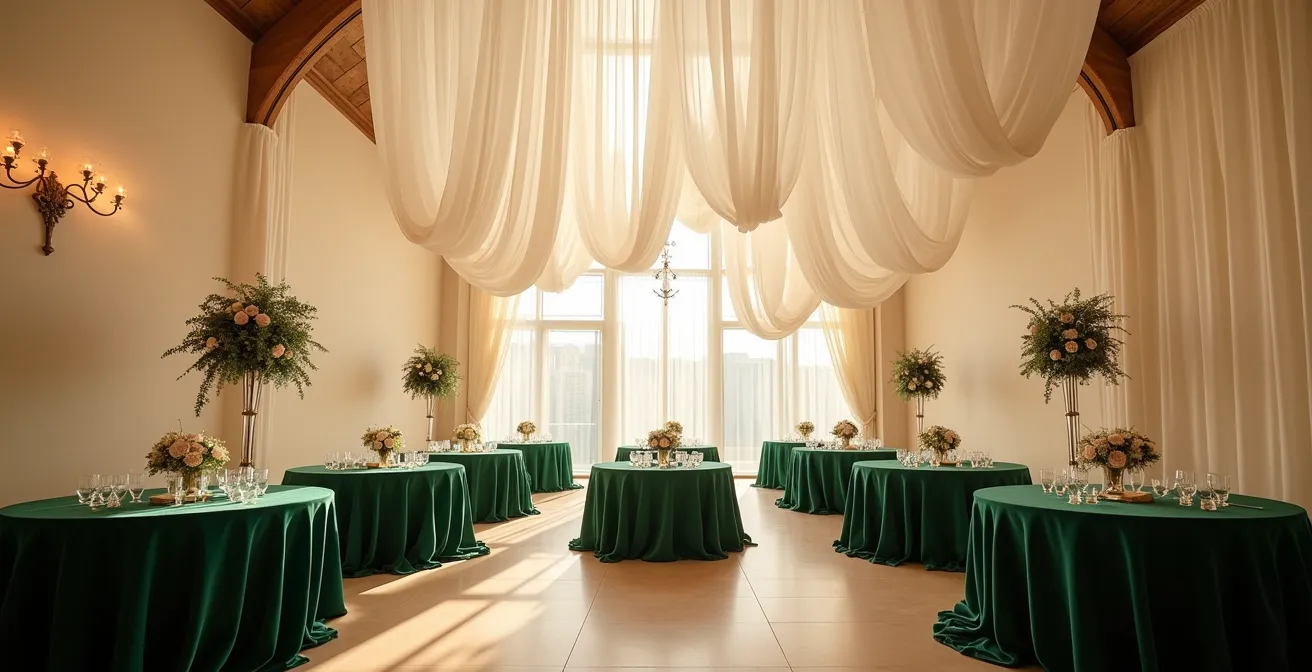
This “Air & Earth” balance is also functional. Using too much velvet—on tables, walls, and ceilings—can lead to over-damping, making a room feel acoustically “dead” or stuffy. Introducing a sheer fabric like chiffon prevents this, allowing sound to reflect and move in a controlled way. The lighting strategy also benefits. As CV Linens’ design team notes, velvet has a “weight that creates gentle folds and a shimmering surface that perfectly reflects candlelight.” In contrast, uplighting on translucent chiffon creates an ethereal glow. This allows for a layered lighting design: soft, ambient light from above and intimate, pooled light on the tables below.
Why Uplighting Works Best on Textured Brick or Stone Walls?
The principle behind why uplighting is so effective on textured walls like brick or stone is a core concept in lighting design called “grazing.” When a light source is placed close to a surface and aimed at a sharp, shallow angle, it rakes across the texture. This light catches the high points and casts dramatic, elongated shadows in the low points. It’s this high contrast between light and shadow that exaggerates the surface’s three-dimensional quality, making it feel deeper, more complex, and more visually interesting. The effect is so powerful that professional wedding lighting specialists report that grazing light at sharp angles creates dramatic shadows that enhance texture depth by up to 300%.
While this technique is commonly associated with architectural features, the exact same physics apply to fabrics—especially a high-pile fabric like velvet. A flat, uniform light source (like overhead fluorescent lighting or a direct flash) will kill velvet’s texture, making it look dull and one-dimensional. However, by applying the grazing light principle, you can bring its texture to life. This is the secret to creating those rich, dynamic tablescapes seen in magazines.
Case Study: Applying Wall Lighting Principles to Velvet Tables
Wedding photographers intuitively use this technique. They understand that natural side-lighting from a window or the low-angle light from candles creates a softer, more romantic look. By positioning candles, pin-spots, or other small light sources at a low angle relative to the tablecloth, they are effectively “grazing” the velvet’s pile. The light catches the tips of the fibers, creating a subtle shimmer, while the deep, non-reflective base absorbs the rest, creating a powerful interplay of micro-light and shadow. This technique transforms the tablecloth from a simple colored surface into a dynamic textural landscape.
Therefore, when planning your event’s lighting, think of your velvet tablecloths not as flat surfaces but as miniature textured walls. Use low-angle light sources to reveal their depth and avoid flat, direct light that would erase their most beautiful characteristic.
Key Takeaways
- Velvet is a technical material that controls a room’s atmosphere by absorbing both light and sound.
- Its effectiveness comes from its three-dimensional pile, which traps sound waves and scatters light to create depth.
- Strategic use of velvet, from full cloths to napkins, allows for balancing budget, visual impact, and acoustic control.
How to Style Banquet Tables for a Communal “Feast” Atmosphere?
Creating a communal “feast” atmosphere at long banquet tables goes beyond simply seating guests together. It’s about fostering a psychological sense of connection, warmth, and intimacy. This is where velvet becomes a powerful tool, not just for its look, but for its profound effect on a room’s psychoacoustics. In a large, reverberant hall, the cumulative noise of conversations can become a cacophony, forcing guests to raise their voices and creating a stressful, disconnected environment. Velvet tablecloths, with their dense pile, act as highly effective sound absorbers right at the source.
By dampening the clatter of cutlery and absorbing ambient chatter, velvet lowers the overall noise floor of the room. This makes it easier for guests to hold conversations at a normal volume, fostering a more relaxed and intimate social dynamic. The “inviting vibe” that event experts attribute to velvet is a direct result of this acoustic comfort. It physically makes the space more conducive to connection. This effect can be further enhanced by using a continuous velvet runner down the center of the banquet table, which not only unifies the table visually but also creates a shared tactile and acoustic buffer zone.
Light plays an equally important role. The non-reflective nature of velvet is perfect for creating intimate “pools” of light. By using pin-spotting or candles on a velvet surface, you create defined zones of warmth and focus, breaking up the monotony of a long table and encouraging guests to connect with those seated near them. This combination of controlled sound and intimate lighting, facilitated by the unique properties of velvet, is the formula for transforming a simple dinner into a truly communal and memorable feast.
| Element | Impact on Communal Feel | Velvet Application | Guest Experience |
|---|---|---|---|
| Continuous Runner | Creates visual unity | Single velvet runner down center | Shared tactile element |
| Sound Absorption | Enables conversation | Full velvet coverage | Reduced echo and clatter |
| Light Pooling | Creates intimate zones | Non-reflective surface | Cozy gathering spots |
| Textural Warmth | Psychological comfort | Plush pile fabric | Inviting touch sensation |
By understanding velvet not as a mere decorative element but as a high-performance material for environmental design, you can make informed, strategic choices that elevate the entire sensory experience of your wedding, turning any venue into an intimate and unforgettable space.