
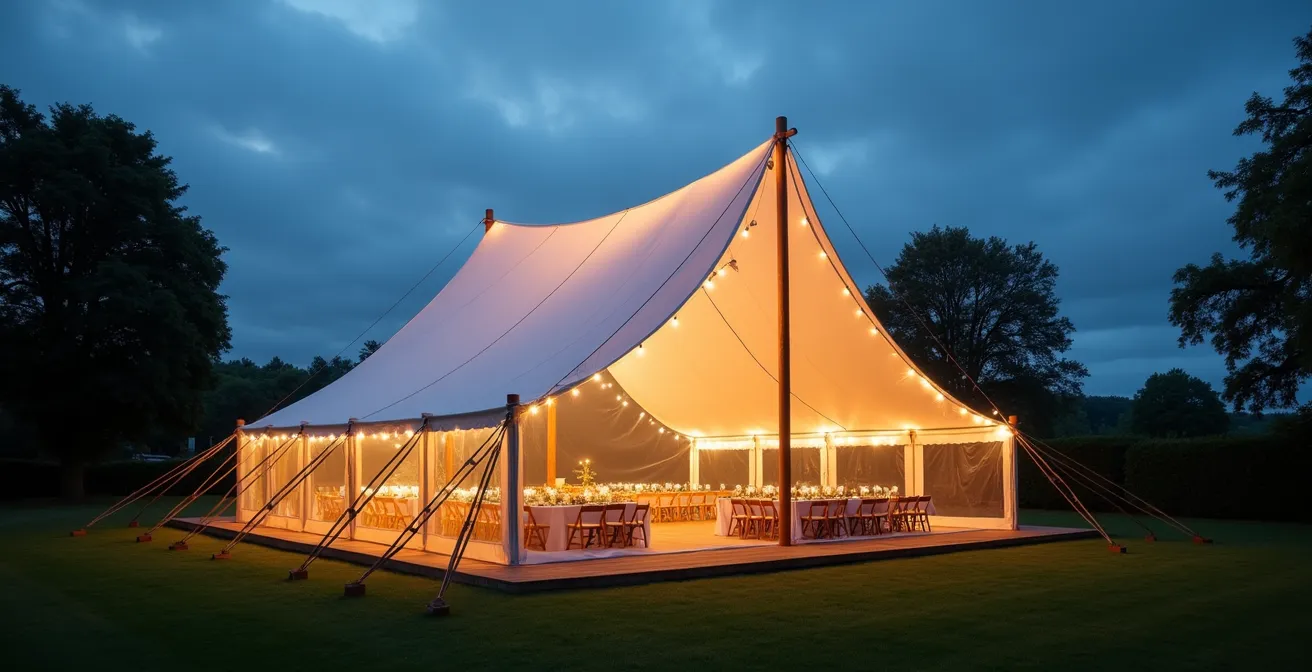
A sailcloth tent’s signature glow comes not from the lights you add, but from the tent fabric itself acting as a massive, elegant light diffuser.
- The translucent canvas softens and scatters light, eliminating harsh shadows and creating a warm, ethereal ambiance.
- Proper lighting is about “sculpting” this inherent glow by strategically placing sources to enhance the tent’s architectural form.
Recommendation: Treat the tent as a lighting instrument, not just a structure. Focus on how light interacts with the fabric to shape the atmosphere, rather than simply trying to illuminate the space.
There’s a moment at every sailcloth tent wedding that feels like pure magic. As dusk settles, the structure ceases to be just a tent and transforms into a luminous beacon, a giant lantern radiating warmth and celebration. This ethereal glow is the primary reason couples are drawn to the nautical elegance of sailcloth. Yet, achieving this signature look is less about the quantity of lights and more about a deep appreciation for form and fabric. Many approaches focus on simply hanging string lights or placing a few uplights, treating the tent as a blank canvas.
This often misses the fundamental point. The true artistry of lighting a sailcloth tent lies in understanding its inherent properties. The key is its unique, translucent fabric. Unlike opaque vinyl, this material is designed to interact with light, to capture it, soften it, and radiate it back with a gentle, flattering quality. The elegant lines, soaring peaks, and taut curves of the structure aren’t just support; they are architectural elements that can be amplified or diminished by the lighting scheme.
But what if the secret wasn’t just in adding light, but in sculpting it? This guide moves beyond the basics. We will explore the tent not as a shelter to be filled with lights, but as a lighting instrument in its own right. We will treat the canvas as a diffuser, the poles as anchors for atmosphere, and the very perimeter as a stage for creating illusion. By mastering the interplay between light source, fabric, and form, you can elevate a simple lighting plan into an immersive, atmospheric experience that defines the entire event.
This article will guide you through the key decisions and techniques for transforming your sailcloth tent into the glowing spectacle you envision. We will cover everything from floor planning around the tent’s unique structure to using the canopy itself as a dynamic surface for creative expression.
Summary: Why Sailcloth Tents Glow at Night and How to Light Them Properly?
- How to Plan Your Floor Layout Around Fixed Center Poles?
- Sailcloth vs. Frame Tent: Which Handles High Winds Better?
- How to Use the Canopy Canvas as a Projection Surface?
- Customizing the Peak Flags: A Subtle Branding Opportunity?
- The Extra 10 Feet of Perimeter Space Sailcloth Tents Require
- Open Sky or Fabric Top: Which Canopy Style favors Best Lighting?
- Do Banquet Tables Really Save Space Compared to Rounds?
- Is Installing Hardwood Flooring in a Tent Worth the Massive Expense?
How to Plan Your Floor Layout Around Fixed Center Poles?
The majestic center poles of a sailcloth tent are its structural heart, but they are also your greatest allies in crafting an atmospheric lighting design. Instead of viewing them as obstacles to work around, a tent aesthetician sees them as foundational anchors for sculpting the light and flow of the event. The layout of your tables, dance floor, and key features should not just accommodate these poles but leverage their presence. A well-designed floor plan uses the poles to create natural divisions and focal points, turning a purely functional element into a core component of the décor.
Consider the poles as pillars that define distinct zones. You can create a more intimate, cozy dining area by arranging tables in clusters around a pole, then use the wider, open spaces between poles for a high-energy dance floor. This approach allows you to vary the lighting intensity and style across the tent, building a layered and dynamic atmosphere. For instance, the head table or cake table can be strategically positioned to benefit from a dramatic uplighting beam directed up a center pole, creating a stunning visual anchor without obstructing guest movement. The poles themselves become a canvas for decoration; wrapping them in greenery, fabric, or fairy lights integrates them seamlessly into the aesthetic, transforming their vertical lines into columns of light and texture.
The case of Olivia and Cal’s Conway Farms wedding serves as a perfect example. Their design team used the tent’s center poles as anchors for cascading lights and drapery, creating breathtaking focal points. By wrapping the poles in lush greenery integrated with micro-lights, they transformed these structural necessities into enchanting decorative features. This strategy not only solved the layout puzzle but also enhanced the overall glow, proving that planning your layout with the poles as a centerpiece, rather than an afterthought, is the first step to a masterful lighting design.
Sailcloth vs. Frame Tent: Which Handles High Winds Better?
When planning an outdoor wedding, practical considerations like weather are paramount, and it’s no surprise that recent industry data shows that 65% of weddings opt for outdoor venues. Wind is a significant factor, and the choice between a sailcloth tent and a frame tent often involves a discussion of stability. Structurally, a sailcloth tent’s strength comes from its tension-based design, anchored by robust center poles and a network of stakes. This allows the canopy to have a degree of flexibility, which is key to its aesthetic appeal. A frame tent, by contrast, has a more rigid skeleton and an open interior, deriving its stability from its perimeter frame.
From a lighting perspective, this difference in wind response is crucial. A frame tent’s rigidity means hanging fixtures are more static. In a sailcloth tent, however, the canopy is designed to “breathe” with the wind. This subtle, natural movement means the entire surface of the tent interacts with the light in a dynamic way. The glow isn’t static; it ebbs and flows, creating a living, mesmerizing effect. Rather than a flaw, this movement is a feature. The canopy’s natural flex in the wind creates a dynamic light effect that feels organic and alive, something impossible to replicate in a more rigid structure.
Of course, this also informs your fixture choices. The multiple secure center poles of a sailcloth tent provide excellent rigging points for both fixed uplighting and heavier, secured bistro string patterns. For a frame tent, rigging is often limited to the perimeter frame, which can restrict placement and weight. This comparative table highlights how each tent style’s structural design influences both its wind handling and its lighting potential.
| Feature | Sailcloth Tent | Frame Tent |
|---|---|---|
| Wind Resistance Structure | Robust center poles with tension-based design | Open interior with perimeter support only |
| Canopy Movement in Wind | Natural ‘breathing’ creates dynamic light effects | More rigid, less movement |
| Lighting Rigging Points | Multiple secure poles for heavy fixtures | Limited to perimeter mounting |
| Recommended Wind Fixtures | Fixed uplighting, secured bistro strings | Lightweight hanging elements only |
| Power Stability | Poles provide cable routing protection | Exposed cable runs need extra securing |
How to Use the Canopy Canvas as a Projection Surface?
While the inherent glow of a sailcloth tent is its main allure, the translucent canvas also offers a unique opportunity for more advanced light sculpting: projection. Using the tent’s ceiling or walls as a screen for projected images, patterns, or monograms can add a layer of personalization and drama that is truly unforgettable. This technique transforms the canopy from a passive diffuser of light into a dynamic, active canvas. The key is to achieve a balance where the projection enhances, rather than overwhelms, the tent’s natural ambiance.
To do this effectively requires technical consideration. Because the fabric is translucent, not opaque, high-lumen projectors are essential to ensure the images are crisp and visible against the internal ambient glow. Strategic positioning is also critical; placing projectors at an angle helps minimize “wash-out” from the internal lighting. The content of the projection is where the artistry lies. You can opt for static designs, like a sophisticated gobo of the couple’s monogram during the cocktail hour, or create a more atmospheric effect with slow-moving dynamic patterns like clouds or stars. This was masterfully executed at a Newport tent wedding where designers projected subtle tree shadows onto the tent walls, creating a magical, forest-like atmosphere that blended seamlessly with the surroundings.
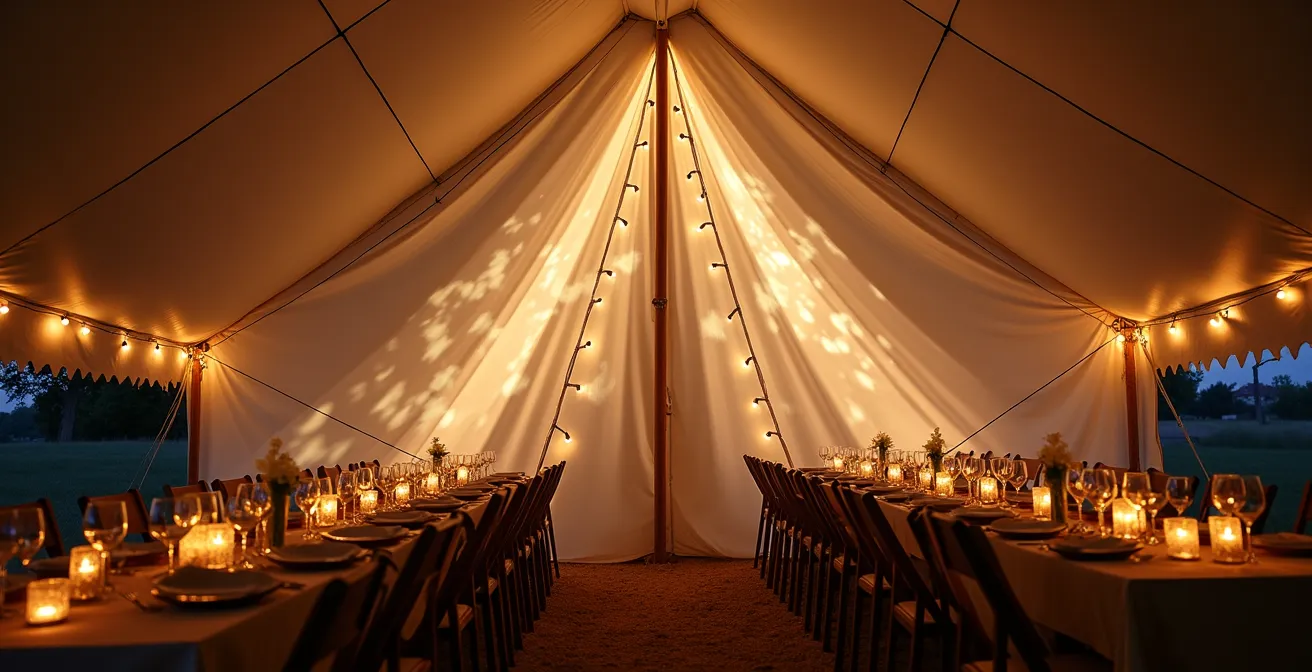
As the image above illustrates, when done with a light touch, projection on sailcloth is ethereal. The texture of the weave catches the light, giving the projected image a soft, painterly quality. The most successful applications use projection sparingly, perhaps during a first dance or as a grand entrance reveal, allowing the signature warm glow of the tent to dominate for the majority of the evening. This ensures the effect feels special and intentional, a moment of high-impact artistry within a beautifully lit environment.
Customizing the Peak Flags: A Subtle Branding Opportunity?
The flying peak flags are a defining feature of a sailcloth tent, evoking the romance of nautical sails and adding to the structure’s graceful silhouette against the sky. While often overlooked, these flags present a subtle yet powerful opportunity for personalization and lighting design. They are the highest points of the structure, visible from a distance, and can serve as elegant beacons that guide guests and set the tone from the moment they arrive. Illuminating these flags turns a standard architectural detail into a bespoke statement.
The tent’s sculpted peaks and clean lines add a timeless elegance to your wedding photos
– Skyline Tent Company, Unique Lighting Options for Tent Weddings Guide
Lighting the flags requires a targeted approach. Instead of broad floodlights, using narrow-beam LED spotlights aimed precisely at each flag creates a dramatic, focused effect. The material and color of the custom flags play a significant role in how they interact with the light. Fabrics with a slight sheen or metallic thread will catch and reflect the light beautifully, while lighter colors like ivory or champagne will be far more visible at night than darker shades. For an even more integrated look, semi-translucent flag material can be used to create a backlit effect, catching the ambient glow from within the tent and appearing to be lit from the inside.
The timing of the flag illumination can also be part of the event’s choreography. Imagine the flags being dark as guests arrive, and then dramatically lit to coincide with the couple’s grand entrance, signaling the start of the celebration. By positioning exterior ground lights to uplight the flags from below, you create a beacon effect, transforming them into elegant wayfinding landmarks. This thoughtful detail doesn’t just add light; it adds narrative and a sense of occasion, reinforcing the bespoke, curated feel of the event.
The Extra 10 Feet of Perimeter Space Sailcloth Tents Require
A crucial logistical detail of any sailcloth tent is the need for an additional 10 to 15 feet of clear space around its entire perimeter for guy-lines and stakes. Planners sometimes see this as a constraint, a “dead zone” that eats into usable venue space. However, a tent aesthetician sees this perimeter as a zone of opportunity—a vital area for executing advanced and seamless lighting designs. This buffer space is the key to creating a clean, uncluttered interior and achieving the magical “floating glow” effect that makes sailcloth tents so enchanting.
This perimeter is the perfect place to conceal the machinery of your lighting design. Ground-based uplighting fixtures can be placed here, aimed back at the tent’s exterior walls. This technique, known as “wall washing,” is what creates the signature, even glow from the outside. It makes the entire structure appear as a single, cohesive lantern. By placing the light sources outside, you keep the interior floor space free of bulky fixtures and unsightly cables, maintaining a clean and elegant aesthetic for guests inside. This approach was used to stunning effect at a wedding at Montage Healdsburg, where the perimeter zone was used for concealed uplighting placement, making the Sperry Tent appear to float ethereally in the California evening.
Furthermore, this space is essential for power distribution, generators, and dimmer packs, keeping the functional—and often noisy—elements of event production out of sight and earshot. By planning to use this perimeter with purpose, you transform a logistical requirement into an aesthetic asset. It’s the secret to achieving a polished, high-end look where the magic of the light is visible, but the mechanics behind it are not. The event rental market is a massive industry, and sophisticated lighting is a key component of creating high-value experiences.
Open Sky or Fabric Top: Which Canopy Style favors Best Lighting?
In the world of tented weddings, clear-top tents have become incredibly popular, with tent rental companies report receiving daily calls for them. The allure is obvious: they bring the outdoors in, allowing for dancing under the stars while being protected from the elements. However, from a pure lighting aesthetic perspective, an open sky or a clear top presents significant challenges. Direct moonlight or starlight is far too faint to serve as functional event lighting, and any internal lighting placed under a clear top can create glare and harsh reflections on the transparent vinyl.
This is where the genius of the sailcloth fabric truly shines. A sailcloth canopy functions as a massive, perfectly engineered lighting diffuser. As one expert eloquently puts it, its purpose is to transform the quality of light.
A sailcloth top acts as a massive ‘softbox.’ It takes harsh, direct light from fixtures and diffuses it into a flattering, even, and gentle illumination that is impossible to achieve under an open sky
– Wedding Lighting Expert, SHELTER Wedding Tent Lighting Guide
This “softbox” effect is the very essence of the sailcloth glow. It takes the potentially harsh, directional beams from uplights, pin-spots, or string lights and scatters them, wrapping the entire space in a soft, luminous ambiance. This diffused light is incredibly flattering for guests and photography, eliminating the hard shadows that can be created by direct light sources under a clear top or an open sky. The fabric itself becomes the most important lighting tool, doing the work of softening and perfecting the illumination.

The close-up view of the fabric above reveals how the weave texture is designed to catch and spread light. You are not just lighting a space; you are illuminating a medium that transforms the light for you. While a clear top offers a view, a sailcloth top offers an atmosphere. For a couple seeking that signature warm, romantic glow, the fabric top is not a compromise—it is the entire point.
Do Banquet Tables Really Save Space Compared to Rounds?
The debate between banquet and round tables often centers on guest count and floorspace efficiency. While banquet tables can sometimes seat more people in a linear footprint, the decision has a far greater impact on the event’s atmosphere, social dynamics, and, most importantly, its lighting design. The shape of your tables dictates the rhythm of the room and creates entirely different opportunities for light sculpting. Shifting the question from “Which saves space?” to “Which creates the desired lighting effect?” is a hallmark of a sophisticated design approach.
Banquet tables, arranged in long, elegant rows, create a sense of community and a strong linear geometry. This layout pairs beautifully with overhead lighting installations, such as linear trusses rigged with Edison bulbs or long swags of bistro lights. This creates rhythmic, parallel lines of light on the canopy above, amplifying the length and grandeur of the tent. Centerpieces on banquet tables are typically low and continuous, allowing for integrated micro-lights or candlelight to create a warm wash of light down the center of the table.
Round tables, conversely, foster a more intimate atmosphere, breaking the space into smaller, conversational pods. The lighting strategy here shifts from linear to focal. A central chandelier can serve as a grand statement piece, while individual pin-spot lights can be used to dramatically illuminate the centerpiece on each table. This creates pools of intimate light, drawing guests together. On the canopy above, this arrangement produces a lovely, scalloped pattern of dispersed light. As one successful case study showed, a mixed layout can be the best of both worlds, using differentiated lighting—linear lights over banquets and pin-spots on rounds—to define distinct zones within a cohesive design.
| Aspect | Banquet Tables | Round Tables |
|---|---|---|
| Lighting Installation | Linear overhead trusses with Edison bulbs | Central chandelier or pin-spots per table |
| Shadow Pattern on Canopy | Rhythmic parallel lines | Scalloped, dispersed effect |
| Social Atmosphere | Communal wash lighting promotes unity | Intimate pools of light for conversation |
| Centerpiece Lighting | Low continuous arrangements with micro-lights | Tall dramatic pieces with integrated uplighting |
| Space Between Tables | 60-80 inches required | 52-66 inches minimum |
Key Takeaways
- The magic of a sailcloth tent is its translucent fabric, which acts as a giant “softbox” to create a flattering, diffused glow.
- Effective lighting is about “sculpting” this inherent glow by using the tent’s architectural elements (poles, peaks) as part of the design.
- Every choice, from the floor plan and table shape to the flooring itself, directly impacts the quality and reflection of light within the tent.
Is Installing Hardwood Flooring in a Tent Worth the Massive Expense?
Flooring is one of the most significant expenses in a tent rental budget, and it’s easy to view it as a purely practical or aesthetic choice. However, its impact on your lighting design is profound and often underestimated. The color, material, and finish of your floor directly affect how light behaves within the space, essentially acting as the largest reflective surface in the tent. The decision to invest in quality flooring, particularly hardwood, is therefore not just about comfort or style—it’s an investment in the quality of your light. As recent wedding industry statistics reveal that 40% of couples use reusable or rented items, making a smart, impactful choice on a significant rental like flooring is key.
The reflective properties of flooring are a critical factor. A dark or matte-finish floor will absorb a tremendous amount of light, meaning you need significantly more powerful (and expensive) lighting fixtures to achieve the same level of ambient brightness. Conversely, a light-colored wood floor can nearly double the effective output of your lighting by bouncing it back up into the tent canopy, enhancing the overall glow and reducing the need for additional fixtures. This “return on investment” is not just financial; it’s atmospheric. The reflected light adds to the soft, multi-directional quality that makes a sailcloth tent so magical.
Furthermore, a solid, level floor provides a stable and safe foundation for more complex lighting structures, such as truss towers for mounting spotlights or intricate dance floor lighting. It also protects all electrical equipment and cabling from ground moisture, a critical safety consideration. When evaluating the cost, it’s essential to think beyond the material itself and consider its role within the entire lighting ecosystem. A more expensive floor that enhances your lighting may allow you to save money on the lighting package itself, all while creating a superior aesthetic result.
Action Plan: Calculating Flooring’s ROI on Your Lighting Design
- Calculate lighting power needs: Acknowledge that dark floors can require up to 40% more lumens for the same brightness as light-colored floors.
- Compare rental costs: Get quotes for a basic uplighting package versus the enhanced package needed to properly illuminate a dark-floored tent.
- Factor in safety and structure: Assess if your desired lighting design (e.g., truss towers) requires the stability that only a hard floor can provide.
- Consider the reflection coefficient: Factor in how a light wood floor can double your effective lighting output, potentially reducing the number of fixtures needed.
- Assess weather contingencies: Value the protection a solid floor offers to expensive electrical equipment and cabling from potential ground moisture.
Ultimately, to master the glow of a sailcloth tent is to embrace it as a complete system, where the fabric, the structure, the floor, and the light all work in harmony. By moving beyond simple decoration and into the realm of intentional light sculpting, you can create an atmosphere that is not only beautiful but also deeply personal and emotionally resonant.