
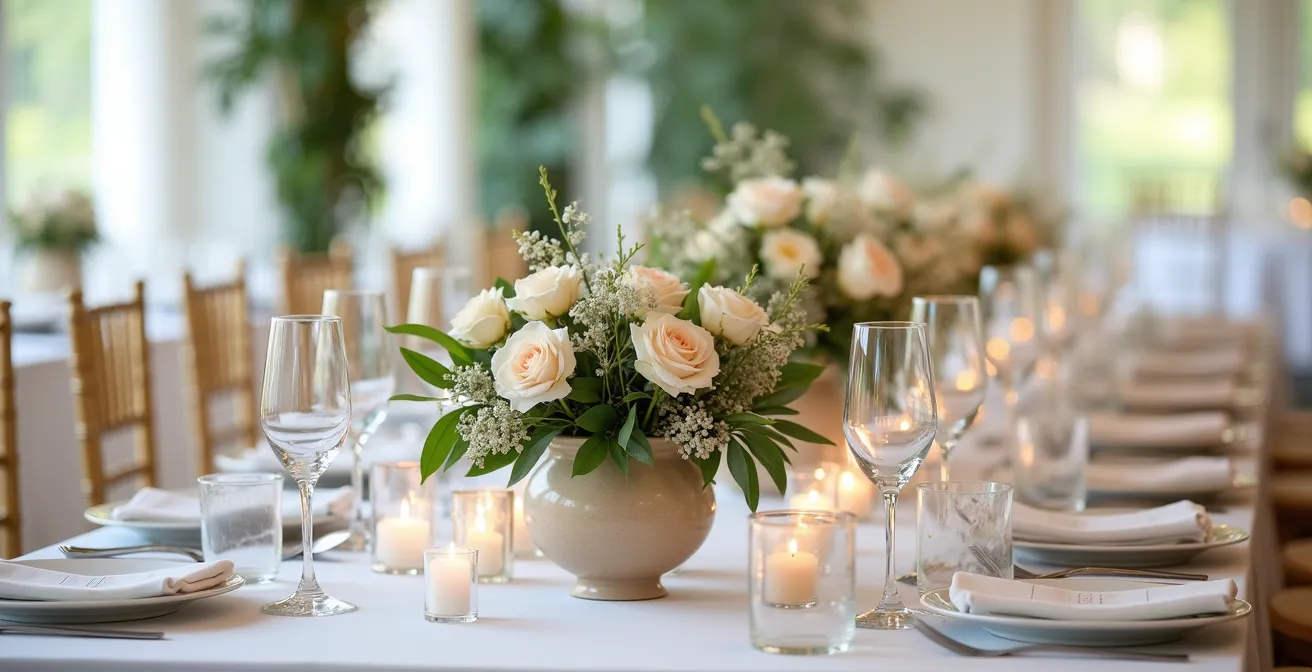
The most successful wedding tables aren’t just beautiful; they are intentionally designed for human connection.
- Choosing a low centerpiece is a strategic act of social architecture, removing physical barriers to encourage natural conversation.
- Mastering tabletop ergonomics—the science of spacing, scale, and sensory details—is more critical than the height of your florals.
Recommendation: Shift your focus from creating a purely visual statement to engineering an environment that helps your favorite people connect more meaningfully.
Imagine the scene: a beautifully decorated wedding reception, tables adorned with stunning floral arrangements that tower towards the ceiling. It’s a photographer’s dream, but for the guests seated at the table, it’s a social obstacle course. Conversations become a game of peek-a-boo around a wall of roses and eucalyptus, with guests leaning awkwardly to make eye contact. While dramatic, high centerpieces have long been a staple of lavish wedding design, they often achieve their visual impact at the expense of the primary purpose of a reception: fostering connection and celebration among your loved ones.
The common advice focuses on aesthetics—matching colors, following trends, or creating a ‘wow’ factor. But what if the true measure of a centerpiece’s success wasn’t its height, but its ability to disappear? This guide reframes the centerpiece debate entirely. We will move beyond simple decoration and explore the concept of tabletop ergonomics. This is the art and science of designing a tablescape that actively facilitates, rather than hinders, human interaction. A low centerpiece isn’t a compromise; it’s a strategic choice in social architecture, designed to engineer an atmosphere of intimacy and effortless conversation.
By treating your table design with this level of intention, you can transform it from a static display into a dynamic catalyst for connection. We will explore how to make low arrangements feel luxurious, choose the right shapes for your tables, and use elements like candlelight and texture to create an environment where conversations can flourish. It’s time to design a wedding experience that feels as good as it looks.
This guide breaks down the key principles of using low centerpieces to enhance guest interaction. Follow along as we explore the strategic decisions that lead to a more connected and memorable wedding reception.
Summary: Designing Wedding Tables for Better Conversation
- How to Make Low Centerpieces Look Expensive and lush?
- Round Bowl or Rectangular Trough: Which Fits Your Table Width?
- How to Mix Taper Candles With Low Florals for Height Variation?
- The Table Width Mistake That Makes Low Centerpieces Feel Crowded
- Which Flowers Look Best When Guests Are inches Away?
- How to Curate Bespoke Table Styling That Encourages Guest Interaction?
- How to Maximize Floral Impact by Embracing Seasonal Botanical Availability?
- Cut Crystal vs. Smooth Glass: Which Reflects Candlelight Better?
How to Make Low Centerpieces Look Expensive and lush?
A common misconception is that height equals value. In reality, a low centerpiece can communicate luxury far more effectively than a tall one, but it requires a strategic approach to composition and materials. The key is to focus on density, texture, and the quality of the vessel. When an arrangement is low, guests have an intimate, top-down view, allowing them to appreciate the complexity and richness of the design in a way that’s impossible with a towering arrangement. This is not about saving money, as a lush, low centerpiece can be a significant investment; professional centerpieces typically cost between $902 and $1,069 on average. The value is instead reinvested into high-impact details.
To achieve a high-end look, prioritize a diverse mix of textures. Combine statement blooms with more complex, secondary elements like delicate ferns, interesting grasses, or seeded eucalyptus. This layering creates visual depth and sophistication. The container itself is also a critical element. A generic glass vase can cheapen the look, whereas a vintage compote bowl, a low pedestal vase, or a unique ceramic piece acts as a solid, elegant foundation. These details signal quality and intentionality, proving that impact is a matter of thoughtful design, not sheer scale.
Action Plan: Creating Expensive-Looking Low Centerpieces
- Invest in the Vessel: Start with a quality foundation. Use low pedestal vases or source unique vintage compote bowls that add character and an elevated feel before a single flower is added.
- Layer Strategic Textures: Combine your main blooms with complex, interesting textures. Mix in elements like ferns, varied grasses, and seeded eucalyptus to create a dense, sophisticated look.
- Utilize Flower Frogs: For a professional, structured arrangement, use versatile and reusable floral frogs. They provide a sturdy base and allow for more creative and airy designs than foam.
- Practice the Arrangement: Don’t wait until the last minute. Test your design in numerous different vessels well in advance to build confidence and perfect the composition.
- Incorporate Seasonal Accents: Add unique character by layering in seasonal elements. In fall, this could be berries or small branches; in winter, frosted foliage can add a touch of magic.
Round Bowl or Rectangular Trough: Which Fits Your Table Width?
The shape of your centerpiece vessel is a fundamental decision in your table’s social architecture, as it directly influences the flow of conversation. This choice should be dictated by your table type and the kind of interaction you want to encourage. It’s not just about aesthetics; it’s about creating functional conversation zones. A round bowl on a circular table creates a single, unified focal point, encouraging a group dynamic where all guests can engage with one another. A rectangular trough or a series of smaller vessels on a long banquet table, however, fosters multiple, more intimate conversation clusters along its length.
The width of the table is a crucial factor. Long, narrow farmhouse tables are perfectly suited for linear arrangements like garlands or troughs, which guide the eye and conversation down the table. Wider banquet tables offer more flexibility. For round tables, which typically seat 8-10 guests, a single, central arrangement in a round bowl is the most logical choice. It mirrors the shape of the table and ensures no guest is visually isolated. The key is to match the centerpiece’s footprint to the table’s geometry to create a balanced and functional design.
The following table breaks down the key differences to help you decide which shape best aligns with your table setup and social goals.
| Feature | Round Bowl | Rectangular Trough |
|---|---|---|
| Ideal Table Type | 60-72″ round tables | Long farmhouse/banquet tables |
| Conversation Pattern | Single focal point for group conversation | Multiple intimate conversations |
| Container Width | 4-6″ diameter | Multiple small containers or garlands |
| Guest Capacity | 8-10 guests comfortably | 8-10 guests (4 per side) |
| Visual Effect | Centralized focus | Linear flow along table |
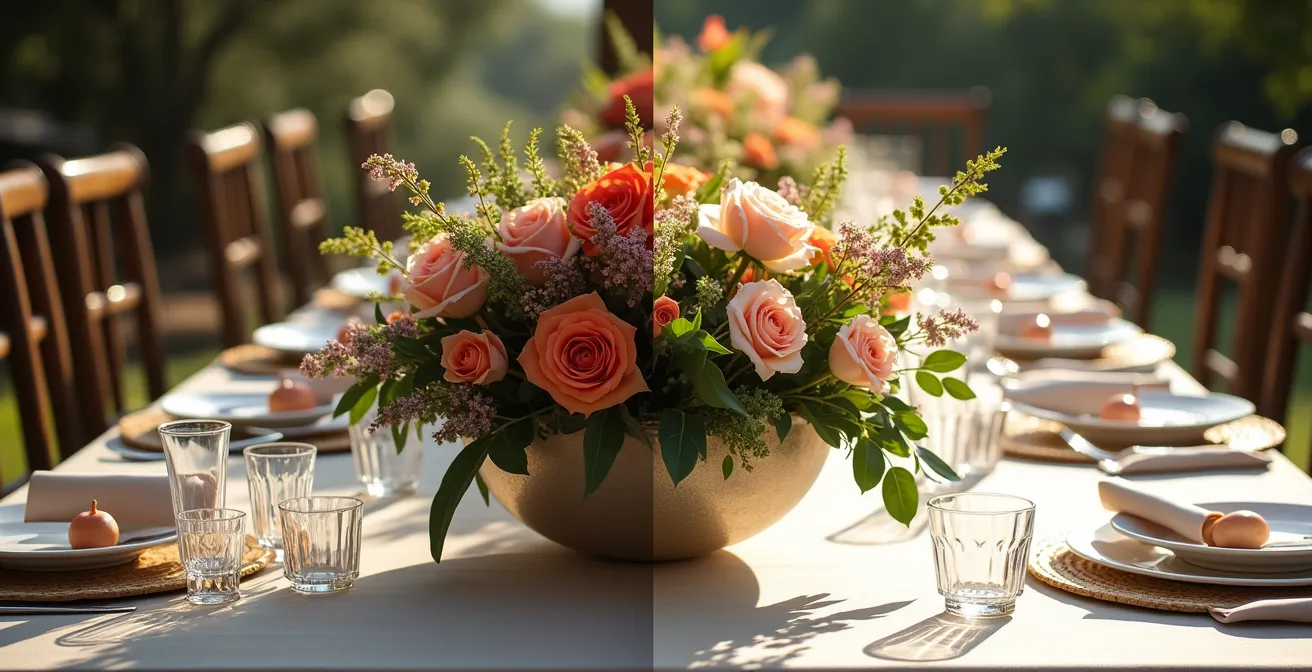
As the visual comparison shows, each style creates a distinct social environment. The round bowl unifies, while the rectangular trough segments. Choosing the right one is the first step in designing a table that actively promotes connection.
How to Mix Taper Candles With Low Florals for Height Variation?
Incorporating height variation with candles is an excellent strategy to add dynamism to a low tablescape, but it must be executed with precision to avoid creating new sightline obstructions. The goal is to create visual rhythm, not visual barriers. The key lies in maintaining a clear “conversation corridor” across the table. This means that while candles can add vertical interest, they must be slender enough and spaced properly to prevent them from becoming a new wall to talk around.
A widely accepted guideline comes from event design experts who focus on creating distinct height zones. As QC Event Planning advises, you should maintain a clear separation between high and low elements. Their expert guidance states:
As a general guideline, you’ll want to keep your tall pieces at 24″ or higher and your short pieces at 12″ or under
– QC Event Planning, The Dos and Don’ts of Centerpieces
This “safe zone” between 12 and 24 inches is where most people’s sightlines fall when seated. By keeping your lush floral arrangements below the 12-inch mark and using only thin taper candles to occupy the space above, you create a dynamic look without sacrificing interaction. Studies on centerpiece design confirm that varying candle heights from 8-14 inches while keeping floral elements low creates the perfect balance, adding visual interest while maintaining clear, unobstructed views for every guest at the table.
The Table Width Mistake That Makes Low Centerpieces Feel Crowded
The single most common mistake in designing a low centerpiece is underestimating the space each guest requires. A beautiful arrangement can quickly feel cluttered and overwhelming if it encroaches on personal space. This is a core principle of tabletop ergonomics: the table must be functional for dining and conversation first, and decorative second. To avoid this, you must respect the “guest footprint”—the area needed for place settings, glassware, and personal comfort.
A well-established industry standard is the “one-third rule.” Your table’s surface should be visually divided into three concentric zones. The outer two-thirds are reserved for place settings, while the centerpiece should be contained entirely within the central third. This ensures there is ample room for plates, glasses, and elbows without anything feeling cramped. For this to work, you must account for the space needed per person. To ensure comfort, professional florists recommend allocating 24-30 inches of table edge per guest. For a 60-inch round table seating eight people, this leaves a surprisingly small diameter for the centerpiece once all place settings are accounted for.
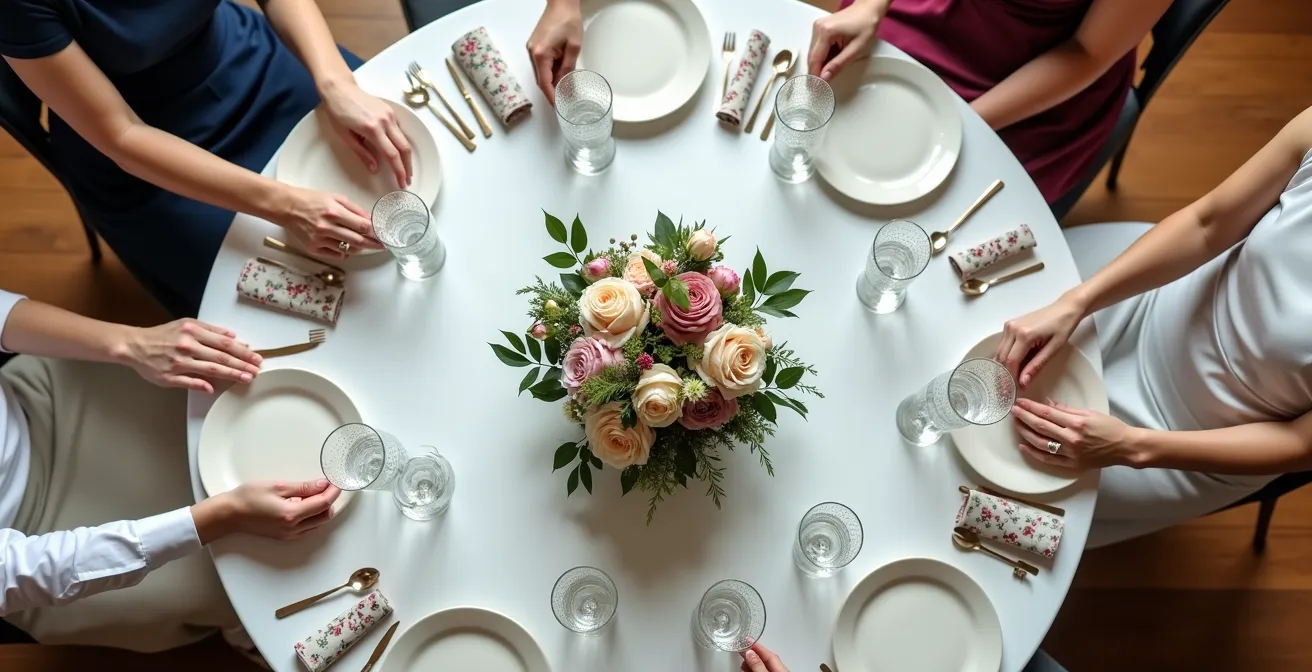
Ignoring this spatial math is what leads to a crowded table. Guests may be forced to move parts of the decor to make room for their bread plate, or constantly worry about knocking over a vase. By strictly adhering to the one-third rule and respecting each guest’s personal zone, your low centerpiece will feel integrated and intentional, rather than like an intrusive obstacle.
Which Flowers Look Best When Guests Are inches Away?
When a centerpiece is low, the viewing experience shifts from a distant impression to an intimate examination. Guests aren’t just seeing a shape or a color; they are inches away from every petal, stem, and leaf. This proximity demands a different approach to flower selection. Bold, large-headed blooms like hydrangeas or standard roses can be effective, but the real opportunity lies in choosing flowers with intricate, close-up beauty that rewards a closer look. Think of it as designing at an “intimate scale.”
Flowers with complex structures, delicate patterns, or fascinating textures become the stars of a low arrangement. These are the types of botanicals that might get lost in a large, towering display but are captivating when viewed up close. As the experts at The Knot suggest, focusing on these details is key.
Focus on flowers appreciated for their intricate, close-up beauty with complex structures, delicate patterns, or fascinating textures like Astrantia, Scabiosa, Fritillaria, and Hellebores
– The Knot, 10 Small Wedding Centerpiece Ideas
These varieties invite curiosity and can even become conversation starters in their own right. A guest might lean in to admire the speckled pattern of a Hellebore or the pin-cushion-like structure of a Scabiosa. This close-up appreciation adds another layer of sensory experience to the table, making the decor not just something to look at, but something to discover. Choosing flowers for their detailed charm is a sophisticated move that shows a deep understanding of the guest experience.
How to Curate Bespoke Table Styling That Encourages Guest Interaction?
Beyond the florals themselves, the surrounding tablescape can be curated to act as a social lubricant. This is where you move from simple decoration to true social architecture. The goal is to style the table with “conversation pieces”—unique, personal, or intriguing elements that prompt questions and spark dialogue among guests who may not know each other. This transforms the table from a passive backdrop into an active participant in the social experience.
These elements don’t need to be loud or grand. The key is thoughtful curation. Instead of perfectly identical arrangements, consider subtle variations from table to table that encourage guests to compare and discuss. This could be a slight difference in the floral mix or the use of different, complementary vessels. Non-floral elements are particularly effective here. A beautiful piece of driftwood, a collection of unique stones, elegant feathers, or a cluster of seashells can add a personal and unexpected touch. These items tell a story and invite curiosity, giving guests an easy, natural entry point for conversation.
Case Study: Designing for Interaction
To understand this in practice, consider the findings from Jamali Garden’s wedding design research. Their study on table styling reveals that creating a cohesive look without exact replication is a powerful tool for encouraging discussion. They found that modern centerpieces that incorporate branches, seashells, or unique stones alongside florals become natural conversation pieces. Furthermore, they confirmed that grouping candles of varying heights and widths does more than add dimension; it creates pockets of intimate lighting that make guests feel more comfortable, encouraging them to lean in and connect.
By thoughtfully placing these bespoke elements, you provide social “icebreakers” directly on the table. You give your guests something to talk about, making the initial moments of sitting down with strangers less awkward and more engaging.
How to Maximize Floral Impact by Embracing Seasonal Botanical Availability?
Working with the seasons is not just a practical and budgetary choice; it’s a powerful narrative tool that can elevate the impact and authenticity of your low centerpieces. When flowers are in their natural season, they are at their most vibrant, healthy, and expressive. A peony in June, for example, has a lushness and fragrance that a forced, out-of-season version simply cannot replicate. Embracing seasonality ensures your arrangements feel connected to the time and place of your wedding, grounding the celebration in its environment.
The financial benefit is, of course, significant. Sourcing flowers that are locally and seasonally abundant drastically reduces costs associated with transportation and greenhouse cultivation. In fact, studies show that choosing seasonal flowers can cost 30-50% less than demanding out-of-season blooms. This saved budget can then be reinvested into creating fuller, more luxurious low arrangements or into higher-quality vessels and other tablescape details. It allows you to maximize impact without inflating your overall floral spend.
Beyond cost, seasonality offers a broader creative palette. It encourages you to think beyond just blooms and incorporate other beautiful, textural elements that define the time of year. Here are some ideas for leveraging the best of each season:
- Spring (April-June): Let peak-season stars like peonies or ranunculus shine in lush, single-variety statements.
- Summer: Take advantage of the cost-efficiency of locally grown garden roses, zinnias, and dahlias for vibrant, full looks.
- Fall: Incorporate rich textures with elements like turning leaves, textured branches with lichen, and vibrant, colorful berries.
- Winter: Create scale and drama with elegant flowering branches like quince or dogwood, paired with hardy hellebores.
By aligning your floral choices with the natural calendar, your decor becomes more meaningful, sustainable, and visually stunning.
Key takeaways
- A low centerpiece is an act of social architecture; its primary function is to facilitate, not just decorate.
- The “one-third rule” is non-negotiable: reserve the central third of the table for decor and the outer two-thirds for guests to ensure comfort.
- Every detail matters at an intimate scale; the choice of vessel, flower texture, and lighting material directly shapes the conversational atmosphere.
Cut Crystal vs. Smooth Glass: Which Reflects Candlelight Better?
The final layer of your table’s social architecture is lighting, and the material of your candle holders and vases plays a surprisingly significant role in shaping the atmosphere. The choice between cut crystal and smooth glass is not merely stylistic; it’s a decision that determines the quality of light and can either enhance or detract from a comfortable conversational environment. Each material interacts with candlelight in a fundamentally different way, one creating energy and the other fostering serenity.
Cut crystal, with its many facets, works through refraction. It catches the flame’s light and shatters it into countless dancing sparkles that project around the room. This creates a high-energy, glamorous, and prismatic effect, often associated with formal or “Great Gatsby” style events. While visually spectacular, this constant movement can also create a form of “visual noise” that can be distracting or even fatiguing for guests over a long dinner.
Smooth glass, in contrast, works through reflection. It reflects the candlelight as a soft, warm, and diffuse glow. This effect is far more serene and restful on the eyes. It contributes to an intimate, cozy ‘Hygge’ style ambiance that is highly conducive to conversation. The gentle, steady light encourages guests to lean in and connect without the distraction of glittering light fragments. The following table highlights how this choice impacts the overall guest experience.
| Aspect | Cut Crystal | Smooth Glass |
|---|---|---|
| Light Effect | Refraction – splits light into dancing sparkles | Reflection – soft, diffuse glow |
| Visual Impact | Energetic, prismatic sparkle | Serene, warm ambiance |
| Best Event Style | Formal, glamorous, ‘Great Gatsby’ vibe | Modern, minimalist, intimate ‘Hygge’ style |
| Guest Experience | Can create visual noise over long dinners | More restful, conducive to conversation |
| Ideal Pairing | High-energy celebrations | Intimate dinner parties |
Ultimately, designing a tablescape that fosters connection requires you to think like a social architect. By prioritizing clear sightlines, respecting personal space, and choosing details that create a comfortable and engaging atmosphere, you can craft a wedding experience where the most beautiful feature is the sound of your guests laughing and connecting with one another. To put these principles into practice, start by mapping out your table layout with guest interaction as the guiding objective.