
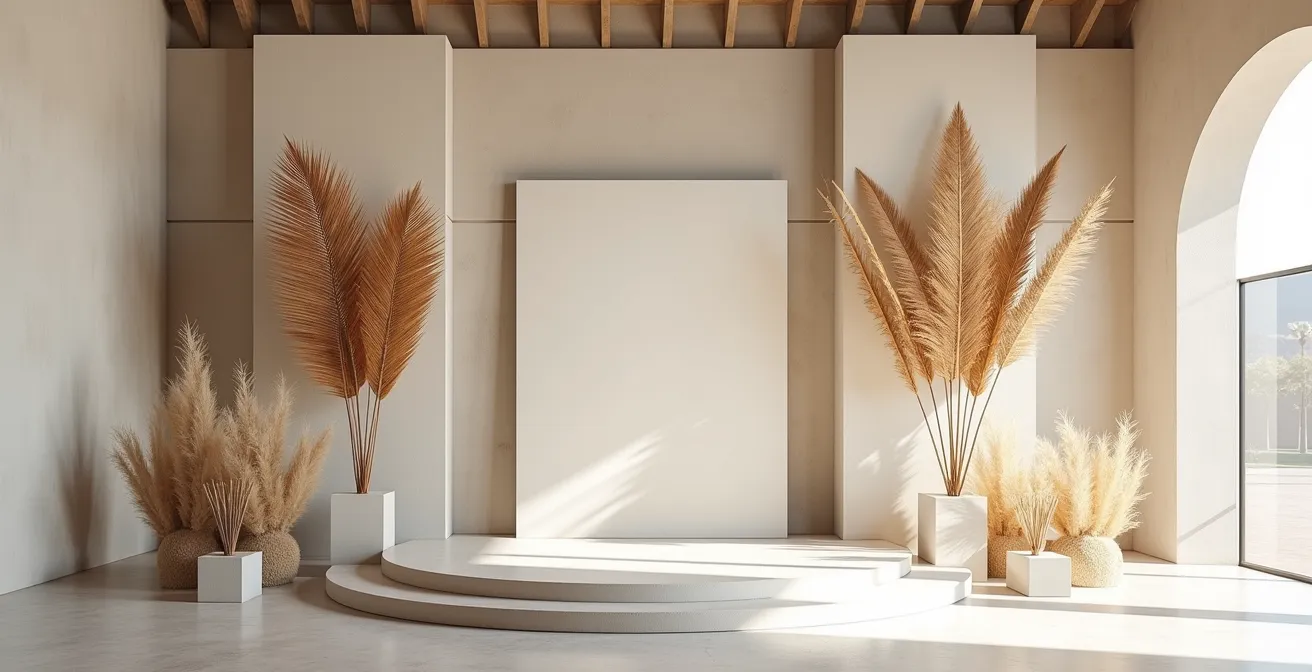
The fine art of wedding design has moved beyond soft romance; dried palms are now the definitive medium for sharp, architectural statements.
- Instead of random filler, dried palms function as a sculptural tool to define line, mass, and negative space.
- Fusing dried elements with fresh flowers creates a powerful tonal contrast that feels intentional and modern, not messy.
Recommendation: Brief your floral designer as you would an architect. Discuss form and structure first, then color and texture, to create a truly bespoke installation.
When you picture dried palms at a wedding, your mind likely defaults to a singular aesthetic: soft, dusty, bohemian romance. It’s an image of pampas grass clouds, macrame backdrops, and a general feeling of rustic ease. But for couples craving a look that’s less folk song and more modern art gallery, this association feels limiting. You want clean lines, structural integrity, and a design that makes a sharp, deliberate statement. The conventional wisdom about dried botanicals falls short, often resulting in designs that feel messy rather than minimalist.
The common approach is to treat dried palms as just another flower, a textural accessory to a fresh bouquet. But this misses their fundamental power. What if the key wasn’t to soften their edges, but to sharpen them? To treat them not as decoration, but as a sculptural medium? Their true value lies in their architectural capabilities—their rigid forms, their ability to hold a line, and their permanent nature. This is where longevity stops being a simple budget benefit and becomes a structural advantage, allowing for creations impossible with fresh, wilting stems. They are the key to unlocking a modern, edgy, and profoundly artistic wedding aesthetic.
This guide deconstructs the use of dried palms, moving beyond the boho cliche. We will explore how to manipulate them with color, pair them with fresh flowers to create deliberate contrast, and select their shapes like a sculptor choosing a tool. We will also cover the practical logistics of creating and preserving these architectural pieces, ensuring your wedding design feels less like a temporary decoration and more like a commissioned work of art.
To master this modern aesthetic, we will delve into the specific techniques and design principles that elevate dried palms from a simple trend to a sophisticated artistic medium. This guide is structured to walk you through the entire creative process, from concept to post-wedding preservation.
Summary: A Sculptor’s Guide to Dried Palm Installations
- How to Paint Dried Palms to Match a Specific Pantone Palette?
- How to Mix Dried Palms With Fresh Roses Without It Looking Dead?
- Fan, Spear, or Sun: Which Palm Shape Suits a Minimalist Arch?
- The Transport Mistake That Snaps Dried Palms Before the Event
- How to Preserve Your Ceremony Palms as Home Decor After the Wedding?
- How to Design Boho Installations That Look High-End Instead of Messy?
- Modern vs. Bohemian: How to Merge Opposing Styles into “Mod-Boho”?
- How to Achieve a Modern Aesthetic Without Your Wedding Feeling Cold?
How to Paint Dried Palms to Match a Specific Pantone Palette?
Treating dried palms as a sculptural medium begins with understanding that you have absolute control over their form and color. You are not limited to their natural beige and brown tones. Painting palms allows you to integrate them into any high-concept color story, transforming a natural element into a bespoke piece of art. For instance, a Palm Springs-style dessert table can be elevated with a hanging installation of palms painted a sophisticated rose-gold, creating what one design studio calls a look of ’70s elegance while maintaining natural texture. This isn’t about hiding the palm; it’s about enhancing its form with a deliberate, artistic layer of color.
The process, however, requires more finesse than simply aiming a can of spray paint. The palm’s porous surface can absorb paint unevenly, resulting in a splotchy, amateur finish. The key is proper preparation and technique. A primer base coat is non-negotiable; it seals the leaf and creates a uniform canvas. From there, your choice of paint—floral spray versus acrylics—will determine the final effect, from a soft matte look to a high-gloss, textured finish. A crucial pro-tip for color matching is to compensate for the palm’s natural warmth. To hit a precise Pantone color, you must select a paint that is one to two shades cooler than your target to counteract the yellow or brown undertones of the leaf.
With these methods, you can move beyond simple color matching into advanced effects like ombré gradients or sharp, geometric patterns, truly establishing the palm as a piece of custom-made sculpture.
How to Mix Dried Palms With Fresh Roses Without It Looking Dead?
The fear is valid: placing a dried, brittle element next to a lush, living one can create a jarring visual that reads as “decaying” rather than “design.” The secret to avoiding this is to reframe the combination. You are not mixing “dead” and “alive”; you are creating intentional tonal contrast. It’s a deliberate artistic choice that pits the sharp, fibrous texture of the dried palm against the soft, velvety petals of a fresh rose. When executed correctly, the result is a composition that is dynamic, sophisticated, and rich in texture.
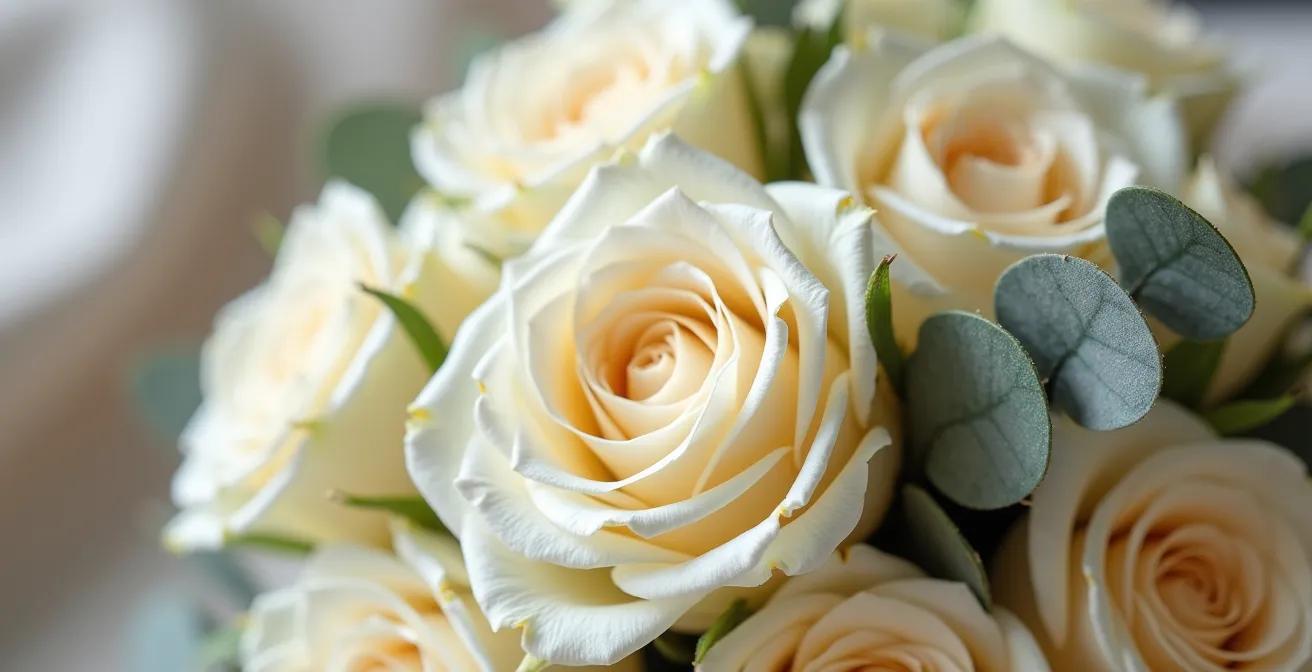
The key to a successful fusion is the use of “bridge elements.” These are semi-preserved botanicals like preserved eucalyptus or bleached ferns that share characteristics of both the fresh and dried components. Their waxy or papery texture provides a visual and tactile transition, allowing the eye to move seamlessly from the fresh rose to the architectural palm without shock. This makes the entire arrangement feel cohesive and intentional, a study in texture rather than a collision of opposites. The goal is a high-contrast look that feels modern and sculptural.
Furthermore, the ratio of dried to fresh elements is critical and depends entirely on your desired aesthetic. A design aiming for a sculptural statement will lean heavily on dried elements, using fresh flowers as a small, high-impact focal point.
| Arrangement Style | Dried Palm % | Fresh Flowers % | Bridge Elements |
|---|---|---|---|
| Modern Minimalist | 80% | 20% | Preserved eucalyptus |
| Romantic Boho | 60% | 40% | Bleached ferns |
| Sculptural Statement | 90% | 10% | Preserved ruscus |
This data-driven approach, as detailed in an analysis of modern wedding arrangements, removes the guesswork and empowers a truly architectural design process where every element has a purpose.
Fan, Spear, or Sun: Which Palm Shape Suits a Minimalist Arch?
Choosing a dried palm is not like choosing a flower. You must think like a sculptor selecting a material based on its inherent properties. Each palm shape serves a distinct architectural purpose, and the success of a minimalist design hinges on using them correctly. The two primary functions are creating “line” and creating “mass.” Understanding this distinction is the core principle for moving from decoration to structural art. A minimalist arch, in particular, relies on the powerful interplay between the object and the empty space around it—the negative space.
As the editorial team at Green Wedding Shoes explains, the choice of shape dictates the energy of the entire composition. In their guide to using these elements, they make a critical distinction:
Spear palms provide ‘line’ and direction, perfect for creating dynamic, asymmetrical compositions. Fan palms provide ‘mass’ and a solid plane, better for creating a focal point or a symmetrical backdrop.
– Green Wedding Shoes Editorial, Creative Ways to Use Dried Palms in Weddings
For a minimalist arch, this means your choice is strategic. Do you want to draw the eye upwards with the sharp, directional energy of spear palms? Or do you want to create a solid, grounded focal point with the broad surface of fan or sun palms? An asymmetrical arch might use a cluster of spears on one side to create movement, while a symmetrical design might use two large fan palms to frame the couple. The shape you choose fundamentally defines the structure. One studio, aiming for a “Museum of Modern Art aesthetic,” created an impactful ceremony background from a dozen enormous, dried palm fronds, using their shapes to create a powerful architectural statement through mass and negative space.
Ultimately, the most sophisticated designs often use a combination: the solid mass of a fan palm as an anchor, with the sharp lines of spear palms extending from it to create dynamism and direction.
The Transport Mistake That Snaps Dried Palms Before the Event
The greatest strength of a dried palm—its rigid, sculptural form—is also its greatest vulnerability. Unlike fresh flowers that can bend and bounce back, a dried palm under the wrong pressure will snap. The single biggest mistake is treating a large-scale installation as a single, monolithic piece during transport. Moving a fully assembled 8-foot arch covered in brittle palms is a recipe for disaster. The stress on the structure’s joints and the individual leaves is immense, and a single bump in the road can lead to catastrophic fractures.
Professional floral sculptors approach this problem with an architectural mindset: design for modularity. The installation should be conceived from the start as a series of smaller, interlocking sections that can be assembled quickly on-site. This dramatically reduces the risk of transport damage and allows for much safer packing. Each component can be packed vertically in tall, sturdy boxes, using bunched packing paper or foam inserts to isolate every piece and prevent them from colliding. It’s also wise to reinforce known weak points, like the base of a palm stem, with a discreet application of hot glue or floral wire before it even leaves the studio.
Even with the best planning, accidents can happen. A comprehensive emergency kit is the sign of a true professional. This isn’t just a pair of scissors; it’s a mobile repair station designed specifically for dried botanicals.
Your On-Site Sculpture Repair Kit: A Professional Checklist
- Design for modularity: Build installations in smaller interlocking sections that assemble on-site in under 30 minutes.
- Pack vertically in tall sturdy boxes using bunched packing paper or foam inserts to isolate each piece.
- Reinforce weak points with hot glue or floral wire painted to match before transport.
- Emergency kit essentials: Color-matched floral spray paint, high-tack floral adhesive (Oasis brand), binding wire, and extra small leaves for patching.
This level of preparation, as outlined by floral supply experts, ensures that the artwork unveiled at your ceremony is as flawless as it was when it left the artist’s studio.
How to Preserve Your Ceremony Palms as Home Decor After the Wedding?
The value of a sculptural palm installation extends far beyond the wedding day. Because these elements are already preserved, they represent a unique opportunity to own a lasting piece of art that is intrinsically tied to your celebration. The trend of “floral upcycling” is growing, with couples increasingly commissioning their florists to reconfigure ceremony backdrops into permanent wall hangings or floor sculptures for their homes. As noted by wedding trend-spotters, a major benefit is that you can upcycle these florals into your homes after the big day, transforming a temporary expense into a long-term investment in art.
However, transitioning a piece from an outdoor or event environment to an interior setting requires a specific reconditioning process. The installation will likely have collected dust, pollen, or moisture. The first rule is to never use water for cleaning, as it can cause mildew and staining. Instead, a can of compressed air is the professional’s tool of choice to gently blow away debris without damaging the delicate fibers. The second, and most critical, step for longevity is protecting the piece from sunlight.
Just because they are dried does not mean they are immune to the elements. UV rays will cause the colors—whether natural or painted—to fade and become brittle over time. A light coating of a matte UV-protectant spray is essential to preserve the color and integrity of the leaves for years to come. Once cleaned and protected, the installation can be mounted. Key sections can be arranged on linen-backed boards or within deep shadow box frames for a gallery-quality display. For individual statement stems, a tall, minimalist floor vase allows the single palm to stand alone as a sculptural object.
This final step completes the lifecycle of the palm, cementing its status not as a disposable decoration, but as a meaningful and enduring piece of personal history.
How to Design Boho Installations That Look High-End Instead of Messy?
The “boho” aesthetic, when not expertly executed, can quickly devolve into a cluttered, chaotic mess. The line between effortlessly chic and simply untidy is razor-thin. The secret to achieving a high-end boho look lies in a core principle of all great design: deliberate editing. It’s less about what you add, and more about what you consciously choose to leave out. This creates negative space, allowing the most impactful elements to breathe and command attention.
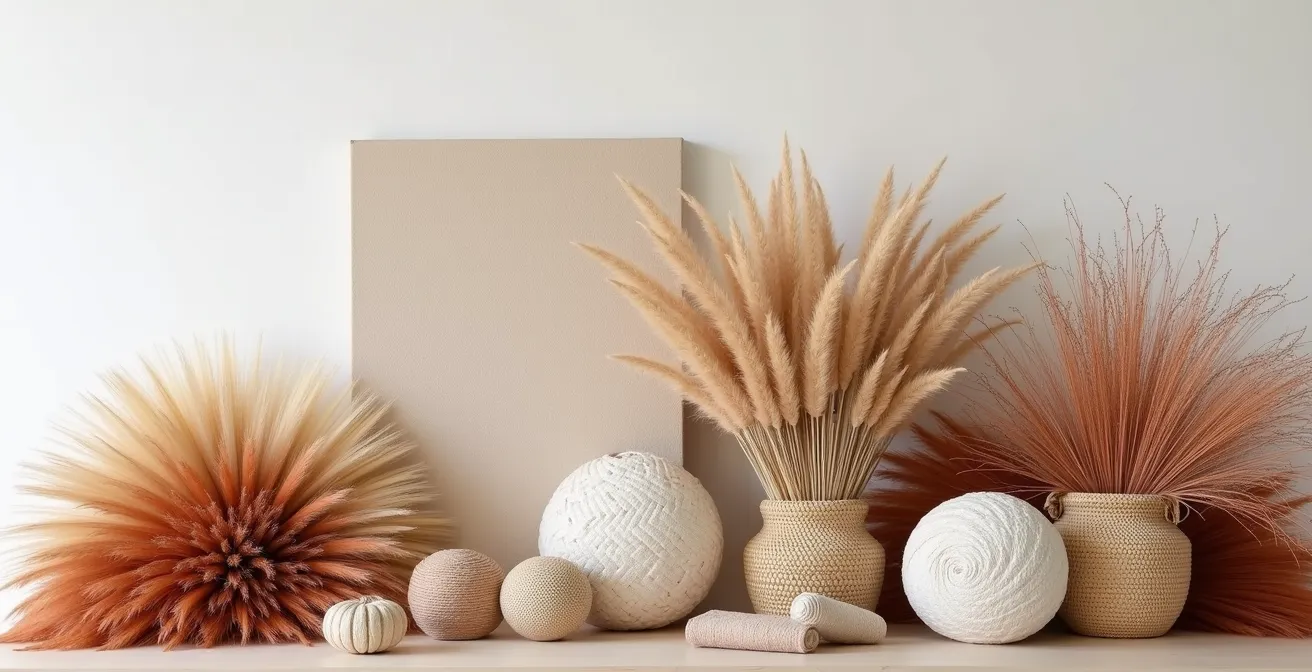
A powerful technique for achieving this is “texture blocking.” Instead of mixing a dozen different types of grasses and leaves randomly, you group them into distinct zones. Imagine one large mass of fluffy pampas grass on the left, a tight cluster of architectural spear palms in the center, and a cascade of preserved ruscus on the right. Each texture is given its own space to shine, creating a composition that feels organized and sophisticated, yet still wild and organic. This controlled chaos is the hallmark of luxury boho design.
This principle of subtraction is a counter-intuitive but powerful tool. As one floral design expert wisely states, the path to sophistication is often through removal, not addition. This insight is a guiding rule for any designer looking to elevate their work:
High-end design is often about what’s left out. Removing 20% of the smaller, filler elements from a cluttered boho design allows the high-impact shapes to breathe, instantly elevating the entire composition.
– Floral Design Expert, 18 Bohemian Dried Palm Leaves Wedding Ideas
By focusing on strong shapes and giving them room to exist, you ensure the final installation is a testament to high-end, intentional design, not just a random collection of dried foliage.
Modern vs. Bohemian: How to Merge Opposing Styles into “Mod-Boho”?
The term “Mod-Boho” can feel like a contradiction. Modernism is built on clean lines, geometric forms, and a minimalist ethos. Bohemian style is characterized by wildness, organic shapes, and a free-spirited, layered approach. Merging these two requires a designer to act as a skilled mediator, knowing exactly which elements from each style to fuse together. The result is a dynamic style that pairs the structural integrity of modern design with the textural richness of boho. This is no passing fad; according to leading floral design trend reports, dried and preserved florals remain a design staple, solidifying their place in sophisticated, forward-thinking aesthetics.
The fusion happens at specific points of contrast. For structure, you might take a starkly geometric metal arch (Modern) and cover it in an untamed explosion of wild dried palms (Bohemian). For containers, you could place a chaotic, tumbling arrangement (Bohemian) atop a clean, acrylic plinth (Modern). This “high/low” combination is the essence of the Mod-Boho style. It honors the core tenets of both aesthetics by putting them in direct, dramatic conversation with one another.
This successful fusion relies on a clear understanding of which components belong to which style category. A disciplined approach allows for intentional blending, preventing the final look from becoming confused.
This comparative table, based on an analysis of Mod-Boho design elements, provides a clear framework for deconstructing and then reconstructing the style.
| Design Element | Modern Contribution | Bohemian Contribution | Mod-Boho Fusion |
|---|---|---|---|
| Structure | Geometric metal arch | Wild dried palms | Copper arch covered in palms |
| Container | Acrylic plinth | Tumbling florals | Clean plinth with chaotic arrangement |
| Scale | Minimalist tablescape | Vast pampas cloud | Dramatic scale contrast |
Ultimately, Mod-Boho is about celebrating contrast. It’s the tension between the clean line and the wild form that gives the style its unique energy and sophistication.
Key Takeaways
- Reframe your thinking: Dried palms are not filler; they are a sculptural medium used to create line, mass, and negative space.
- Master the materials: Use primer and color-correcting techniques when painting palms, and use “bridge elements” like preserved eucalyptus to fuse dried and fresh florals.
- Embrace editing: High-end design, even in a boho style, relies on negative space. Remove clutter to let strong, architectural palm shapes command attention.
How to Achieve a Modern Aesthetic Without Your Wedding Feeling Cold?
The primary concern for couples drawn to a modern, minimalist aesthetic is the risk of it feeling cold, sterile, or impersonal. Sharp lines and sparse arrangements can easily tip into starkness. However, warmth is not exclusively the domain of soft colors and overflowing florals. In modern design, warmth is a multi-sensory experience created through deliberate choices in lighting, texture, and even scent. A sculptural palm installation can be the centerpiece of a deeply inviting space, provided you layer in these “warming” elements.
First, lighting is your most powerful tool. The harsh, cool light of a typical venue can kill a modern vibe. Instead, use warm-toned lighting (around 2700K) and strategically uplight your palm installations. This creates dramatic, warm shadows that add depth and visual interest to a blank wall, instantly making the space feel more intimate. Second, you must consciously introduce curves to break up the harsh geometry. This can be achieved with a rounded ceremony arch or simply by allowing the natural, gentle droop of a large palm leaf to serve as a soft, organic line within the composition.
Finally, warmth is tactile and ambient. A case study of a tropical modern wedding shows how guests dined beneath a spectacular canopy of dried palms and other textures. The designers noted that the neutral, washed-out color scheme was deliberately warmed through the layering of textures and ambient lighting, giving what they described as the “vibe of a beach party” rather than a cold hall. Layering soft textiles like velvet lounge furniture or raw silk ribbons against the hard lines of the palms provides crucial tactile contrast. And don’t underestimate non-visual warmth: designing a “scent-scape” with diffusers of sandalwood, amber, or fig creates a welcoming atmosphere that guests feel the moment they enter the room.
To bring these concepts to life, start by discussing lighting and textural layering with your planner and floral designer as the foundational elements of your modern aesthetic.