
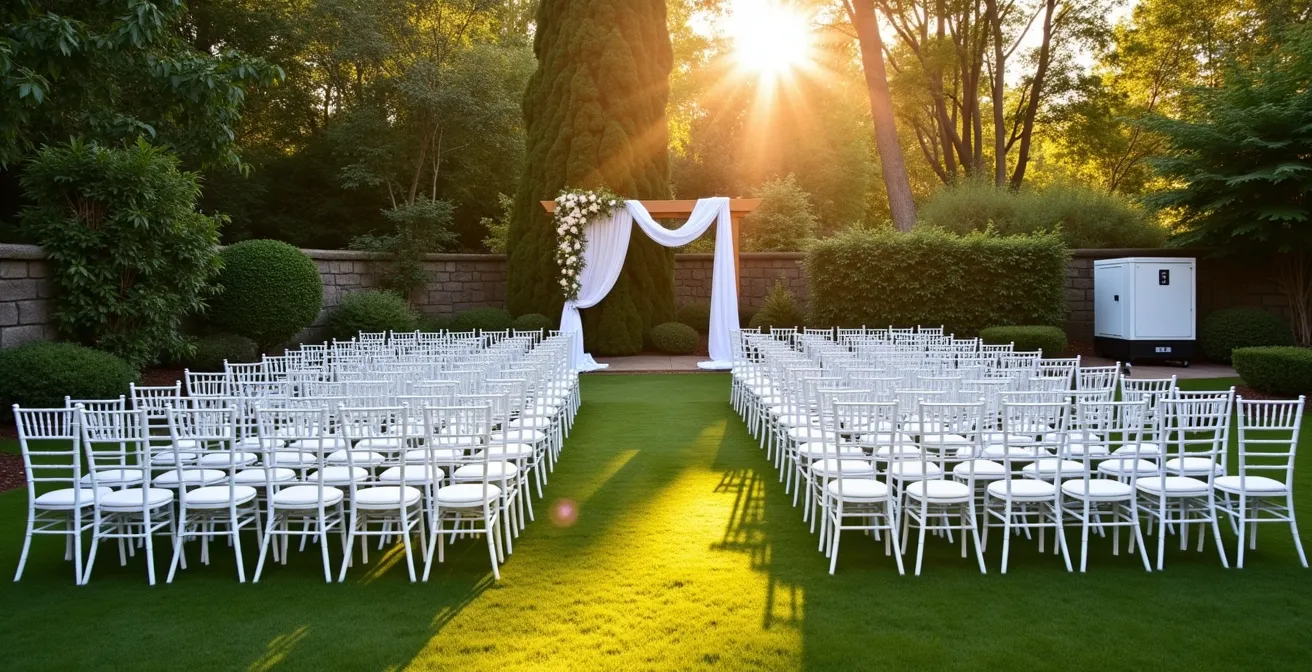
Opting for a cheap construction generator isn’t a cost-saving measure; it’s an acceptance of audio failure and event risk.
- Standard generators produce “dirty power” and audible noise (75+ dB) that will introduce a hum into your sound system and be heard during quiet moments.
- Professional event power requires meticulous planning for load, placement, cabling, and backup redundancy to prevent a single point of failure.
Recommendation: Prioritize a professional-grade, “silent” inverter generator (operating under 60 dB) with a twin-pack backup system as a non-negotiable investment in your guest experience.
When planning an outdoor wedding, power often feels like a simple logistical box to check. The prevailing wisdom suggests renting a generator, and to save on costs, a standard model from a construction supplier seems logical. This is the first, and most critical, mistake a couple can make. The issue isn’t just about noise; it’s about a concept we call “technical debt.” Choosing inadequate power is like taking out a loan against your event’s quality, and the interest payments come in the form of audio pollution, equipment failure, and logistical chaos. While many guides focus on the obvious need for power, they rarely delve into the technical specifics that separate a seamless experience from a disastrous one.
The reality is that venue power outlets are often insufficient or located impractically for the demands of a band, DJ, and catering. This creates a false sense of security. The true challenge lies not just in having power, but in having the *right kind* of power—stable, clean, and silent—delivered through a professional power infrastructure. A humming, vibrating generator isn’t just an annoyance; it’s an active threat to the clarity of your vows and the quality of your music. It is, in short, a form of audio pollution that contaminates the most important moments of your day.
This guide moves beyond the platitudes. We will not tell you to simply “get a quiet generator.” Instead, we will deconstruct the technical reasons why a professional power strategy is non-negotiable. We’ll explore how to calculate your precise needs, understand the science of silent operation, and implement a robust system that accounts for everything from cable management to emergency backups. Forget thinking about a generator as a loud box to be hidden; start thinking of it as the foundational heartbeat of your entire event’s audio and logistical success. The goal is to eliminate power as a variable, ensuring the only thing your guests hear is the magic of the moment.
To navigate these critical decisions, this article breaks down the essential components of a professional event power strategy. We’ll cover everything from the initial calculations to the final logistical coordination, providing a clear roadmap for ensuring your outdoor ceremony has a flawless and reliable power backbone.
Summary: Why a “Silent” Generator Is Non-Negotiable for Flawless Outdoor Ceremony Audio
- How to Calculate Amps for Band, Catering, and Lights Combined?
- How Far Away Must the Generator Be to Be Truly Inaudible?
- Hiding Yellow Cable Ramps in a Formal Garden Setting
- Why You Need a Twin-Pack Generator for Automatic Backup?
- Who Refuels the Generator During a 10-Hour Event?
- Venue Coordinator vs. Private Planner: Who Is Really on Your Side?
- The Toast Mistake That Kills the Energy Before Dancing Starts
- How to Fog for Mosquitoes Without Your Guests Smelling Chemicals?
How to Calculate Amps for Band, Catering, and Lights Combined?
The first step in building a reliable power infrastructure is to abandon guesswork. Underestimating your power needs is the primary cause of tripped breakers and mid-event blackouts. You must conduct a thorough power audit by listing every single piece of equipment that will require electricity. This isn’t just the big items; it’s everything from the band’s amplifiers and the DJ’s turntables to the caterer’s coffee makers and the lighting designer’s uplights. Each device has a specific power draw, usually measured in amps or watts, which is typically found on its compliance plate or in its technical specifications.
A professional event power specialist will sum these figures meticulously. For example, a typical live band’s gear requires 20-30 amps, while catering equipment can be surprisingly demanding: coffee urns can pull 8-15 amps each, and food warmers often require 10-15 amps. A medium-sized outdoor wedding typically requires a total power consumption of around 11-12 kWh over the course of the event. Once you have a total amperage, the most important professional rule is applied: the 25% buffer rule. You must plan for a generator that can supply at least 125% of your calculated peak load. This buffer accounts for startup surges and prevents the generator from running at 100% capacity, which is inefficient and risky.
Crucially, for any audio equipment, you must insist on an inverter generator. These models produce a “pure sine wave” output. Standard construction generators produce a “modified sine wave,” which is a blocky, stepped approximation of an electrical signal. This “dirty power” can cause a persistent, low-frequency hum in audio equipment and can even damage sensitive electronics over time. Requesting the pure sine wave output specifications from your rental company isn’t an optional detail; it’s a fundamental requirement for clean, professional audio.
Ultimately, a precise calculation is your first line of defense against the technical debt of poor planning, ensuring your power supply is a source of stability, not a source of stress.
How Far Away Must the Generator Be to Be Truly Inaudible?
The term “silent generator” is a marketing misnomer; no generator is truly silent. The correct technical goal is to achieve an operational noise level that is below the ambient noise floor of your event space, rendering it effectively inaudible during the quietest moments, like the exchange of vows. From an audio engineering perspective, this means the generator’s noise must not be picked up by any open microphones. The difference between a professional “silent” model and a standard construction generator is dramatic and measurable. A cheap generator can roar at 75-85 decibels (dB), the equivalent of a busy city street. In contrast, silent portable generators typically operate at 50-60 dB at a standard distance, which is comparable to a quiet conversation.
Distance is the primary tool for sound attenuation, but the exact placement is more nuanced than simply putting it “far away.” A professional will use a site survey to identify the ideal location. This involves not only maximizing distance from the ceremony and reception areas but also leveraging the landscape. Natural sound barriers are your greatest allies in mitigating audio pollution.
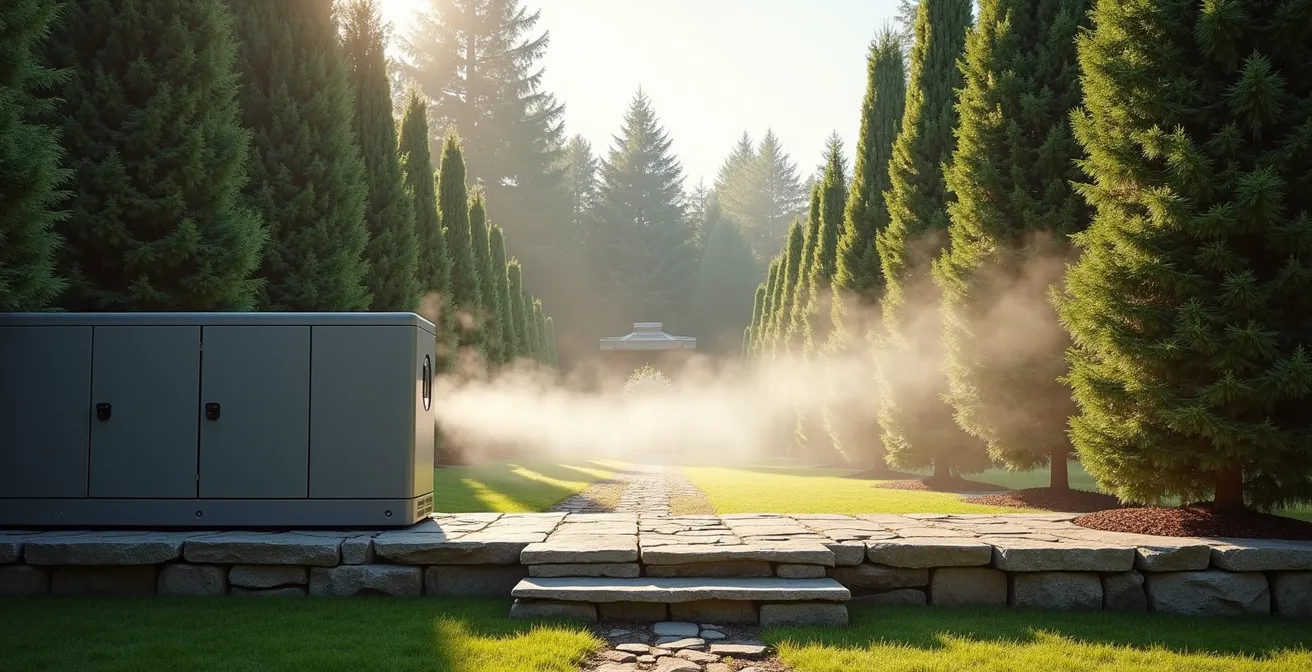
As the illustration shows, placing the generator behind a dense row of trees, a stone wall, or even the catering tent itself can significantly diffuse sound waves. As a professional event company like Carron Marquees demonstrates, the best practice is to position silent-run generators discreetly behind ancillary spaces. Their engineers then route cables strategically to create a completely invisible power infrastructure. This combination of a low-dB unit, maximum distance, and natural sound barriers is what makes a generator truly “inaudible” where it counts. The goal is an integrated solution, not just a distant noise source.
Without this strategic approach, even a “quiet” generator can become an unwelcome guest, its low-frequency hum a constant reminder of poor technical planning.
Hiding Yellow Cable Ramps in a Formal Garden Setting
Once you’ve sourced silent power, the next element of your power infrastructure to consider is distribution. A generator placed 100 feet away is useless without a safe and aesthetically pleasing way to get that power to the band, the caterer, and the lights. The amateur mistake is to run a few extension cords across the lawn, creating immediate trip hazards and a visual mess. The professional solution involves creating a thought-out cable management plan that prioritizes both safety and discretion, a service often provided by expert firms like Bristol Event Generators for weddings across the South-West.
The most visible and disruptive elements are often the cable ramps themselves. Standard safety-yellow ramps scream “construction site” and can shatter the elegant illusion of a formal garden setting. However, you cannot simply omit them, as exposed cables in high-traffic areas are a major liability. The key is to plan ahead and work with a rental company that understands event aesthetics. Many professional suppliers offer black or brown cable ramps that blend almost seamlessly into grass, mulch, or pathways. You should always request these first.
The strategy for hiding cables involves several key steps:
- Site Plan Mapping: Before the event, map the shortest and least intrusive cable runs on a site plan. The goal is to avoid crossing major guest walkways entirely.
- Edge Routing: Run cables along the edges of pathways, flowerbeds, or architectural features where they are less likely to be stepped on.
- Secure Covering: In areas where crossing a path is unavoidable and low-profile ramps are used, secure them properly. Use outdoor-rated gaffer tape on hard surfaces to secure the edges and prevent movement.
- Overhead Routing: Inside a tent, consider running cables overhead along the tent’s frame. This completely eliminates ground-level hazards and keeps the floor plan clean.
Ultimately, your power infrastructure should support the event, not detract from it. Professional cable management ensures that the only thing your guests notice is the flawless experience, not the logistics required to create it.
Why You Need a Twin-Pack Generator for Automatic Backup?
For any critical event, relying on a single piece of mechanical equipment is an unacceptable risk. A generator, no matter how well-maintained, is a machine with moving parts that can fail. It can run out of fuel, overheat, or experience a mechanical fault. This constitutes a single point of failure that could plunge your entire reception into darkness and silence. The professional standard for mitigating this risk is not just having a second generator on standby; it’s implementing a twin-pack system with an automatic transfer switch (ATS). This is how professional event companies ensure seamless experience with what is effectively a 100% uptime guarantee.
A twin-pack, or parallel, system involves two identical inverter generators running in tandem. The total load is typically shared between them. The critical component is the ATS. This device constantly monitors the power output. If it detects a failure in the primary generator—whether from fuel starvation or a mechanical issue—it instantly and automatically switches the full load to the secondary generator. The transition is so seamless, typically occurring in milliseconds, that the lights won’t flicker and the music won’t stop. No one will even know a failure occurred.
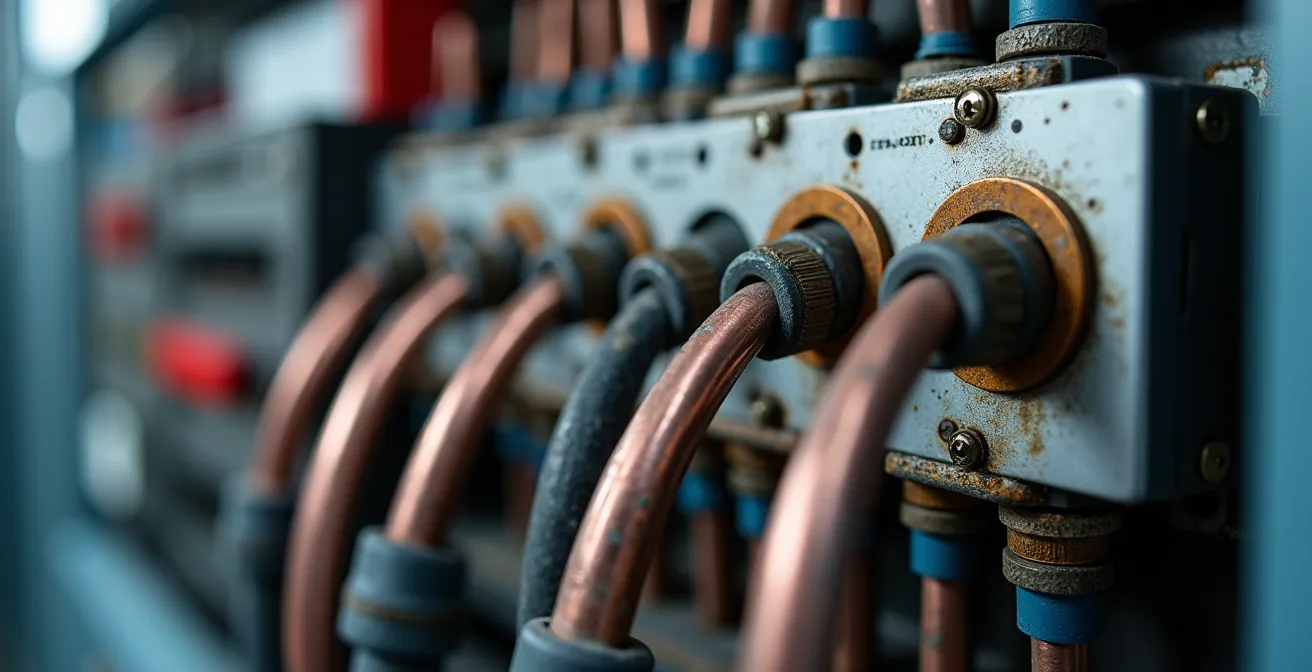
This level of redundancy is the absolute standard in broadcast and critical live events, and your wedding should be no different. The additional cost of a second generator is negligible compared to the cost of a reception ruined by a power outage during the first dance or the main course. The visual of a parallel system, with its robust connections and transfer switch, is a testament to a professional’s commitment to eliminating technical debt. It’s a physical manifestation of a plan B that you hope you’ll never need, but absolutely cannot afford to be without.
Opting for a single generator is not a calculated risk; it’s a gamble. A twin-pack system is not an extravagance; it’s a fundamental insurance policy against a catastrophic single point of failure.
Who Refuels the Generator During a 10-Hour Event?
A generator is not a “set it and forget it” device. It is a fuel-burning engine that requires monitoring and maintenance throughout your event. One of the most common—and entirely avoidable—causes of power failure is simply running out of fuel. For a 10-hour event, this is a significant logistical concern. A standard generator’s internal tank may only last 6-8 hours under a moderate load. The question of who is responsible for refueling it, and when, must be answered long before the wedding day.
Leaving this task to a well-meaning but untrained venue coordinator or family member is a recipe for disaster. Refueling a hot generator is a safety hazard that involves handling flammable liquids. It also requires interrupting the power supply unless a complex hot-refueling system is in place, which is rare outside of industrial applications. The professional solution, as offered by full-service companies like Carron Marquees, is to eliminate this problem at the source. They provide comprehensive services that include a qualified engineer to handle installation, testing, and monitoring throughout the event.
There are several strategies to manage fuel logistics and ensure continuous operation:
- Oversized Fuel Tanks: The simplest solution is to rent a generator model equipped with an oversized or external fuel tank rated for 12-24 hours of continuous operation. This completely removes the need for mid-event refueling.
- Dedicated Attendant: For very long events or complex setups, hiring a dedicated generator attendant or power technician is the industry standard. This person’s sole responsibility is to monitor the power system, including fuel levels, and manage any issues that arise.
- Contractual Clarity: Your rental contract must explicitly state who holds the liability for fuel management. A professional company will assume this responsibility. If the contract is silent, you are likely liable for any failures due to fuel starvation.
This is another area where paying for a professional service eliminates a significant point of failure. The peace of mind that comes from knowing an expert is managing your power infrastructure is invaluable.
Venue Coordinator vs. Private Planner: Who Is Really on Your Side?
When it comes to the highly technical domain of event power, it’s crucial to understand the roles—and limitations—of your event team. A venue coordinator is an employee of the venue. Their primary responsibility is to the venue itself: protecting its property, managing its staff, and ensuring you adhere to its rules. While often helpful, they are not your personal advocate, and they are almost certainly not a power specialist. They may suggest the venue’s preferred (and often cheapest) generator supplier, or even point to a few outlets and say “you should be fine,” without a true understanding of your specific technical needs.
A private wedding planner or a dedicated production manager, on the other hand, works for you. Their loyalty is to you and the success of your event. They are your advocate, tasked with vetting suppliers and ensuring every technical detail aligns with your vision. When it comes to power, a seasoned planner will know that the cheap option is rarely the best one. They will understand the catastrophic difference between generator types. They know that standard construction generators operate at a disruptive 75-85 dB(A) versus the 55 dB(A) of high-quality inverter models. This 20-30 dB difference is not subtle; it is the difference between audible noise pollution and a peaceful ceremony.
This is where an expert’s advice becomes invaluable. As wedding industry professional Rick Ryan states, the need for technical oversight is paramount:
You’ll want an inverter-style generator for the electronics (music). After you’ve added up the full power draw, plan on having a generator with AT LEAST double the capacity.
– Rick Ryan, Wedding Industry Professional Blog
This advice—insisting on an inverter style and planning for at least double the capacity—is exactly the kind of specific, technical guidance a venue coordinator may not provide. Your planner or production manager is the one who should be asking these questions on your behalf, ensuring your power supplier meets these non-negotiable standards for clean power and adequate headroom. They are the ones on your side, defending your event from the technical debt of a poor recommendation.
Don’t assume the person managing the venue is also managing your event’s best interests in every technical category. For critical infrastructure like power, you need a dedicated advocate.
The Toast Mistake That Kills the Energy Before Dancing Starts
There is no moment more vulnerable to audio failure than the wedding toasts. After a beautiful ceremony and a lively cocktail hour, the energy focuses on a few individuals speaking from the heart. The room is quiet, and every word is meant to be heard. The critical mistake is assuming the audio will simply work. This is where the technical debt incurred by choosing a cheap generator comes due with devastating interest. A persistent hum from “dirty” power, a sudden microphone cutout due to an overloaded circuit, or the distracting rumble of the generator itself can completely kill the intimacy and emotion of the moment.
Professional audio technicians live in fear of these moments. A high-quality, battery-powered sound system is one way to completely eliminate generator noise, as it provides whisper-quiet, clean audio for critical moments. However, if a generator is powering the main reception, its quality is paramount. To prevent audio pollution during toasts, a pure sine wave inverter generator is the only acceptable option. Any lesser-quality power source risks introducing interference that a sound technician cannot easily fix. It’s a problem that must be solved at the source—the generator itself.
Beyond the power source, ensuring flawless audio for toasts requires a meticulous pre-flight check by a professional. This goes far beyond a simple “one-two, one-two” sound check before guests arrive. A real-world audio environment changes dramatically once a room is full of people, as human bodies absorb RF signals and alter acoustics.
Your Action Plan: Pre-Toast Audio Quality Checklist
- Test wireless microphone range with bodies present (people absorb RF signals). This should be done during cocktail hour, not in an empty room.
- Install fresh, premium-brand batteries in all wireless microphones immediately before the toasts are scheduled to begin.
- Position the sound technician with a clear line of sight to the speakers and their equipment, allowing for real-time level adjustments.
- Use wind screens on all microphones if there is any air movement, even indoors from HVAC systems, to prevent distracting popping sounds.
- Verify with the power provider that the generator is supplying pure sine wave power specifically to prevent audio interference and humming.
Failing to prepare for this moment means risking that the heartfelt words of your loved ones are lost to technical glitches, an unrecoverable error that kills the energy right before the celebration is meant to begin.
Key Takeaways
- Power is not a commodity; it’s a technical infrastructure. A cheap construction generator creates “technical debt” that leads to audio failure and risk.
- The standard for event power is a “silent” inverter generator (under 60 dB) providing pure sine wave output, placed strategically using natural sound barriers.
- A professional power plan includes redundancy (twin-pack backup system), meticulous cable management, and expert oversight for refueling and monitoring.
How to Fog for Mosquitoes Without Your Guests Smelling Chemicals?
A truly seamless event is one where the logistics are invisible. Guests should experience the magic, not the mechanics. This principle extends to every ancillary service, including pest control and power generation. The mistake is to treat these services as isolated tasks. A professional production manager views them as interconnected elements on a master timeline. For example, scheduling mosquito fogging requires careful coordination with your generator setup to prevent chemical smells from bothering guests and to ensure the safety of technicians.
The key to “invisible” fogging is timing. The treatment should be done hours before guests arrive, allowing ample time for the chemical to do its work and for any odor to dissipate completely. This directly impacts your power setup timeline. You cannot have an electrical crew laying cables and testing a generator in an area that has just been fogged. The generator itself, a potential ignition source, must also be placed a safe distance from any treated areas until they have fully settled. Professional guidelines suggest that generators must be positioned at least 30 feet from guest areas, a rule that also serves to keep it away from freshly treated foliage.
A master timeline for coordinating these “invisible services” is essential. Here is a logical sequence that a production manager would follow:
- Pest Control (T-minus 6 hours): Schedule the mosquito fogging to occur 4-6 hours before guest arrival. This is the first major vendor on-site for the day’s setup.
- Settling Time (T-minus 5 hours): Allow at least one hour for any chemical treatments to settle and dissipate before other setup crews enter the main event space.
- Generator Placement & Cabling (T-minus 4 hours): The power team arrives after the pest control is complete. They can now safely place the generator and run all necessary cables.
- Generator Test (T-minus 2 hours): The generator should be fully operational and tested under load at least two hours before guests arrive to identify and resolve any issues.
- Ancillary Deliveries (T-minus 1.5 hours): Other large items, like portable restrooms, should be delivered and positioned *after* the main cable runs are established to avoid conflicts.
By sequencing these tasks logically, you ensure that services like pest control and power generation remain completely behind the scenes, contributing to a flawless guest experience without ever drawing attention to themselves.