
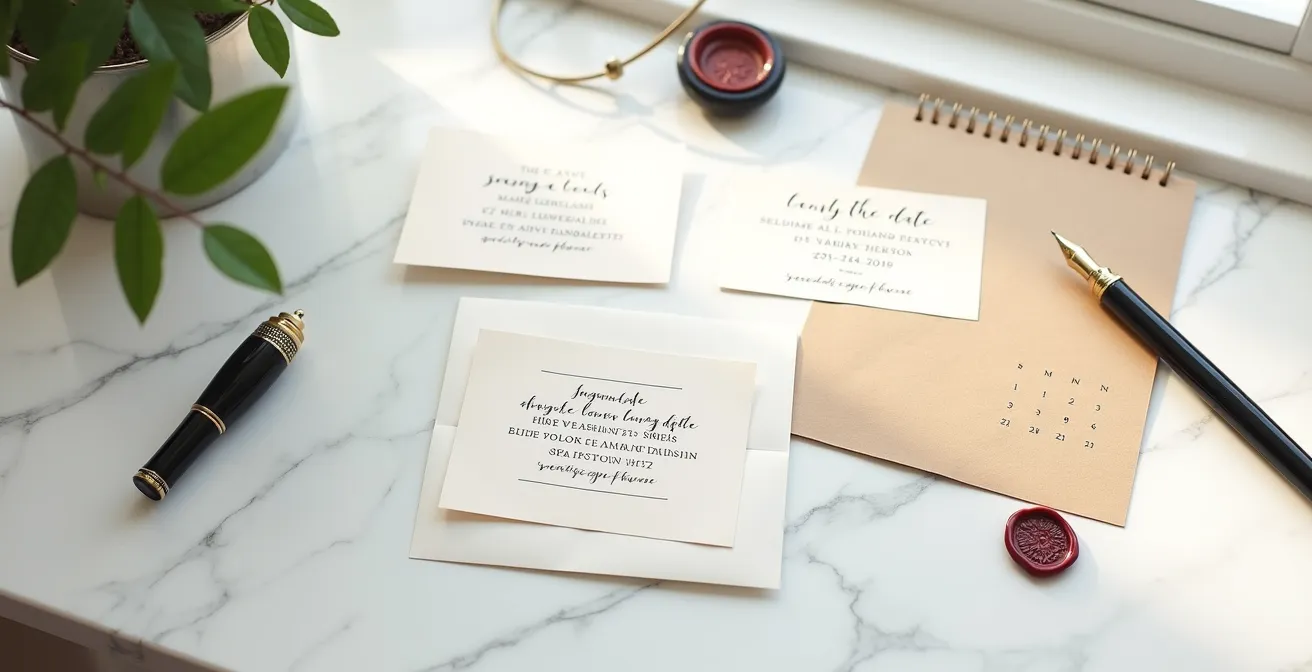
The ideal time to send save-the-dates is 8-10 months out for destination weddings and 6-8 months for local ones; this is a strategic decision, not just an etiquette guideline.
- Sending too early (12+ months) creates “guest list lock-in” before your relationships or plans are finalized.
- Sending too late (under 6 months) compromises guest travel planning and can lead to higher no-show rates.
Recommendation: Solidify your ‘A-List’ and venue first, then send save-the-dates at the 8-month mark as a logistical trigger to begin coordinating your guests.
Deciding when to send your save-the-dates feels like the official start of your wedding journey, but it’s a decision fraught with conflicting advice. Standard etiquette often suggests a simple 6 to 8-month window, but for couples navigating the complexities of modern weddings—especially those with travel involved—this advice is dangerously oversimplified. The debate between sending them a full year in advance versus waiting until the six-month mark isn’t just about timing; it’s about control, budget, and guest experience. Sending them too early can lock you into a guest list that may change, while sending them too late can cause logistical chaos for your loved ones.
This isn’t just about putting a magnet on a fridge. The save-the-date is the first critical logistical trigger in your wedding’s project plan. It sets in motion a cascade of financial commitments and guest expectations. Many couples fall into the trap of viewing it as a casual “heads-up,” only to find themselves managing costly changes and fielding endless questions later. The reality is that this single piece of communication dictates the success of your guest management, influences your final headcount, and sets the entire tone for your event long before the formal invitation is ever stamped.
The key isn’t to follow a generic rule but to understand the strategic implications of your timing. What if the real question wasn’t “when” to send them, but “what logistical processes” do you need to have in place before you do? This guide moves beyond basic etiquette to provide a strategic framework from a guest logistics perspective. We will deconstruct the timeline, analyze the risks of sending too early or too late, and provide a clear methodology for making the right choice, ensuring your save-the-date maximizes attendance and minimizes stress.
To help you navigate this critical decision, this article breaks down the strategic timeline for your save-the-dates, from the special requirements of destination weddings to the irreversible impact on your guest list. Explore the sections below to master your guest communication strategy.
Summary: When to Send Save-the-Dates to Avoid Guest Confusion and No-Shows?
- Why Destination Weddings Require a 10-Month Lead Time Minimum?
- Is It Tacky to Send Digital Save-the-Dates for a Black-Tie Wedding?
- The Save-the-Date Mistake That Traps You Into Inviting People You Don’t Want
- What Information Must Be on the Save-the-Date vs. The Invitation?
- Engagement Photo or Typography: Which Sets a Better Design Precedent?
- Why Importing Peonies in Winter Doubles Your Floral Budget?
- How a Planner Manages Your 12-Month Timeline Without You Lifting a Finger?
- How Your Invitation Suite Sets the Tone Before Guests Even Arrive?
Why Destination Weddings Require a 10-Month Lead Time Minimum?
For a local wedding, a six-month notice is a courtesy. For a destination wedding, it’s a logistical necessity. The planning horizon for guests attending a wedding that requires flights, accommodation, and potentially time off work is significantly longer. Sending a save-the-date inside the standard window is often too late, preventing guests from securing affordable travel or making necessary arrangements. This is why the industry standard has shifted; recent industry data shows destination weddings require a planning timeline of 9 to 12 months. This extended lead time is not arbitrary; it’s a direct response to real-world guest needs.
This timeline serves as a crucial “bureaucracy buffer” for your guests. International travel can involve renewing passports, a process that can take up to six months in some cases, or applying for visas. By sending your save-the-dates 10 to 12 months out, you are giving your guests the gift of time. It allows them to budget for the trip, request vacation days far in advance, and coordinate with other family members who might be attending. It also provides you, the couple, with the necessary runway to set up group travel contracts and secure hotel room blocks at favorable rates, a task that is impossible without a preliminary headcount.
Your wedding website becomes the central hub of information during this period. The save-the-date should prominently feature its URL, directing guests to a resource where they can find detailed accommodation options, travel tips, and a tentative schedule. This approach transforms the save-the-date from a simple notification into the starting gun for your guests’ planning, ensuring they feel supported and informed from the very beginning. Failure to provide this long lead time is one of the primary drivers of high decline rates for destination weddings.
Ultimately, the 10-month minimum is an act of consideration that directly impacts your attendance rate, making it a non-negotiable for any couple planning to say “I do” away from home.
Is It Tacky to Send Digital Save-the-Dates for a Black-Tie Wedding?
The question of digital versus paper save-the-dates becomes particularly sharp when planning a black-tie wedding. Traditional etiquette dictates that the formality of the event should be mirrored in its communications. A high-end, multi-course meal, top-shelf open bar, and live band signal a level of sophistication that a quick email or text can undermine. The medium is part of the message, and for a truly formal affair, a beautifully crafted piece of paper has historically been the only acceptable precursor to a formal invitation.
However, the modern wedding landscape has embraced efficiency, and a sophisticated compromise is emerging. A recent comparative analysis highlights a hybrid approach. While physical save-the-dates printed on premium cardstock remain the gold standard for setting formal expectations, a well-designed digital announcement followed by a traditional paper invitation suite is now a widely accepted strategy. This method maintains the elegance expected of a black-tie event while leveraging the convenience and cost-effectiveness of digital delivery for the initial notice. The key is execution: the digital save-the-date must be just as thoughtfully designed and formally worded as its paper counterpart.
It’s also important to distinguish between the save-the-date and the invitation. While it’s considered poor form to put dress code details on a save-the-date, the design and quality of the piece itself do the heavy lifting in setting expectations. A formal, typography-focused design signals a more traditional event, whereas a casual photo might suggest a more relaxed atmosphere. As one Wedding Etiquette Forum expert noted, the explicit “black-tie requested” directive should be reserved for the bottom of the formal invitation itself, not the save-the-date.
In the end, sending a digital save-the-date for a black-tie wedding is not inherently tacky, but it requires a high level of design sophistication and must be followed by an impeccable physical invitation suite to successfully telegraph the event’s formality.
The Save-the-Date Mistake That Traps You Into Inviting People You Don’t Want
The single most significant strategic error a couple can make is sending a save-the-date too early, before their guest list is absolutely final. A save-the-date is not a “maybe”; it is a promise. Once it is sent, you are socially and ethically obligated to send a formal invitation. According to wedding etiquette experts who agree that once a save-the-date is sent, recipients must receive a formal invitation, there is no retracting this gesture. This creates a critical point of no return known as “guest list lock-in.”
This becomes a major problem when save-the-dates are sent 12 or more months in advance. Over the course of a year, relationships can change. A close work friend might leave the company, a new friendship might not deepen as expected, or family dynamics can shift. By sending the save-the-date before these relationships have solidified, you trap yourself into inviting guests who are no longer a priority, often at the expense of new, more meaningful connections you’ve made since. This can lead to awkward situations and a guest list that doesn’t accurately reflect your inner circle on your wedding day.
To avoid this trap, you must treat your guest list as a strategic asset to be protected. This involves segmenting your list and timing your communications with precision. Never send a save-the-date to a “maybe” guest or someone you feel obligated to invite but are not truly excited about. The initial excitement of being engaged can lead to impulsive decisions, but a disciplined approach is essential for long-term success and budget control. It is far better to add someone to the guest list later than to be forced to remove them after a save-the-date has been sent.
Your Guest List Protection Strategy
- Create an A-list of 100% confirmed guests before sending any save-the-dates. These are your non-negotiable attendees.
- Establish a VIP Pre-Communication Tier for informal “feelers” with must-have guests to get a soft confirmation before any formal mailings.
- Send A-list save-the-dates at the 8-month mark. You can include a non-binding RSVP on your wedding website to get an early headcount.
- Reserve B-list save-the-dates for the 5.5-month mark, to be sent only after you have a clear picture of declines from the A-list.
- Address cards specifically to the invited parties only. Avoid ambiguous phrases like “and family” or “plus one” unless you mean it.
By adopting this tiered and timed strategy, you maintain flexibility and ensure that the people celebrating with you are the ones you truly want by your side, avoiding the financial and social cost of a premature commitment.
What Information Must Be on the Save-the-Date vs. The Invitation?
A common source of confusion for guests stems from a misunderstanding of the distinct roles of the save-the-date and the formal invitation. They are not interchangeable. The save-the-date is a logistical heads-up with a singular purpose: to get the event on the calendar. The invitation is a formal request for their presence, containing all the specific details needed to attend. Overloading the save-the-date with information creates noise and can lead to guests overlooking the most critical detail: the date itself.
The rule is simple: the save-the-date should contain the absolute minimum information required for planning. This includes the couple’s names, the wedding date (or weekend, for multi-day events), the city and state/country, and a link to the wedding website. The phrase “Formal invitation to follow” is also a crucial inclusion, as it manages expectations and clarifies that more details are coming. Information like the specific venue address, ceremony time, RSVP details, dress code, and reception information has no place on the save-the-date. Including these details too early can cause problems if plans shift, which is common in the early stages of wedding planning.
The wedding website acts as the “single source of truth” bridging the gap between the two mailings. While the save-the-date is sparse, the website can be populated with travel guidance, accommodation blocks, and a tentative schedule as details are confirmed. This strategy keeps the physical card clean and focused while still providing eager guests with the information they need. The formal invitation then arrives later as the definitive guide to the wedding day itself.
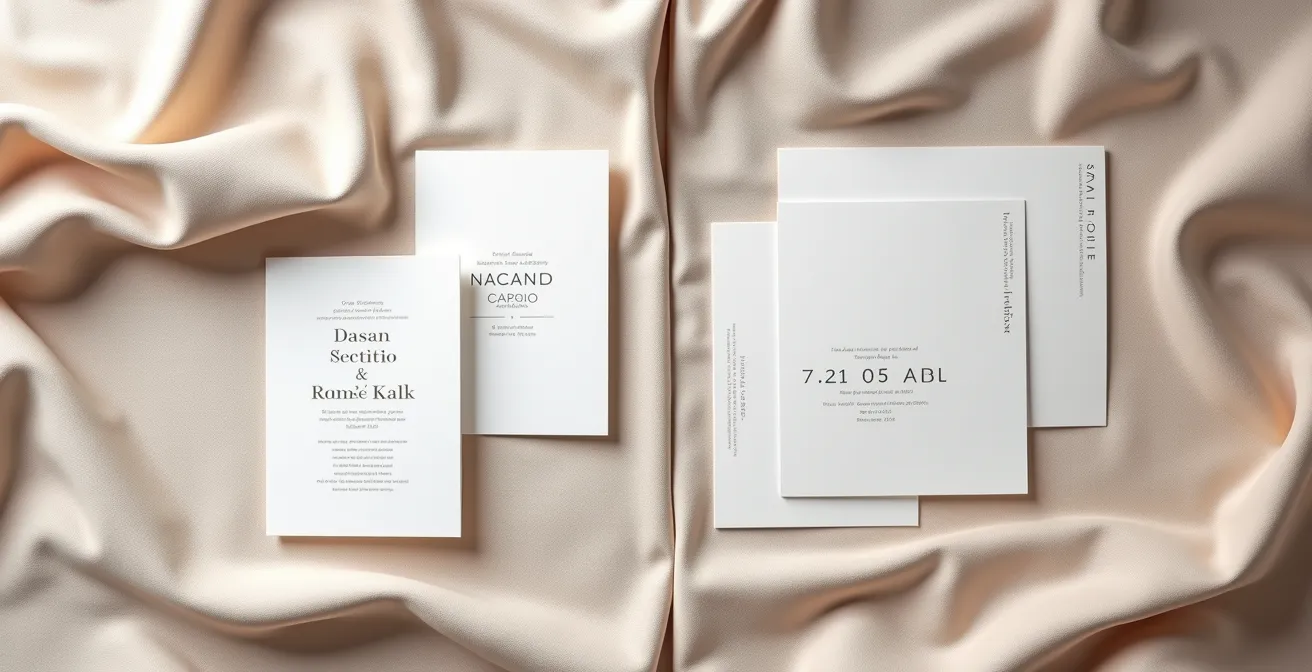
The visual distinction shown above is a clear representation of their different functions. The save-the-date is minimal, while the invitation suite is comprehensive. The following table, based on guidance from a comprehensive stationery guide, breaks down precisely what information belongs where.
| Information Type | Save-the-Date | Formal Invitation |
|---|---|---|
| Names | Couple’s names (first names okay for casual) | Full names with titles |
| Date | Wedding date or weekend range | Exact date and ceremony time |
| Location | City and state/country only | Precise venue name and address |
| Wedding Website | Essential – serves as ‘single source of truth’ | Optional reminder |
| RSVP Details | Not included | RSVP deadline and method |
| Dress Code | Not included | If black-tie or specific requirements |
| Reception Info | Not included | Full reception details |
| Registry | Website link only | Can include on enclosure card |
| Note | ‘Formal invitation to follow’ | Not applicable |
By respecting this informational hierarchy, you create a clear, streamlined communication flow that prevents guest confusion and ensures everyone has the right information at the right time.
Engagement Photo or Typography: Which Sets a Better Design Precedent?
The choice between featuring a professional engagement photo or opting for a clean, typography-focused design on your save-the-date is more than just an aesthetic preference; it’s a strategic decision that sets a powerful precedent for your entire wedding. This first piece of communication signals the tone, formality, and overall “brand” of your event. Each choice tells a different story and manages guest expectations in a distinct way.
An engagement photo save-the-date is inherently personal. It introduces you as a couple, the “characters” at the heart of the celebration. This approach tends to feel more casual and is ideal for very early announcements (10-12 months out), when you want to give a warm, personal heads-up before all the formal details are set. It’s particularly effective for relaxed, outdoor, or destination weddings where the vibe is more about shared experience than strict formality. Conversely, a design centered on elegant typography, perhaps with letterpress or foil stamping, signals that “plans are set, and this is a formal affair.” It creates an expectation for a sophisticated, detail-oriented event, like a black-tie wedding in a historic ballroom. This choice communicates craftsmanship and intention.
This decision also has logistical implications. A high-end typography design using techniques like letterpress can have a production timeline of 6-8 weeks, a factor that must be built into your master schedule. A digital photo card can be produced in 2-3 weeks. According to a study on design choices, couples who established and used recurring design elements—like a specific monogram, color palette, or motif—from the save-the-date through to their day-of stationery reported stronger brand cohesion. Guests were better able to recognize and connect with the wedding’s aesthetic from start to finish.
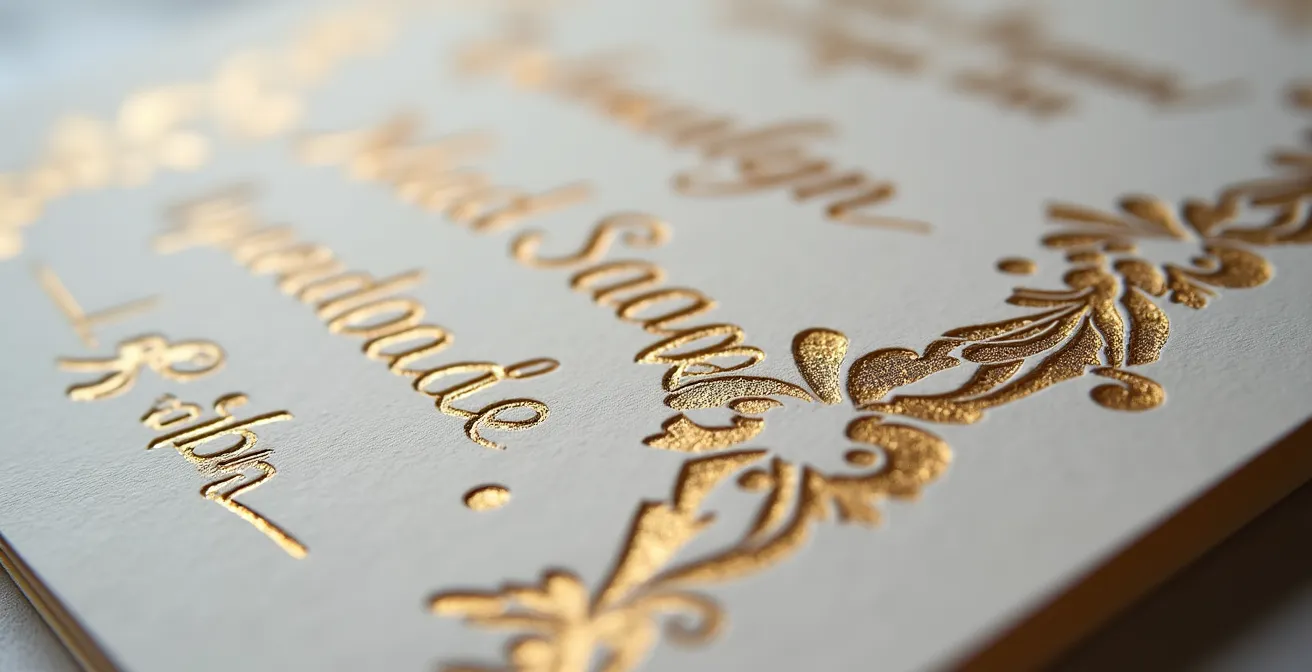
As seen in the detail above, the tactile quality of a letterpress design communicates a level of formality that a photograph cannot. The best approach is to consider your venue and overall wedding style. Test the coherence by placing a sample save-the-date next to your planned invitation style to ensure they tell a consistent story.
Ultimately, whether you choose a photo or typography, the key is to make a conscious choice that aligns with the event you are planning, setting a clear and consistent design precedent from the very first touchpoint.
Why Importing Peonies in Winter Doubles Your Floral Budget?
This question is a metaphor for a core principle of wedding logistics: ignoring seasonality and timing creates exponential, often hidden, costs. Just as attempting to source peonies out of season will drastically inflate your floral budget due to supply chain complexities, poor timing on your save-the-dates triggers a similar financial chain reaction. Sending them too late can force guests into expensive last-minute flights and hotels, potentially lowering attendance. Sending them too early, before your budget is set, can lock you into a larger guest count than you can ultimately afford.
These logistical missteps are especially costly in the context of destination weddings, a segment with massive financial stakes. Consider that the global destination wedding market is projected to double from $34.2 billion to $68.2 billion between 2024 and 2035. In a market of this scale, small mistakes have large financial consequences. A 10% drop in attendance due to poor guest communication can mean thousands of dollars lost on non-refundable venue deposits and food and beverage minimums.
The “peony problem” is about understanding the system you are operating in. The wedding timeline is an interconnected system of deadlines and dependencies. Your save-the-date timing directly impacts your ability to negotiate hotel blocks, which require an estimated headcount. It affects your guests’ ability to find affordable travel, which influences their decision to attend. This, in turn, affects your final numbers, which dictates everything from catering costs to the number of centerpieces you need. Every decision is linked, and a mistake at the beginning—like choosing the wrong send date—will have cascading financial repercussions down the line.
Therefore, treating your save-the-date timing with the same strategic foresight you would apply to a major budget item like florals or catering is essential to maintaining financial control over your event.
How a Planner Manages Your 12-Month Timeline Without You Lifting a Finger?
While it may seem like a wedding planner has a magic wand, their real power lies in rigorous project management and a deep understanding of logistical sequencing. A planner doesn’t just “remind” you to send save-the-dates; they strategically position that action within a master timeline, ensuring all prerequisites are met first. For a planner, the “Send Save-the-Dates” task at the 8-month mark is the culmination of several preceding milestones: the venue is booked, the guest list is finalized, and the wedding website is launched and populated with essential information.
This professional oversight is why destination wedding couples hire planners at higher rates than hometown weddings (36% vs. 24%). They understand the increased complexity and the high cost of logistical errors. Planners manage the entire guest communication flow, using specialized software to collect addresses, track RSVPs, and field the inevitable wave of questions that save-the-dates generate. This frees the couple from an enormous administrative burden and ensures a professional, consistent experience for guests.
Case Study: The Planner’s ROI on Save-the-Date Timing
A professional wedding planner’s expertise in timing demonstrates clear financial benefits. By managing the save-the-date process, they secure better hotel block rates with more accurate early headcounts. They implement strategic follow-ups to minimize no-shows and avoid rush fees with vendors by providing them with reliable numbers. One planner reported saving their clients an average of $3,000-$5,000 on a destination wedding through optimized save-the-date timing and meticulous response tracking alone. This proves that a planner’s fee is often an investment that pays for itself by preventing costly logistical mistakes.
A planner acts as your logistical command center. They know the deadlines that you don’t—like when to lock in a room block before a hotel’s rates increase for the season. They anticipate the guest questions about airport transfers and local activities. By managing this entire process, they aren’t just saving you time; they are actively mitigating financial risks and ensuring your guests feel cared for and confident in their travel plans.
Hiring a planner transforms the save-the-date from a task on your to-do list into a fully managed strategic initiative, a critical step in executing a seamless and successful event.
Key takeaways
- Your save-the-date is a logistical trigger, not just an announcement. Its timing has financial and guest-list consequences.
- For destination weddings, a 10-12 month lead time is mandatory to allow for guest travel planning and passport/visa processing.
- Avoid “guest list lock-in” by finalizing your A-list before sending any save-the-dates, ideally around the 8-month mark.
How Your Invitation Suite Sets the Tone Before Guests Even Arrive?
Long before the first toast is made, your wedding’s story begins in your guests’ mailboxes. The invitation suite—starting with the save-the-date and culminating in the formal invitation—is the prologue to your event. It’s the first tangible piece of your wedding that guests will experience, and it does the critical work of setting the tone, managing expectations, and communicating the level of formality and style you envision for your day. A cohesive, well-executed stationery suite signals a well-planned, thoughtful event, inspiring confidence and excitement in your guests.
This process is about creating a consistent narrative. If your save-the-date is a rustic, photo-centric card, and your invitation is a hyper-formal, five-piece suite with gold foil and calligraphy, the messaging becomes confused. This disconnect can leave guests wondering about the true nature of the event, especially regarding attire. Conversely, when the design elements—fonts, colors, monograms, paper quality—flow seamlessly from the save-the-date to the invitation and even to the day-of paper goods like menus and programs, you create a powerful and immersive brand for your wedding. This consistency makes the experience feel polished and intentional.
The key to an effective save-the-date is striking the right balance between form and function. While the design should be visually compelling and reflective of the couple’s style, it must also be practical for guests, ensuring they can easily reference the key details.
– Chris Neubauer, Founder of Yonder Design
As the quote suggests, this is a balance. The “form” (design) sets the emotional tone, while the “function” (information) provides the logistical framework. Your save-the-date initiates this balance. Its strategic timing and clear, minimal information serve the function, while its design serves the form. The formal invitation then expands on both, providing the final, detailed functional information within a design that fully realizes the aesthetic precedent you’ve already set. This two-part communication strategy is the foundation of a great guest experience.
By viewing your stationery not as a series of separate tasks but as one cohesive suite, you can strategically guide your guests’ journey and build anticipation for a beautifully orchestrated celebration.