
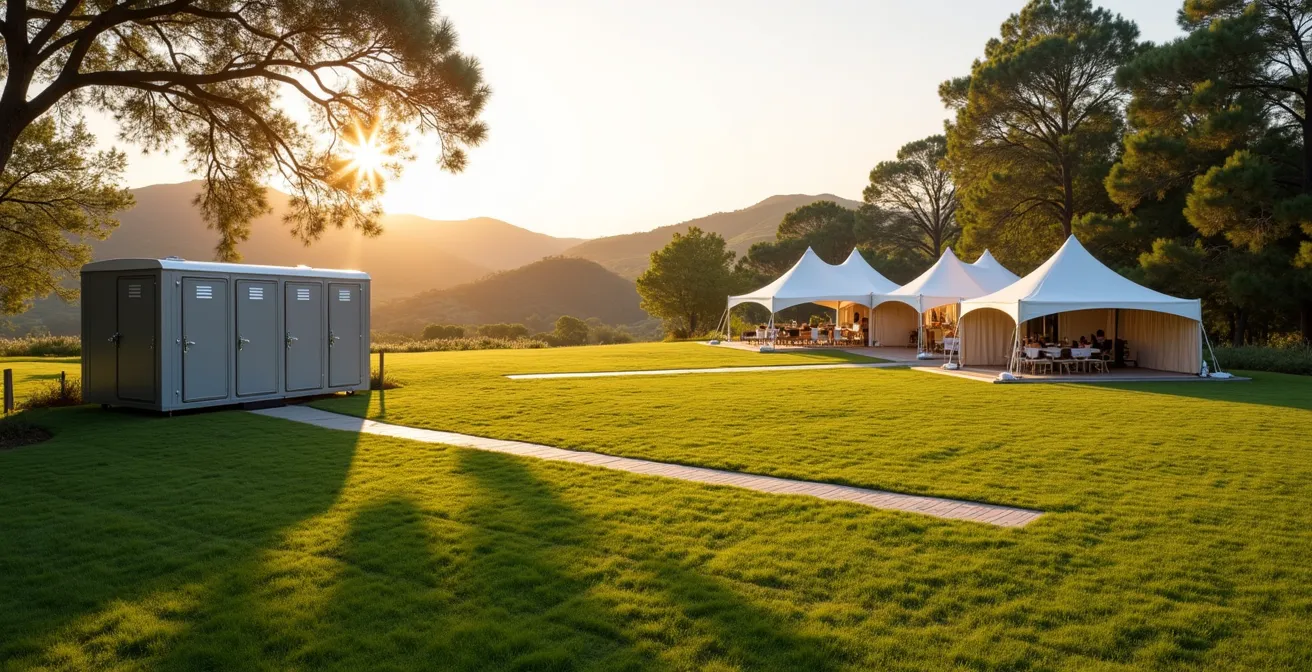
The romance of a backyard wedding hides a brutal financial reality: you’re not saving on a venue fee, you’re becoming a general contractor for a multi-thousand dollar construction project.
- Essential services like power, water, and restrooms aren’t simple “rentals”; they are complex systems requiring dedicated circuits, plumbing, and professional management, often costing upwards of $10,000.
- Liability and guest experience depend on non-glamorous infrastructure like ground protection for parking, commercial-grade cook tents, and professional waste hauling, which are standard in venues but a costly addition to a backyard.
Recommendation: Before forgoing a traditional venue, get a line-item quote for the complete temporary infrastructure—then compare the true costs.
The vision is undeniably romantic: a beautiful tent on a lush family lawn, string lights twinkling as you celebrate under the stars. The most common justification for this dream is a financial one: “We’ll save a fortune by not paying a venue fee.” As a site production manager who has overseen countless outdoor events, I can tell you this is one of the most dangerous myths in wedding planning. You are not eliminating a cost; you are transferring it and adding immense complexity.
When you choose a professional wedding venue, you are paying for more than four walls and a roof. You are paying for a pre-built, fully-permitted, commercial-grade event space. This includes a robust power grid, commercial kitchens, permanent and plentiful restrooms, graded parking lots, waste management contracts, and liability insurance. When you opt for bare grass, you don’t save that money. Instead, you inherit the role of a general contractor, and the “venue fee” transforms into your infrastructure budget—a separate, often shocking, line item you are now responsible for building from the ground up.
This is not about choosing linens and floral arrangements. This is about site production: the unglamorous, logistical-heavy work of creating a safe, functional, and comfortable temporary city for your guests. From power distribution and water supply to waste removal and ground integrity, every element a venue provides must now be sourced, quoted, managed, and paid for by you. The following breakdown isn’t meant to discourage you, but to provide a logistical reality check. This is the real cost of building a venue on bare grass.
This article will deconstruct the core infrastructure components you must build from scratch. We will explore the non-negotiable specifications and the true budget impact for each, providing a clear-eyed view of what it takes to turn a backyard into a black-tie-ready venue.
Summary: The Real Costs of a Backyard Wedding Build-Out
- Why “Executive” Restroom Trailers Are Mandatory for Black Tie on Grass?
- The “Cook Tent” Specs Your Caterer Needs to Serve Hot Food Outdoors
- Who Hauls the Trash Away: The Detail Backyard Weddings Forget
- How to Prevent Cars From Getting Stuck in Muddy Grass Parking Lots?
- How to Supply Potable Water When the Hose Spigot Isn’t Enough?
- Venue Coordinator vs. Private Planner: Who Is Really on Your Side?
- Website URL or Physical Card: Which Gets Faster Responses?
- Why “Silent” Generators Are Non-Negotiable for Outdoor Ceremony Audio?
Why “Executive” Restroom Trailers Are Mandatory for Black Tie on Grass?
The first and most immediate reality check for any aspiring backyard wedding is sanitation. Your home’s two or three bathrooms are not equipped to handle 100+ guests in formal wear over a 6-hour period. The solution isn’t a row of plastic porta-potties, which are entirely inappropriate for a high-end event. The mandatory standard is an “executive” restroom trailer. These units feature flushing toilets, running water sinks, climate control, and lighting, mirroring the experience of a permanent facility. However, they are a significant logistical and financial undertaking.
These trailers are not self-sufficient. They require a dedicated power source, often a 30-amp circuit that your home’s exterior outlets likely cannot provide. They also need a substantial water supply, either from a dedicated onboard tank that needs to be sized correctly for your guest count or a direct, high-pressure hose connection. This is a far cry from simply “dropping off a unit.” The cost reflects this complexity; data shows that luxury restroom trailers cost between $1,799 to $2,499 per day for a weekend event, and that’s before adding the cost of a restroom attendant to keep it pristine.
Furthermore, placement is a strategic decision. The trailer must be on level ground, accessible via a clear path, yet positioned discreetly—typically over 100 feet from ceremony and dining areas to mitigate noise from its generator and pump systems. This single “rental” is, in fact, a complex subsystem that dictates parts of your site plan and power grid. It’s the first major item in your new infrastructure budget.
Your Checklist for Executive Trailer Infrastructure
- Verify trailer has a dedicated water tank (minimum 100 gallons for 150 guests)
- Confirm power requirements (typically a 30-amp dedicated circuit)
- Arrange a pre-event waste servicing plan with the vendor
- Check for ADA-compliant stall availability to ensure accessibility
- Budget for a restroom attendant ($25-$50 per hour)
- Plan strategic placement (100+ feet from the ceremony, accessible but discreet)
The “Cook Tent” Specs Your Caterer Needs to Serve Hot Food Outdoors
Your caterer cannot produce a high-quality, hot meal for 150 guests from your home kitchen. They require a dedicated, commercial-grade field kitchen, commonly known as a “cook tent.” This is not just any pop-up tent; it’s a specific, functional workspace that you must provide. The caterer will give you a list of specifications, and it’s your responsibility as the site’s “general contractor” to build it. This is a non-negotiable for food safety, service quality, and staff efficiency.
The core requirements for a cook tent are extensive. It needs to be a specific size to accommodate prep tables, warming ovens (cambros), and cooking equipment. Critically, it demands dedicated power—often one or more 30-amp circuits, separate from the power for lighting or the DJ. It also requires specialized, non-slip commercial flooring to ensure a safe, clean working surface, not just bare grass. Finally, it must have access to potable water and a plan for greywater disposal. All of this must be strategically located close enough to the main reception tent for efficient service but far enough to keep cooking noise and smells away from guests.
This setup is a significant expense that is completely absent from a traditional venue’s invoice because it’s already built into their facility. For you, it’s a major new item in the infrastructure budget.
Case Study: The Real Infrastructure Bill
To put this in perspective, an analysis by Behind the Scenes Events documented the actual infrastructure costs for outdoor weddings. The study revealed that infrastructure alone typically adds $17,500 to $42,000 to the baseline budget. This includes generators and electrical work ($3,000-$6,000), climate control systems for the tents ($2,000-$4,000), and the professional setup crew required to manage the load-in ($2,000-$4,000). The cook tent is just one piece of this expensive puzzle.
The size and power needs scale directly with your guest count, and therefore, so do the costs. The table below illustrates how these requirements escalate, turning a simple tent into a costly field operations center.
| Guest Count | Tent Size | Power Requirements | Flooring Needs | Estimated Cost |
|---|---|---|---|---|
| 50-75 | 10×20 ft | 20-amp circuit | 240 sq ft non-slip | $800-$1,200 |
| 100-150 | 20×30 ft | 30-amp dedicated | 600 sq ft commercial | $1,500-$2,500 |
| 200+ | 30×40 ft | 50-amp + generator | 1,200 sq ft reinforced | $3,000-$4,500 |
Who Hauls the Trash Away: The Detail Backyard Weddings Forget
At the end of the night, after the last dance, you’re left with a significant problem: garbage. A wedding with 150 guests will generate hundreds of pounds of waste, from food scraps and empty bottles to floral arrangements and rental packaging. Your weekly residential trash service is not an option. This is a commercial-level waste management issue that is often completely overlooked in the initial “backyard wedding” fantasy, leaving the couple or their family to deal with overflowing bins and a massive cleanup job the next day.
Professional event planners use a simple calculation to forecast this problem. According to industry experts, you should plan for an average of 2 pounds of waste per guest. For a 150-person wedding, that’s 300 pounds of garbage. This requires a formal waste management plan. It involves renting multiple large-capacity bins, setting up designated stations for trash, recycling, and compost to manage the volume during the event, and, most importantly, hiring a private waste removal service to perform a bulk haul-away the following day. This is a professional service with a corresponding price tag.

The logistics go beyond a simple pickup. You’ll need dedicated staff during the event whose job is solely to monitor the bins, empty them into a central collection point (out of sight), and keep the guest areas clean. This isn’t a task for a groomsman or a family member. It’s a paid position, adding to your staffing costs. The entire process—from the bins to the staff to the final haul-away—constitutes another critical, and often forgotten, component of your site production budget.
How to Prevent Cars From Getting Stuck in Muddy Grass Parking Lots?
A sprawling lawn may seem like the perfect parking area, but it’s a liability waiting to happen. A little rain can turn that field into a mud pit, trapping guest vehicles and turning your elegant affair into a logistical nightmare. Unlike a venue with a paved, lit, and insured parking lot, you are 100% responsible for providing safe and reliable parking. This requires proactive contingency planning and a budget for ground protection, not just wishful thinking about the weather.
At a minimum, you must have a weather contingency plan. This could involve hiring parking attendants to direct traffic to the most stable ground and having a local tow truck service on standby. However, for a truly secure, black-tie experience, the professional standard is to rent and install temporary ground protection. These are heavy-duty mats or portable roadways that create a stable surface for driving and parking, regardless of the weather. This solution offers peace of mind but comes at a significant cost. According to industry data, professional ground reinforcement systems can cost $120-$250 per square foot to install, a cost that can quickly run into thousands of dollars for even a modest number of cars.
An alternative to reinforcing the ground is to eliminate on-site parking altogether. This involves securing a nearby commercial parking lot (like a school or office park) and hiring a shuttle service to transport guests to and from the property. While this solves the mud problem, it introduces its own set of costs and logistical challenges, including shuttle rental fees, driver wages, and clear communication to guests. There is no “free” solution; there are only different budget allocations for managing the same problem.
The following table breaks down the good, better, and best approaches to managing this critical aspect of guest experience and liability.
| Solution Level | Strategy | Cost | Reliability | Guest Experience |
|---|---|---|---|---|
| Good | Well-marked area + weather contingency | $200-$500 | Weather dependent | Basic |
| Better | Parking attendants + tow truck standby | $800-$1,500 | Moderate protection | Managed |
| Best | Ground protection mats or shuttle service | $2,000-$4,000 | Weather-proof | Premium |
How to Supply Potable Water When the Hose Spigot Isn’t Enough?
Water is a critical utility you likely take for a granted, but at a temporary event venue, it’s a major logistical challenge. A single outdoor hose spigot is woefully inadequate for the demands of a wedding. You need to supply potable (drinkable) water for three separate, high-demand systems: the caterer’s cook tent, the executive restroom trailer, and guest hydration stations. This requires a professional-grade temporary plumbing system, not just a garden hose.
The volume required is substantial. A standard rule of thumb is a minimum of 1 gallon per guest for drinking and cooking. The restroom trailer needs its own reserve of 100-200 gallons. The caterer will require an additional 3-5 gallons per guest for food prep, hand washing, and cleanup. For 150 guests, you are easily looking at a demand for over 500-700 gallons of water. This water must be delivered with adequate pressure, which often means renting a potable water tank (or “water buffalo”) connected to an on-demand pump system. This entire setup, including food-grade hoses and a greywater disposal plan for sink drainage, is another infrastructure cost. Wedding planning experts confirm that water delivery and pumping systems can add $500 to $1,500 to the budget.

This is a perfect example of a hidden cost. The water itself is free, but the system to store, pump, and deliver it safely and at the required volume is not. A professional venue has this plumbing infrastructure built in. On bare grass, you are responsible for constructing it. It’s a crucial part of the site production plan that ensures the health, safety, and comfort of your guests and vendors.
Venue Coordinator vs. Private Planner: Who Is Really on Your Side?
When you sign a contract with a traditional venue, it often includes the services of a “venue coordinator.” This can lead to the dangerous assumption that you don’t need your own wedding planner. In a backyard wedding scenario, this misunderstanding can be catastrophic. It’s crucial to understand the fundamental difference in their roles and loyalties, especially when you are the one building the venue.
A venue coordinator works for the venue. Their primary responsibility is to protect the venue’s assets and enforce its rules. They manage the venue’s existing infrastructure, but they are not your personal project manager. A private planner, on the other hand, works for you. Their loyalty is exclusively to you and your budget. In a backyard wedding context, the private planner’s role elevates to that of a general contractor and site manager. They are the expert responsible for sourcing vendors for power, water, and sanitation, managing the complex load-in and load-out schedule, and troubleshooting the inevitable problems that arise when building a venue from scratch.
While a private planner is an additional cost, their experience in site production for outdoor events can save you thousands in costly mistakes, vendor negotiation, and logistical mishaps. They understand the intricate dependencies—like knowing the generator needs to be in place before the caterer can set up their ovens. They are your advocate, your project lead, and your single point of contact in a sea of logistical complexity. For a backyard build, they are not a luxury; they are an essential part of the project team.
The table below clearly outlines the critical differences in their roles, highlighting why a private planner is an indispensable asset for an outdoor wedding.
| Aspect | Venue Coordinator | Private Planner |
|---|---|---|
| Primary Loyalty | Venue’s assets and rules | Couple’s interests only |
| Cost Incentive | None (venue profits from rentals) | Find savings through vendor relationships |
| Infrastructure Experience | Limited to venue’s existing setup | Acts as general contractor for temporary sites |
| Typical Cost | Included in venue fee | $2,000-$8,000 (saves money elsewhere) |
| Conflict Resolution | Protects venue interests | Advocates for couple |
Website URL or Physical Card: Which Gets Faster Responses?
In the context of a complex backyard wedding, your communication method is more than just an invitation; it’s a critical tool for logistical management. While physical cards have a traditional charm, a digital platform via a wedding website is indispensable for managing the intricate details of a venue you’re building yourself. The data supports this shift, as 2024 wedding statistics show that 62% of couples now use a wedding website to communicate with guests.
For a backyard event, the website’s function transcends sharing your love story. It becomes your central information hub for site-specific logistics. This is where you post detailed parking maps, shuttle schedules, and pick-up locations. It’s where you can offer crucial advice that prevents guest frustration, such as a “footwear recommendation” for walking on grass. Most importantly, it’s a tool for data collection and real-time updates. You can add RSVP questions like “Will you be using the shuttle service?” or “Do you have any accessibility needs we should be aware of?” to help you finalize your logistical plans.
Furthermore, the digital platform allows for agile communication. If there’s a last-minute change due to weather—for instance, if on-site parking is no longer viable and you must switch to the shuttle contingency plan—you can send a mass email or text update to all guests instantly. This level of real-time control is impossible with physical invitations alone. The website isn’t just a modern convenience; it’s the operational dashboard for your temporary venue, ensuring that your guests are well-informed and your carefully laid plans are executed smoothly.
Key Takeaways
- A “backyard” is an empty construction site requiring a full infrastructure build-out, not just decoration.
- Your budget must account for a separate, often five-figure “Infrastructure Budget” for power, water, waste, and ground safety.
- A private planner isn’t a luxury in this scenario; they are the essential “general contractor” managing your complex build.
Why “Silent” Generators Are Non-Negotiable for Outdoor Ceremony Audio?
Power is the invisible lifeblood of a modern wedding, running everything from the catering ovens to the DJ’s speakers and the tent’s lighting. For a backyard wedding, this power doesn’t magically appear; it must be generated on-site. The critical mistake many couples make is underestimating the type of generator required. A standard construction generator is not an option. You need a professional-grade “silent” or “inverter” generator, and it’s a non-negotiable part of the infrastructure budget.
The reason is simple: noise. A standard contractor generator, while cheap to rent, is incredibly loud. Reports show these units produce 70-80 decibels (dB) of noise, equivalent to a vacuum cleaner running constantly. This is loud enough to drown out conversations during cocktail hour and, most devastatingly, completely ruin the audio of your ceremony. Your vows, the officiant, and the delicate processional music would be competing with a constant, droning engine. A silent generator, by contrast, operates at a much lower 55-65 dB, a level that can be easily masked by placing it several hundred feet away from the main event areas.
This need for a silent generator introduces significant costs and logistics. These units are more expensive to rent, with event planners reporting that the full generator infrastructure—including the unit, hundreds of feet of heavy-gauge power cabling, and distribution boxes—typically costs between $3,000 and $6,000. This investment prevents audio interference and also protects expensive vendor equipment (like speakers and lighting) from the “dirty” power and voltage fluctuations common with cheaper generators. This is the final, perfect example of a hidden cost: a seemingly simple need (power) requires a sophisticated, expensive, and logistically complex solution.
Before you commit to that beautiful vision of a wedding on the lawn, the next logical step is to get a real-world quote. Contact a local event production or rental company and ask for a line-item estimate for a complete infrastructure package for your guest count—including power, restrooms, a cook tent, and ground protection. Only then can you make a truly informed financial decision.