
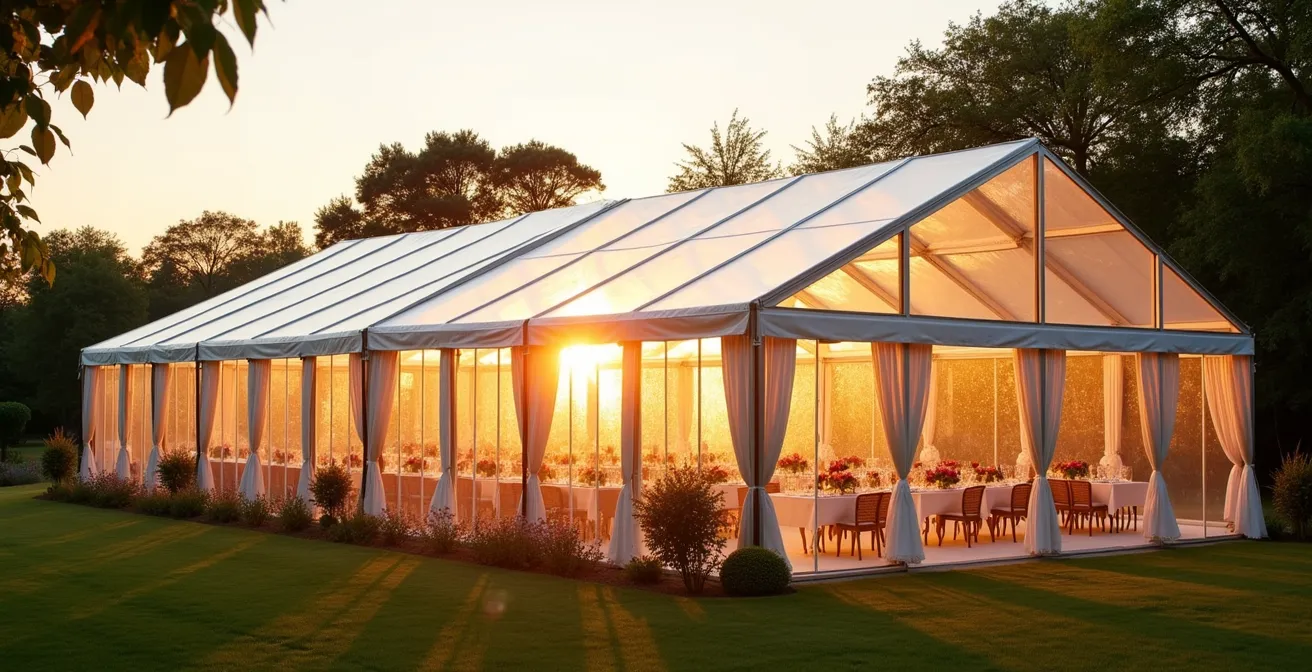
Contrary to popular belief, managing a clear tent isn’t about fighting heat; it’s about controlling a complex and unstable ecosystem where light, moisture, and structural physics create hidden failure points.
- The “greenhouse effect” makes standard fans useless and requires up to 50% more cooling power than an opaque tent.
- At night, interior lighting creates a “black mirror,” and guest-generated humidity can cause condensation to rain down from the ceiling.
Recommendation: Treat a clear tent as a technical construction project, not a simple rental. Prioritize professional consultation on HVAC, lighting, and structural foundations over purely aesthetic choices.
The vision is intoxicating: a wedding reception under the stars, surrounded by nature, yet perfectly sheltered within a crystal-clear marquee. For couples dreaming of this seamless indoor-outdoor experience, the clear-span tent appears to be the ultimate solution. The primary concern, if any, is usually a simple one: “Will it get too hot in the summer?” This leads to the conventional solutions of adding fans or budgeting for a basic air conditioning unit. However, this focus on ambient temperature is a dangerous oversimplification. It fundamentally misundersores the nature of the structure.
A clear-span marquee is not a room with transparent walls; it is a self-contained biosphere with its own set of physical laws. The very transparency that makes it so desirable creates a cascade of interconnected challenges that go far beyond simple heat management. The sun’s energy, the guests’ body heat and breath, the angle of the evening lights, and the stability of the ground beneath all interact in a dynamic, often counter-intuitive system. Ignoring these principles doesn’t just lead to discomfort—it can lead to aesthetic disasters, equipment failure, and genuine safety hazards.
But what if the key to a successful clear tent event wasn’t just brute-force cooling, but a sophisticated understanding of its unique physics? This guide moves beyond the platitudes of “renting an AC unit” to reveal the critical, often invisible, forces at play. We will dissect the technical challenges one by one, from the illusion of airflow and the “black mirror” effect at night to the surprising problem of indoor rain and the absolute necessity of a perfectly engineered foundation. By understanding this complex ecosystem, you can ask the right questions and make the informed decisions needed to protect your investment and execute your vision flawlessly.
This article provides a technical deep-dive into the critical considerations often overlooked when planning an event in a clear-span marquee. The following sections break down each challenge, offering expert insights and professional solutions.
Summary: The Hidden Physics of a Flawless Clear Tent Event
- Why Standard Fans Are Useless in a Clear Tent Under Direct Sun?
- How to Light a Clear Tent Without Creating a Black Mirror Effect?
- The Morning Dew Drip: Why Clear Tents Rain Inside at Night?
- How to Create “Backstage” Areas in a Completely Transparent Structure?
- Why Clear-Span Structures Require a Laser-Leveled Cassette Floor?
- Why Silk Chiffon Drapes Better Than Polyester for Romantic Ceilings?
- Why You Need a Rigging Specialist for Any Floral Install Over 50 lbs?
- Why Sailcloth Tents Glow at Night and How to Light Them Properly?
Why Standard Fans Are Useless in a Clear Tent Under Direct Sun?
The most common and dangerously inadequate response to heat in a clear tent is to place standard fans around the perimeter. This approach fails because it misunderstands the core problem: a clear marquee under the sun is a powerful greenhouse. It traps solar radiation, which is then absorbed by surfaces and re-radiated as heat. This process, known as the greenhouse effect, can be incredibly potent. According to event climate specialists at AirPac Inc., a clear top tent requires approximately 50% more cooling capacity than a solid white tent of the same size. For a 200-guest wedding, this effect alone can raise the internal temperature by a staggering 20°F above the outside ambient temperature, even before accounting for the body heat of guests.
Standard fans placed at ground level do little more than circulate this already super-heated air. The hot air rises and creates a thick, oppressive layer near the ceiling, a phenomenon called thermal stratification. The fans are simply too low to break up this layer, creating the illusion of a breeze without providing any actual cooling relief. Real climate control in this environment is an engineering task that requires a strategic, multi-pronged approach to manage air movement effectively.
Action Plan: Creating Effective Air Movement in a Clear Tent
- Air Curtains: Position high-velocity industrial fans at entrances and exits. This creates invisible “air curtains” that prevent the conditioned cool air from escaping and hot ambient air from entering.
- Break Stratification: Install circulation fans high on the tent’s structural poles, angled downwards. This is critical to push the hot, trapped air at the ceiling down to be cycled through the HVAC system and break the thermal layers.
- Cross-Ventilation: Utilize multiple, smaller fans strategically placed to create a consistent cross-breeze throughout the space, rather than relying on a few large, noisy, and less effective units.
- HVAC Integration: Acknowledge that fans alone cannot combat radiant heat. They must be used in conjunction with a properly sized HVAC system. Fans move air; only HVAC can actually cool it.
- Spot Cooling: If whole-tent cooling is unfeasible, focus resources by directing cooled air and fans toward high-occupancy zones like the dance floor, head table, or bar areas.
How to Light a Clear Tent Without Creating a Black Mirror Effect?
As day turns to night, a new challenge emerges in a clear marquee. The very panels that offered a beautiful, transparent view of the sunset become problematic mirrors. When the interior is brightly lit and the exterior is dark, the clear PVC or glass acts like a one-way mirror, reflecting everything inside. This is the “black mirror” effect, and it can completely destroy the intended ambiance. Instead of seeing the starry sky or surrounding landscape, guests are confronted with reflections of themselves, the lighting fixtures, and service staff, creating a confusing and unflattering environment.
Preventing this requires a professional lighting strategy that works with the physics of reflection, not against it. The key is to control the angle of incidence—the angle at which light strikes the transparent surface. Light hitting the panels at a perpendicular (90-degree) angle will create the strongest reflection. To avoid this, lighting designers use grazing angles (typically 30-45 degrees) to wash the interior with light without causing harsh reflections. This is achieved by carefully positioning uplights along the tent’s perimeter. This technique illuminates the space while allowing the walls to remain transparent, preserving the magical “under the stars” effect.
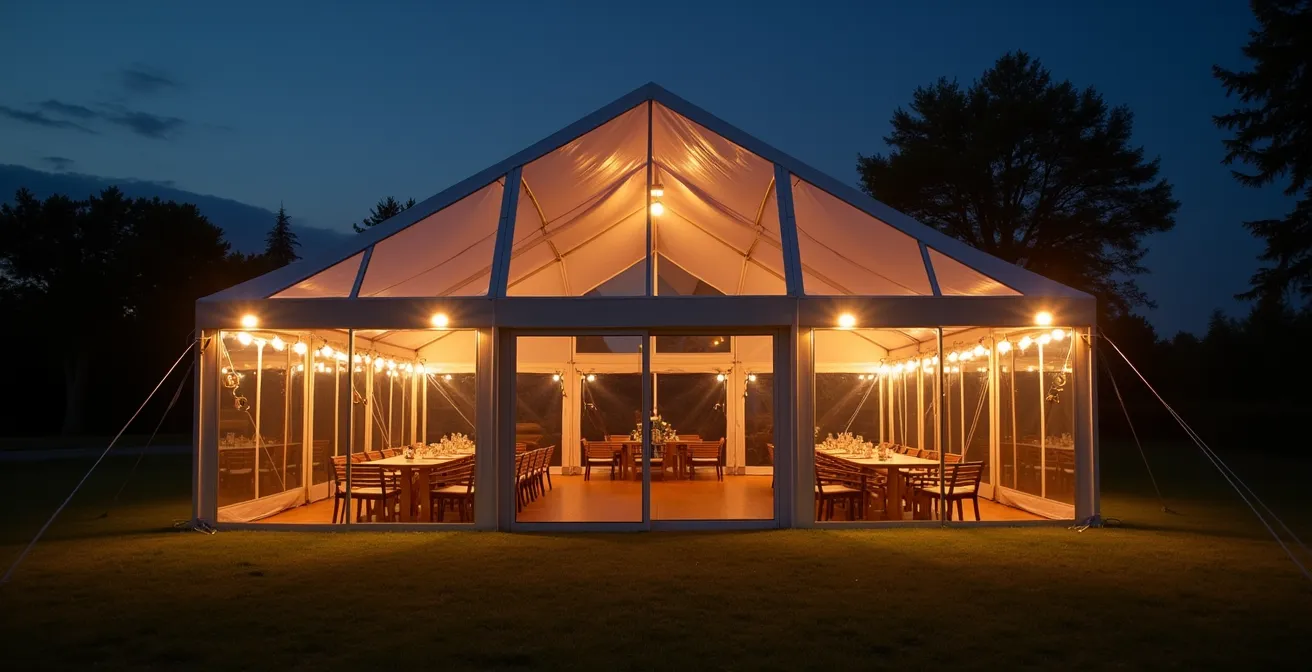
Achieving this seamless transition from daylight to evening glow requires precise timing and programming, adjusting the interior light intensity to match the fading natural light. A professional approach often involves a pre-programmed dimming schedule that gradually increases interior brightness as the exterior darkens, ensuring the tent’s transparency is maintained throughout the entire event.
The Morning Dew Drip: Why Clear Tents Rain Inside at Night?
Perhaps the most shocking and unpleasant surprise for an unprepared event is “indoor rain.” This occurs when a clear tent, filled with warm, moist air from guests, cools rapidly from the outside as night temperatures drop. The inner surface of the tent’s roof reaches its dew point—the temperature at which the air can no longer hold its water vapor, forcing it to condense into liquid. This condensation forms as droplets on the ceiling and, as they accumulate, begins to drip down onto guests, tables, and expensive decor.
The source of this moisture is primarily the guests themselves. Through breathing and perspiration, especially while dancing, people release a significant amount of water vapor. In fact, research on event humidity shows that 200 dancing guests can release several gallons of water vapor per hour into the enclosed space. Without a system to remove this moisture, condensation is almost inevitable in climates with a significant day-to-night temperature swing. Simply opening a sidewall is a poor solution, as it sacrifices all climate control, letting out expensively cooled or heated air.
Professional tent providers understand this and have several methods to combat condensation, ranging from reactive measures to proactive, integrated systems. The choice depends on budget, climate, and the desired level of comfort.
| Method | Effectiveness | Cost | Installation Complexity |
|---|---|---|---|
| Reactive Ventilation | Poor – loses climate control | Low | Simple |
| Integrated HVAC Dehumidification | Excellent – maintains temperature | High | Complex |
| Double-Skinned PVC Panels | Best – eliminates condensation | Very High | Factory Installation |
| Portable Dehumidifiers | Good – targeted moisture removal | Medium | Simple |
How to Create “Backstage” Areas in a Completely Transparent Structure?
The total transparency of a clear-span marquee presents a significant logistical problem: where do you hide the functional necessities of an event? Catering prep stations, staff break areas, storage for equipment, and sound system control boards all need a “backstage” area, but a completely transparent structure offers no inherent privacy. Exposing these operational elements to guests can shatter the elegant illusion you’ve worked so hard to create.
One professional solution is a modular approach. As demonstrated by Collective Event Group, smaller, opaque marquee tents can be directly connected to the main clear-span structure. These connected tents serve as fully functional kitchen, storage, or staff areas, with covered walkways that keep all service activity completely hidden from guests. This allows 100% of the main tent’s transparent real estate to be dedicated to the guest experience, preserving its aesthetic integrity. Another common method is using pipe and drape systems to build fabric “walls” inside the tent, but this can look clumsy and partition the space in an unnatural way.
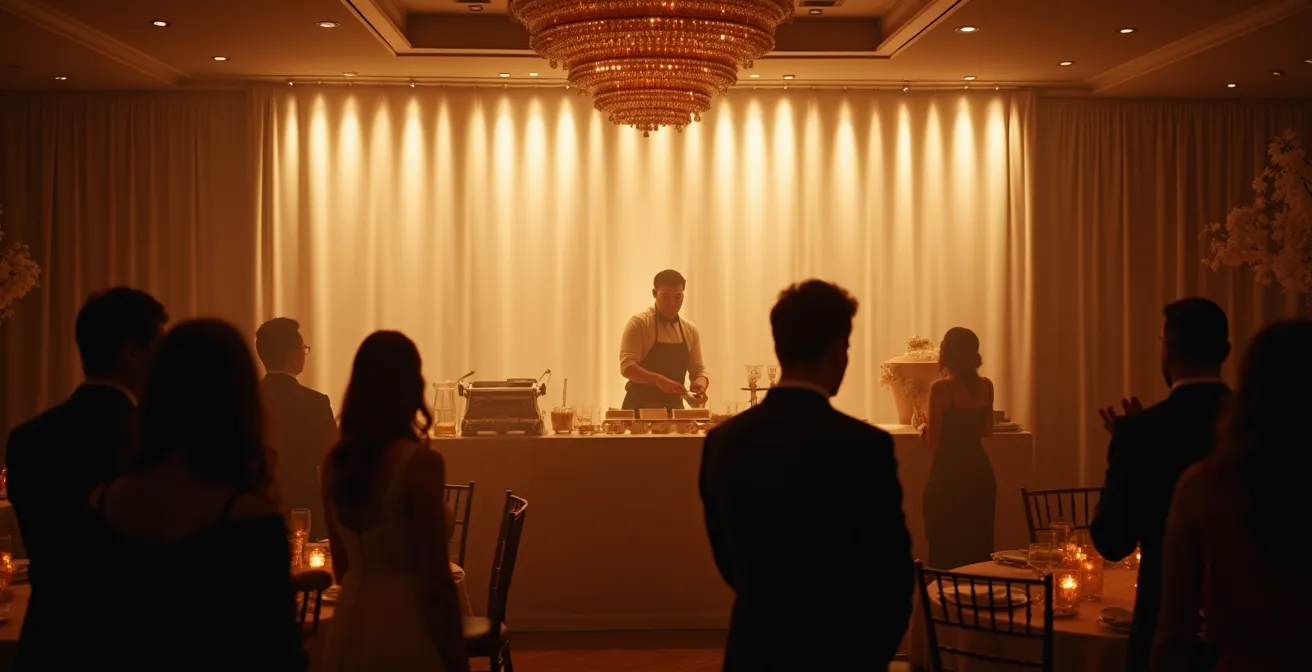
For a more innovative and visually stunning solution, designers can create a “curtain of light.” This technique involves placing a row of tightly focused, narrow-beam uplights close together, running from floor to ceiling. The intense vertical shafts of light create a visual barrier that is virtually impenetrable to the eye. While staff can see through it from the dimmer backstage area, guests in the brightly lit main space see only a dramatic wall of light. This method effectively conceals the functional zones without introducing any physical walls, turning a logistical necessity into a striking design feature.
Why Clear-Span Structures Require a Laser-Leveled Cassette Floor?
While the focus is often on the clear roof, the floor of a clear-span marquee is arguably its most critical structural component. These are not simple pole tents; they are engineered aluminum-beam structures with rigid connections. They have very little tolerance for uneven ground. Attempting to erect a clear-span structure on soft grass, a sloped lawn, or any imperfect surface introduces immense physical forces that can compromise its integrity. A seemingly minor variation in the floor level can have major consequences.
Specifically, an uneven foundation creates torsional stress, a twisting force, on the tent’s rigid frame. Structural engineering analysis reveals that even a 2-inch floor variation can create a 30% increase in torsional stress on the tent frame, potentially leading to warped beams or failed connections. To prevent this, professional installers insist on a leveled sub-floor. The gold standard is the cassette floor system. This is a modular, raised flooring system with adjustable legs that can be laser-leveled to create a perfectly flat and stable foundation, regardless of the terrain underneath.
Case Study: Climate Control Efficiency with Cassette Floors
Beyond structural safety, a cassette floor is crucial for climate control efficiency. Elite Events & Rentals reports that tents with properly installed cassette floors create a sealed, insulated barrier that dramatically improves HVAC performance. In their installations, tents with cassette floors required 40% less cooling capacity compared to tents with standard flooring or no sub-floor. The sealed platform prevents cool air from escaping through gaps and stops ground moisture from rising into the tent, often making the difference between needing a costly 5-ton AC unit versus a more manageable 3-ton unit for a standard 40×60 tent.
Why Silk Chiffon Drapes Better Than Polyester for Romantic Ceilings?
Ceiling drapery is a staple of romantic tent decor, softening the structure and adding to the ambiance. However, in the sensitive ecosystem of a clear tent, the choice of fabric is not just an aesthetic one; it is a technical one. The physical properties of the fabric—its weight, its reaction to humidity, and especially its interaction with light—all play a critical role. While polyester is a common, durable choice, natural silk chiffon offers a visual quality that is technically superior for creating an ethereal, glowing effect.
The difference lies in a physical property called subsurface scattering. When light hits polyester, it reflects mostly off the surface, which can create a cheap-looking, synthetic sheen. When light hits silk chiffon, it penetrates the surface and scatters within the fibers before exiting. This creates a soft, luminous glow from within the fabric itself, enhancing the warm, romantic lighting design. Silk also has a lower bending modulus, meaning it is less stiff and creates softer, more natural-looking folds and swags. This is particularly noticeable in large ceiling installations where the quality of the drape is paramount.
However, the choice is not without trade-offs. Polyester is often inherently flame retardant (IFR) and is more dimensionally stable, meaning it won’t sag or stretch in the high humidity that can be present in a tent. Silk is lighter, which reduces the load on the rigging points, but it may require chemical fire treatment and is more susceptible to humidity.
| Property | Silk Chiffon | Polyester |
|---|---|---|
| Bending Modulus | Lower – creates softer folds | Higher – stiffer drape |
| Light Interaction | Subsurface scattering – ethereal glow | Surface sheen – harsh reflection |
| Weight per yard | Lighter – easier rigging | Heavier but fire-rated |
| Humidity Response | Can sag in high humidity | Dimensionally stable |
| Fire Treatment | Requires chemical treatment | Inherently flame retardant (IFR) |
Why You Need a Rigging Specialist for Any Floral Install Over 50 lbs?
Elaborate hanging floral installations are a breathtaking feature in a clear-span marquee, but they also represent a significant and often underestimated safety risk. Attaching any substantial weight to the tent’s ceiling structure is not a job for a florist or a general event decorator; it is a job for a certified rigging specialist. The reason is that the forces involved are far more complex than just the static weight of the arrangement.
First, there is the issue of “hidden weight.” A lush floral installation is full of water-soaked floral foam. As noted in professional guidelines, this can be a crucial oversight.
Live floral installations soaked in water can weigh 30-50% more than their dry weight. A rigger accounts for this, plus the non-trivial weight of rigging hardware like cables, shackles, and motors.
– Professional Rigging Guidelines, Event Safety Alliance Standards
What might be estimated as a 40lb arrangement can easily exceed 60lbs once fully hydrated. The second, more dangerous factor is the concept of dynamic load. If an installation is accidentally pushed or begins to swing even slightly, it generates momentum. This multiplies the force exerted on the rigging points and the tent structure itself. Rigging safety standards indicate that dynamic loads from swinging can multiply forces by 200-300%. A 50lb static load can momentarily exert 150lbs of force on its anchor point. A rigging specialist understands these forces and knows how to use the tent’s designated load-bearing points, proper hardware (like rated shackles and steel safety cables), and load distribution techniques to ensure the installation is completely secure and poses no threat to the guests below.
Key Takeaways
- A clear tent is a greenhouse that requires 50% more cooling power and specialized air circulation to combat thermal stratification.
- Nighttime lighting must use careful grazing angles to avoid a “black mirror” effect, while humidity from guests can cause condensation to drip from the ceiling.
- The structural integrity of a clear-span marquee depends entirely on a laser-leveled cassette floor to prevent dangerous torsional stress on the frame.
Why Sailcloth Tents Glow at Night and How to Light Them Properly?
To fully appreciate the unique lighting challenges of a clear tent, it is useful to contrast it with a structure that is famously easy to light beautifully: the sailcloth tent. At night, a properly lit sailcloth tent emits a warm, ethereal glow that is both inviting and magical. This signature effect is not an accident; it is a direct result of the tent’s translucent fabric and the professional lighting techniques used to enhance it. Understanding this contrast highlights why the “black mirror” effect is such a specific problem for transparent structures.
The key is that sailcloth is translucent, not transparent. The fabric acts as a massive light diffuser. Professionals like Windows on the Water use a “three-layer” lighting framework to achieve the signature glow. First, the ‘Glow’ layer involves washing the entire canopy from the perimeter with very warm uplighting (typically 2200K-2700K color temperature). The fabric catches this light, diffuses it, and turns the entire tent into a giant, soft light source. This provides beautiful, even, and flattering ambient light throughout the space. ‘Task’ layers (pin-spots on tables) and ‘Accent’ layers (on center poles) are then added for functionality and drama.
This approach is the opposite of what’s required for a clear tent. In a sailcloth tent, you are intentionally lighting the canopy itself. In a clear tent, you must intentionally *avoid* lighting the canopy to prevent reflection. The success of sailcloth lighting relies on a few key principles:
- Use very warm white LEDs (2200K-2700K) to enhance the natural warmth of the canvas material. Cool white light (4000K+) will make it look sterile and grey.
- Position fixtures to “wash” the fabric evenly from the perimeter, not create hot spots.
- Use dimmers to adjust intensity as the natural light fades, maintaining a perfect balance between interior and exterior light levels.
This comparison starkly illustrates the technical nature of tent lighting. The material itself dictates the strategy, and what works beautifully for one type of tent can be a complete disaster for another.
Ultimately, a clear-span marquee is an engineering project masquerading as a party rental. To achieve that flawless, starlit vision, you must partner with rental professionals and designers who are not just decorators, but technical experts. Begin your planning by asking about HVAC capacity, leveled cassette flooring, and their strategy for lighting and rigging, as these are the true foundations of a successful event.