
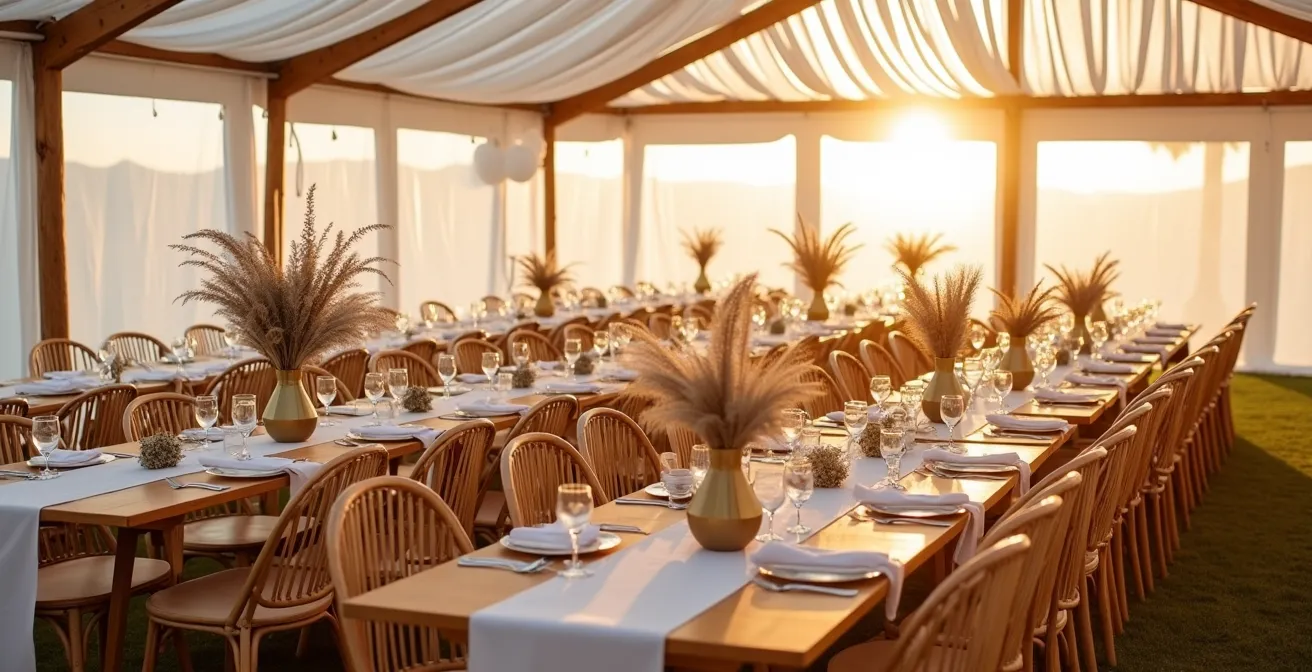
Achieving a successful Mod-Boho wedding isn’t about simply mixing two styles; it’s about creating an intentional aesthetic dialogue where modern structure elevates bohemian wildness.
- The foundation of a unique theme is translating your personal story into abstract concepts, not literal representations.
- Use proven design principles, like the 60-30-10 rule, to bring balance and sophistication to your color palette, decor, and even typography.
Recommendation: Instead of thinking in terms of “half modern, half boho,” focus on using clean, minimalist elements as a ‘frame’ to showcase and highlight rich, natural, and free-spirited textures.
You find yourself caught between two distinct worlds. On one hand, you’re drawn to the clean lines, sharp contrasts, and understated elegance of modern design. It feels sophisticated, intentional, and timeless. On the other, your heart beats for the warm, textured, and free-spirited nature of the bohemian aesthetic, with its earthy tones and connection to nature. The common advice is to simply “blend” them, but this often leads to a visual identity crisis—a space that feels neither here nor there, lacking a cohesive point of view. The result can feel cluttered or, worse, thematically confused.
The core challenge is that these two styles are, by nature, opposites. Modernism is about restraint, structure, and man-made precision. Bohemianism is about abundance, freedom, and organic imperfection. How do you forge harmony from opposition? The secret lies in moving beyond the idea of a simple mix. What if the key wasn’t to find a midpoint between them, but to use the strengths of one style to amplify the beauty of the other? This guide is built on that principle: creating a dynamic and sophisticated “aesthetic dialogue” between modernism and bohemia. We call this the art of “structured wildness.”
This article provides a strategic framework to master that dialogue. We will deconstruct the Mod-Boho look into its core components—from color theory and furniture choices to floral design and personal styling. You will learn the principles that allow you to create a wedding that is both beautifully curated and deeply personal, ensuring your celebration is a testament to your unique story, not a collection of conflicting trends.
This guide breaks down the fusion of modern and bohemian styles into actionable strategies. Explore the table of contents below to navigate the key elements of creating your perfect Mod-Boho aesthetic.
Summary: Mastering the Mod-Boho Wedding Aesthetic
- How to Use Earth Tones With Sharp Contrasts for a Mod-Boho Look?
- Ghost Chairs vs. Peacock Chairs: Mixing Eras Successfully
- Dried Palms in Geometric Vases: The Perfect Mod-Boho Centerpiece
- Serif vs. Sans-Serif: Which Font Bridges the Gap Between Styles?
- Sleek Slip Dresses With Wild Bouquets: Styling the Bride
- How to Translate Your Love Story Into a Bespoke Theme Without It Looking Kitsch?
- How to Achieve a Modern Aesthetic Without Your Wedding Feeling Cold?
- How to Design Boho Installations That Look High-End Instead of Messy?
How to Use Earth Tones With Sharp Contrasts for a Mod-Boho Look?
The color palette is the foundation of the Mod-Boho aesthetic, and it’s where the dialogue between styles begins. The key isn’t to just throw beige and black together; it’s to apply a structured rule to an organic palette. The most effective method is borrowing a classic from interior design: the 60-30-10 rule. This principle provides the ‘modern’ framework needed to control the ‘bohemian’ warmth. Interior design experts have long validated the 60-30-10 rule, allocating 60% for a dominant color, 30% for a secondary, and 10% for an accent, creating visual balance.
For a Mod-Boho theme, this translates into a specific formula. Your 60% dominant portion should be grounded in warm, earthy tones like terracotta, rust, ochre, or sand. These colors provide the soulful, welcoming base of the bohemian style. Next, your 30% secondary color introduces the modern contrast. This is where you’ll use stark, structural monochromes—think crisp white, deep black, or cool grey. These colors are used for foundational elements like tables, signage frames, or structural backdrops. Finally, the 10% accent is your personal signature. This could be a deep emerald green, a dusty rose, or a metallic brass, used sparingly in florals, napkins, or stationery details to create pops of focused interest.
This structured approach prevents the earthy palette from becoming muddy or monotonous. The sharp, modern contrast of the secondary color makes the warm tones feel more vibrant and intentional. It’s the difference between a random assortment of natural colors and a curated, sophisticated color story. The final layer is texture: pairing matte, natural surfaces (like linen tablecloths in your 60% color) with glossy, man-made ones (like black acrylic signage in your 30% color) enhances this dynamic contrast even further.
Action Plan: Applying the Mod-Boho 60-30-10 Color Balance
- Choose warm earth tones (terracotta, ochre, rust) as your 60% foundation for textiles, major florals, and bridesmaid dresses.
- Add 30% structural monochrome elements (black, white, or gray) for modern contrast in furniture, frames, and signage.
- Select a bold personal accent color for the remaining 10% to be used in details like napkins, candles, or a groom’s tie.
- Layer textures by pairing matte natural materials (wood, linen) with glossy or smooth man-made surfaces (acrylic, metal).
- Test the temperature balance of your palette, ensuring the abundance of warm tones effectively offsets any coldness from minimalist elements.
Ultimately, this rule gives you a clear path to follow, ensuring your colors work in harmony to tell a single, cohesive story of structured wildness.
Ghost Chairs vs. Peacock Chairs: Mixing Eras Successfully
Nowhere is the Mod-Boho dialogue more apparent than in furniture choices. The classic conundrum pits the iconic bohemian Peacock Chair against the sleek, minimalist Ghost Chair. The wrong approach is to mix them randomly, which creates visual noise. The right approach is to understand their roles in creating a visual hierarchy. One is a statement piece; the other is a supporting actor. Using them strategically defines spaces and directs attention, turning a simple seating arrangement into a powerful design statement.
The Peacock Chair, with its intricate rattan weave and dramatic silhouette, is a sculptural work of art. It is inherently bohemian, commanding attention and embodying craftsmanship and natural materials. Its role is not as general seating. Instead, it serves as a focal point—a throne for the head table, a stunning photo booth centerpiece, or a ceremonial anchor at the altar. It’s a ‘maximalist’ element that needs space to breathe. Surrounding it with other loud pieces diminishes its impact.
This is where the Ghost Chair comes in. Made from a single piece of transparent acrylic, it is the epitome of modern design—functional, unobtrusive, and almost invisible. Its purpose is to provide seating without adding visual clutter. When used for guest seating, these chairs allow the rest of your decor—the florals, the tablescapes, the venue itself—to take center stage. They are the ‘minimalist’ foundation that makes the bohemian statement pieces, like the Peacock chair, pop. The contrast between the ornate, textured Peacock chair and the clean, transparent Ghost chairs is the very essence of Mod-Boho.
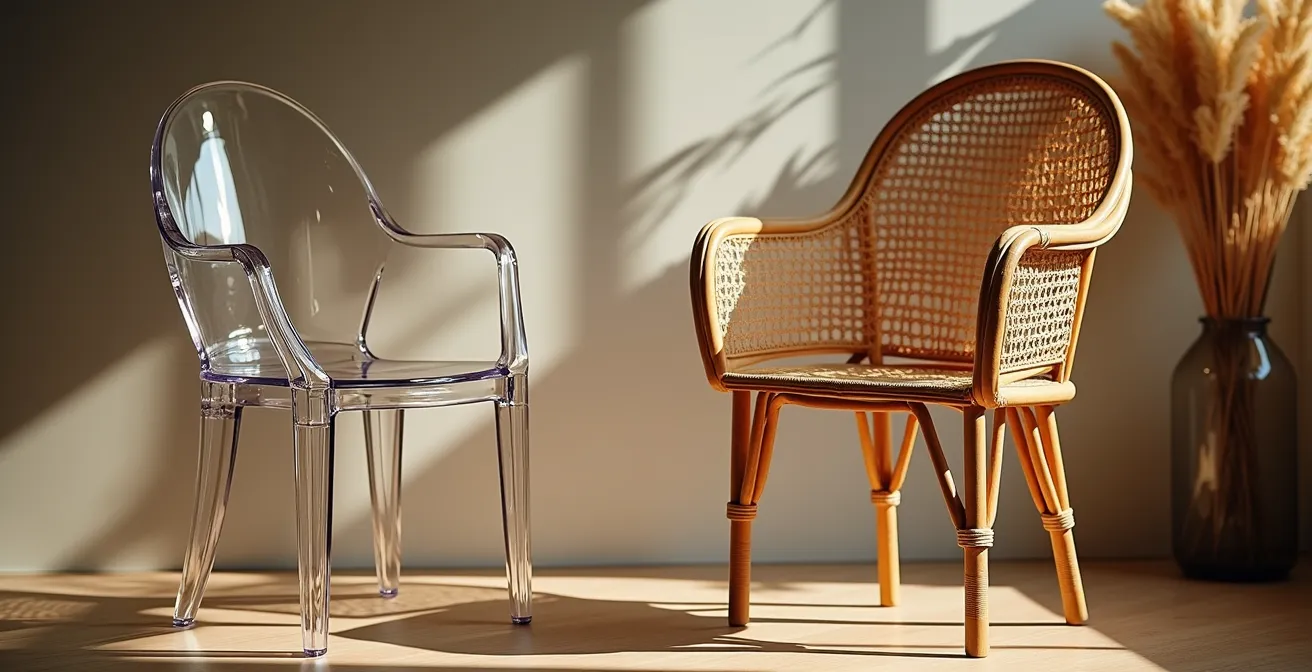
This table breaks down how to deploy these opposing styles for maximum impact, creating a sophisticated and intentional seating plan.
| Chair Style | Best Placement | Design Impact |
|---|---|---|
| Ghost/Lucite Chairs | Guest seating areas | Sleek, modern, blends into scenery |
| Peacock/Rattan Chairs | Head table, altar zone | Bold sculptural statement piece |
| Mixed Configuration | Throughout venue | Creates visual hierarchy |
By assigning clear roles, you create an aesthetic dialogue where the modern elements provide a clean canvas for the bohemian elements to shine as deliberate, artistic focal points.
Dried Palms in Geometric Vases: The Perfect Mod-Boho Centerpiece
The centerpiece is a microcosm of your entire wedding theme, and it’s the perfect place to execute the “structured wildness” principle on a smaller scale. The formula is simple yet effective: pair an organic, free-flowing botanical element with a vessel that has sharp, clean, geometric lines. This contrast between the natural and the man-made is what creates the signature Mod-Boho look, turning a simple table decoration into a miniature sculpture.
The “boho” element comes from the choice of florals. Forget tightly-packed rose balls. Think wild, textural, and often dried materials. Dried palm spears, pampas grass, lunaria, bunny tails, and wispy willow branches are perfect candidates. Their forms are irregular, their textures are rich, and their muted, earthy tones align perfectly with the Mod-Boho palette. They bring a sense of untamed, natural beauty to the table. This choice also aligns with modern values; as consumer preferences shift, The Knot’s forecasts show that over 60% of Gen Z couples prioritize sustainability, making dried and preserved florals a conscious and stylish choice.
The “modern” element is the vase. This is where structure comes in. Look for vessels made of concrete, matte ceramic, smoked glass, or metal. The key is their shape: sharp cylinders, angular triangles, perfect spheres, or cubist forms. A triangular concrete vase containing a single, dramatic dried palm leaf is a perfect example. The vase’s rigid, architectural form tames the wildness of the palm, while the palm’s organic shape softens the harshness of the vase. This creates a beautiful tension and balance. Consider these applications:
- Pampas grass arranged in matte ceramic cylinders for a soft texture contrast.
- Willow branches displayed in smoked glass vessels for ethereal height.
- Air plants positioned on brass geometric stands for a minimalist impact.
- Creating a runner from dozens of small, identical geometric vases, each holding a single stem, for a rhythmic, modern take on a classic garland.
By applying this formula, your centerpieces will look high-end, intentional, and perfectly aligned with your overarching vision of fusing nature with structure.
Serif vs. Sans-Serif: Which Font Bridges the Gap Between Styles?
The aesthetic dialogue of Mod-Boho extends to the smallest details, including the typography on your wedding stationery. Your choice of font is a powerful tool for setting the tone. Here again, the goal is not to find one font that does everything, but to create a harmonious system by assigning clear roles to different font styles. The tension between romantic, traditional serif fonts and clean, modern sans-serif fonts is a perfect opportunity to reinforce your theme.
Think of your stationery with the same 60-30-10 rule we applied to color. Your sans-serif font is your workhorse, your 60% foundation. Fonts like Helvetica, Futura, or Montserrat are clean, legible, and structured. They embody the modern aesthetic. This font should be used for the most practical information: the date, the venue address, the time, and any other logistical details. Its clarity and simplicity create a clean ‘frame’ for the more expressive elements.
Your serif or script font is the ‘soul’ of the invitation, your 30% secondary element. This is where the bohemian warmth comes in. A beautiful serif font (like Garamond) or a flowing, organic script font brings romance, personality, and a human touch. This font should be reserved for the most important, emotional parts of the text: your names and perhaps a key phrase like “join us to celebrate.” The contrast between the clean sans-serif and the expressive serif creates an immediate visual interest and typographic hierarchy.
This table illustrates how to build a typographic system that feels both modern and personal, applying the principles of fusion directly to your paper goods.
| Font Type | Best Use | Emotional Impact | Mod-Boho Application |
|---|---|---|---|
| Sans-Serif | Date, venue, practical info | Modern, clean, structured | Creates the ‘frame’ – 60% of text |
| Serif/Script | Names, emotional copy | Romantic, traditional, personal | Provides the ‘soul’ – 30% of text |
| Custom Monogram | Unifying seal element | Unique, memorable | Accent element – 10% usage |
Finally, your 10% accent can be a custom monogram that combines elements of both styles. This acts as a ‘seal’ that unifies the design. Even the paper choice contributes: a smooth, heavy card stock feels modern, while pairing it with a textured kraft envelope adds a touch of boho authenticity. This system ensures your stationery is not just informative, but a beautiful and cohesive part of your overall wedding design.
Sleek Slip Dresses With Wild Bouquets: Styling the Bride
The bride’s look is the ultimate expression of the wedding’s theme, the living embodiment of the Mod-Boho aesthetic. The same principle of “structured wildness” applies here, creating a breathtaking contrast between the clean lines of the dress and the untamed beauty of the accessories. It’s a look that feels effortlessly chic, deeply personal, and perfectly balanced.
The ‘modern’ foundation of this look is the dress. The ideal silhouette is a minimalist slip dress. Crafted from a fluid fabric like silk or crepe, it features clean lines, a simple cut, and a lack of ornamentation. There’s no lace, no beading, no voluminous tulle. Its beauty lies in its elegant simplicity and the way it drapes the body. This dress is the ultimate ‘modern’ canvas—a statement of restraint and sophistication.
The ‘bohemian’ soul is channeled through the bouquet and accessories. The bouquet should be the direct opposite of the dress: oversized, wild, and textural. It should feel as though it were just gathered from a field, featuring a cascade of diverse elements like dried palms, feathery pampas grass, eucalyptus, and a few choice blooms. Its shape should be asymmetric and organic, a beautiful chaos of textures and muted tones that contrasts dramatically with the sleekness of the dress. This single accessory provides all the bohemian spirit needed.
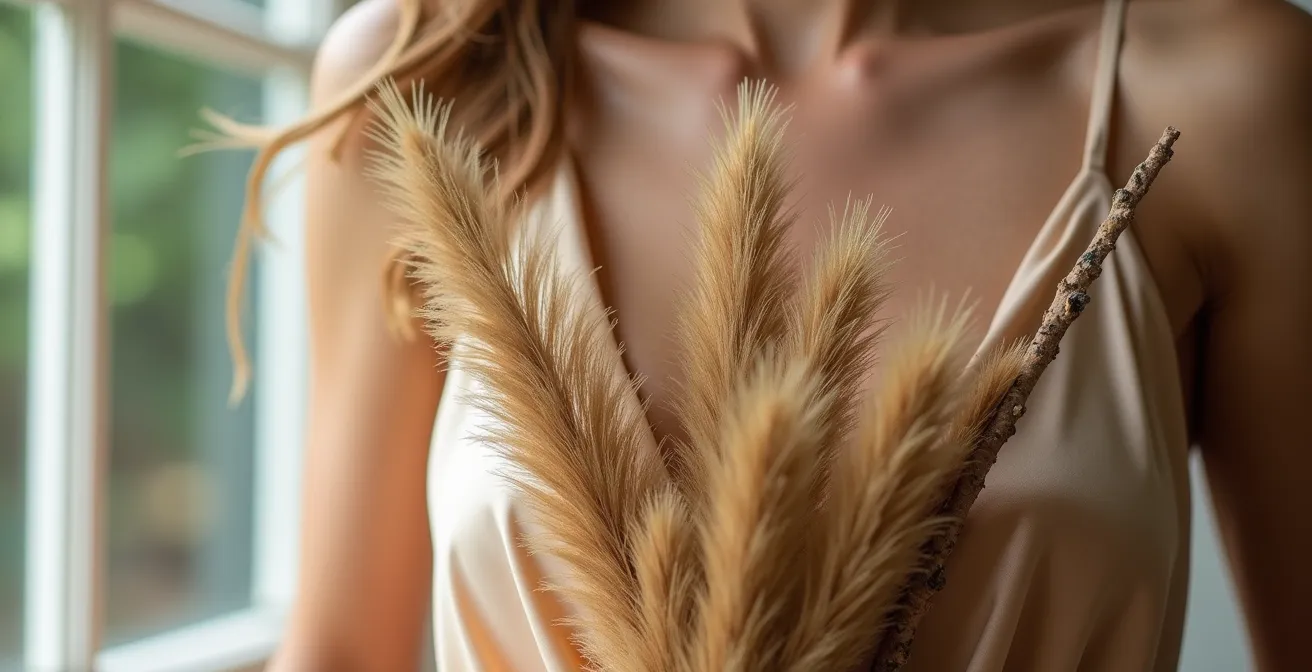
This styling philosophy can be extended to the entire wedding party for a cohesive, high-fashion look:
- Groom: A structured, well-tailored suit, but worn without a tie and paired with a boutonnière made of dried florals to echo the bride’s bouquet.
- Bridesmaids: Modern-cut dresses in identical silhouettes, but in a mismatched palette of complementary earthy tones (terracotta, sage, rust).
- Day-to-Night Transformation: The bride can add a fringed jacket, a wide-brimmed hat, or bold, artisanal jewelry for the reception to lean further into the bohemian vibe as the celebration unfolds.
This juxtaposition—the clean, structured dress and the wild, organic bouquet—is the heart of the Mod-Boho bridal look. It’s a powerful visual statement that is both timelessly elegant and fiercely individual.
How to Translate Your Love Story Into a Bespoke Theme Without It Looking Kitsch?
Before you choose a single color or chair, the most crucial step in designing a Mod-Boho wedding—or any truly personal wedding—is to define your “Aesthetic Mission Statement.” This is the foundational ‘why’ behind all your stylistic choices. A generic theme feels impersonal, but translating your story too literally can quickly become kitsch (e.g., a “travel theme” with globes on every table). The key is to mine your story for abstract concepts, emotions, and textures rather than literal objects.
Start by “story-mining.” Together, list ten key moments, places, or shared passions from your relationship. This could be anything from the city where you had your first date, a shared love for hiking in rugged landscapes, your favorite minimalist art museum, or the genre of music you both adore. Once you have this list, categorize each element. Does it feel more ‘Modern’ (urban, structured, minimalist) or ‘Boho’ (natural, wild, textured)? For example, a first date in a sleek downtown bar is ‘Modern,’ while a proposal during a mountain hike is ‘Boho’.
Now, the most important step: choose subtle representations, not literal translations. Instead of using Eiffel Tower figurines to represent a Paris trip, translate the feeling of Paris into your aesthetic: the moody grey-blue of the Seine in your color palette, the romantic feel of a script font, or the architectural lines of a modern venue. If you love hiking, don’t put hiking boots on the tables. Instead, incorporate textures like slate for place cards, use ferns in your floral arrangements, and name your tables after your favorite trails. This process of abstraction is what elevates a theme from cliché to sophisticated and deeply personal. As one wedding design expert puts it, your goal is a concise, guiding principle.
A celebration of urban structure and natural wilderness finding harmony
– Wedding Design Expert, Example Aesthetic Mission Statement
This mission statement becomes your filter. For every decor decision, ask: “Does this support our story of ‘urban structure and natural wilderness finding harmony’?” This ensures every element, from the biggest installation to the smallest detail, feels cohesive and authentically *you*.
How to Achieve a Modern Aesthetic Without Your Wedding Feeling Cold?
One of the biggest fears when leaning into a modern aesthetic is that the venue might feel cold, sterile, or unwelcoming. Clean lines and minimalist decor can sometimes lack the inherent warmth and intimacy desired for a wedding celebration. The solution lies in layering sensory experiences—focusing not just on what guests see, but also on what they feel and hear. This is where the bohemian sensibility comes to the rescue, injecting layers of warmth and comfort into the modern structure.
The first and most impactful layer is lighting. Harsh, bright, white light is the enemy of intimacy. Instead, opt for a warm-toned lighting scheme. Use amber-hued Edison bulbs strung overhead, group multiple pillar candles of varying heights on tables and ledges, and use warm LED uplighting to wash walls in a soft glow. This instantly changes the atmosphere of a space. In fact, color psychology research confirms that warm hues like orange and yellow can increase a room’s perceived intimacy by 40% by stimulating feelings of comfort and energy.
The second layer is texture. A space with only hard, smooth surfaces will always feel colder. Introduce soft, plush, and woven materials to counteract this. Lay down area rugs with bohemian patterns to define lounge areas. Add velvet cushions and woven throws to modern sofas and armchairs. Create intimate “rooms” within a large, open-plan venue by using draped fabric. Even providing baskets of soft blankets for guests to use as the evening cools down is a powerful hospitality gesture that adds a layer of physical and emotional warmth.
The final layer is sound. The acoustics of a space dramatically affect its feel. A curated playlist of acoustic, folk, or chill-wave music playing at an ambient level provides a warm sonic backdrop. Position speakers strategically for even coverage, avoiding loud hotspots and silent dead zones. These sensory layers work together to transform a potentially cold, modern space into an inviting, intimate, and comfortable environment where guests feel relaxed and welcome, perfectly blending modern cool with bohemian comfort.
By consciously adding these layers of light, texture, and sound, you ensure your modern aesthetic serves as a sophisticated canvas for a truly warm and memorable celebration.
Key Takeaways
- The essence of high-end boho is not abundance, but restraint and quality.
- A modern, geometric frame provides the necessary structure to prevent a boho installation from looking messy.
- Focusing on a single, large-scale statement piece creates a more sophisticated focal point than multiple small, cluttered elements.
How to Design Boho Installations That Look High-End Instead of Messy?
A major concern for couples drawn to the bohemian style is the fine line between “artfully undone” and simply “messy.” A free-spirited floral installation can quickly look like a DIY project gone wrong if it lacks structure and intention. The secret to achieving a high-end, luxe boho look lies in applying modern design principles—restraint, quality, and structure—to bohemian materials and forms. This is the ultimate execution of “structured wildness.”
First, exercise extreme restraint in your color palette. A messy look often results from using too many competing colors. A high-end installation will strictly limit itself to a palette of 3-4 complementary tones, often drawing from the earthy 60-30-10 rule. This color discipline creates an immediate sense of sophistication and cohesion. Second, prioritize quality over quantity in your materials. Instead of many small, cheap, or plastic-looking items, invest in a few large, impactful pieces made from authentic, high-quality materials. One large, handmade macrame hanging or a few dramatic, oversized dried palm leaves will have a far greater impact than dozens of smaller, disconnected elements.
The most critical element is adding a modern structural anchor. A free-floating, asymmetrical cloud of pampas grass can look messy on its own. However, if that same cloud is emerging from or contained within a sharp, geometric frame—like a copper hexagon or a black metal rectangle—it suddenly looks intentional and artistic. The modern frame acts as a visual anchor, providing the structure that contains and elevates the wildness of the boho elements. This frame defines the installation’s boundaries and gives the eye a clean line to follow, making the organic shapes within it feel deliberate and curated.
By focusing on a single, large-scale statement installation rather than cluttering a space with many small decor items, you create an intentional focal point. This approach transforms the bohemian aesthetic from potentially chaotic to undeniably chic, proving that structure is the key to unlocking true creative freedom.