
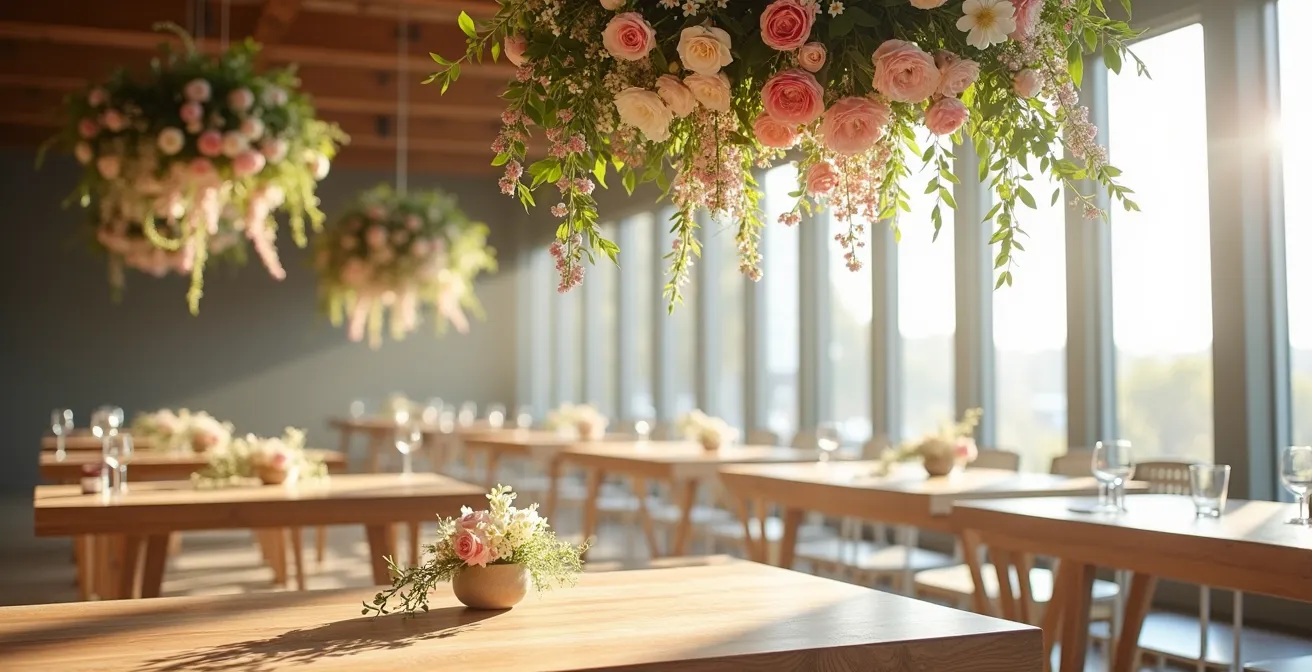
True floral luxury is achieved not through sheer expense, but through the artistic mastery of seasonality, structural form, and sensory experience.
- Seasonal integrity, like choosing garden roses over winter peonies, dramatically increases quality while strategically managing your investment.
- Structural artistry using sustainable, foam-free mechanics and modular design is the secret to creating and repurposing breathtaking, gravity-defying installations.
Recommendation: Shift your mindset from simply ‘buying flowers’ to ‘commissioning a botanical artist’ to create a living, ephemeral sculpture for your day.
For couples envisioning a wedding that transcends the conventional, flowers are not mere decorations; they are the primary medium for creating an immersive, artistic atmosphere. Yet, the path to achieving this is often clouded by persistent myths and generic advice. Many couples with significant budgets fear a common outcome: an expensive display that feels impersonal and disconnected, a sea of peonies and hydrangeas that could belong to any wedding, anywhere.
The standard approach often revolves around matching a Pinterest board or adhering rigidly to a color palette. But what if the secret to unforgettable floral design lies not in imitation, but in interpretation? What if the most profound impact comes from embracing the constraints of nature, rather than fighting against them? This is the core philosophy of the floral artist: to transform your celebration into a gallery of ephemeral sculptures, each telling a piece of your story through the language of botany.
This guide moves beyond the surface-level discussion of flower types. We will delve into the technical and artistic strategies that master florists employ to create powerful botanical narratives. We’ll explore the economic wisdom of seasonal integrity, the hidden engineering behind gravity-defying installations, and the nuanced art of sensory design. It’s time to understand how your floral investment can become the most memorable and meaningful art of your wedding day.
This article explores the fundamental principles that elevate wedding florals from simple arrangements to masterful installations. From budget intelligence to guest experience, each section reveals an essential aspect of commissioning true floral art.
Summary: A Guide to Commissioning True Floral Artistry
- Why Importing Peonies in Winter Doubles Your Floral Budget?
- How Florists Create Gravity-Defying Shapes Without Visible Foam?
- Massed Monofloral Designs or Garden Style: Which Looks More Luxurious?
- The Scent Mistake That Interfers With Your Dinner Service Experience
- How to Move Ceremony Installs to the Reception Without Damaging Them?
- Why Low Floral Centerpieces Are the Key to Better Guest Conversation?
- Is a Full-Service Planner Worth the Investment for Weddings Under 150 Guests?
- Why Garden Roses Are the Superior Alternative to Peonies for Romance?
Why Importing Peonies in Winter Doubles Your Floral Budget?
The allure of the peony is undeniable. Its lush, romantic bloom has made it an icon of wedding luxury. However, a master florist’s first duty is to honor the truth of the seasons, and this is where botanical knowledge becomes a crucial financial tool. Peonies have a fleeting, magnificent season in late spring. To demand them in October is to work against nature, a decision with significant consequences. The logistics of flying these delicate flowers from the opposite hemisphere where they are in season means you are paying for airfreight, climate control, and a high-risk supply chain. In fact, luxury flower specialists confirm that importing peonies out of season can increase costs by up to 200% compared to magnificent in-season alternatives.
This isn’t a compromise; it’s a strategic upgrade. Embracing seasonal integrity means your flowers are at their absolute peak of vitality, size, and fragrance. They haven’t been stressed by long-haul travel. Instead of a costly and often disappointing imported peony, an artist-florist will guide you toward breathtaking alternatives. Consider the delicate, paper-thin petals of Japanese ranunculus, which offer a similar visual density, or the robust, rounded buds of Piano roses that mimic a fresh peony’s form with far greater availability. The principle is simple: true luxury is found in the perfection of what is naturally abundant, not in the forced presence of what is not.
How Florists Create Gravity-Defying Shapes Without Visible Foam?
The most awe-inspiring floral installations—meadows growing up walls, clouds of baby’s breath floating overhead, arches that seem to have sprouted organically from the ground—share a common secret: sophisticated, hidden mechanics. For decades, green floral foam was the industry standard, but it is a non-biodegradable, microplastic-shedding material that top-tier designers are now passionately moving away from. The modern luxury florist is as much an engineer as an artist, employing techniques of ephemeral engineering to create stunning, sustainable structures.
This paragraph introduces the complex mechanics of modern floral design. To better understand this, the image below reveals the underlying structure that makes these creations possible.
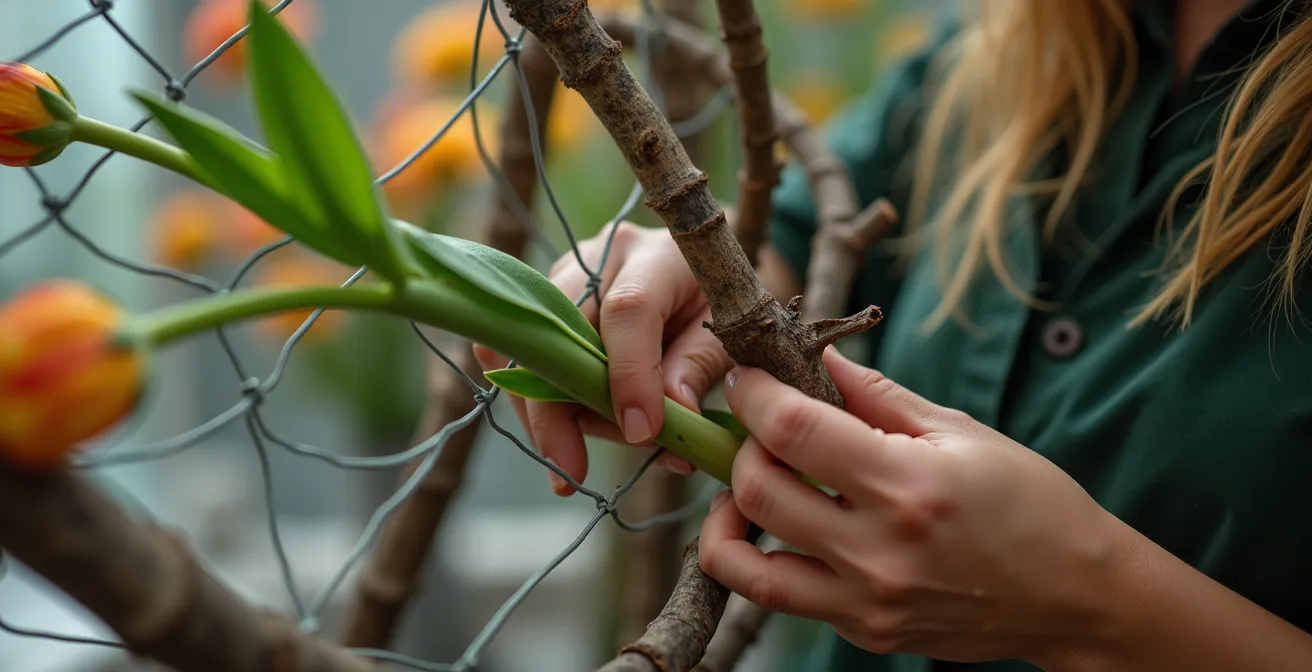
As the illustration shows, the core of these designs is often a carefully constructed armature of chicken wire, branches, or reusable metal grids. Florists meticulously weave stems through this framework, creating a secure and natural-looking base. For hydration, individual water tubes are attached to thirstier stems, or the entire structure is built around a base of saturated moss. This foam-free approach not only is environmentally responsible but also allows for more organic, “breathing” shapes. The mechanics become part of the art, providing a structural skeleton that gives life to seemingly impossible designs, all while remaining completely invisible to the guest’s eye.
Massed Monofloral Designs or Garden Style: Which Looks More Luxurious?
The question of “luxury” in floral design often presents a stylistic choice between two dominant aesthetics: the massed monofloral design and the textured garden style. A monofloral approach, using a single type of flower in a dense, uniform arrangement, creates a bold, graphic, and architectural statement. Think of a solid wall of roses or a sphere of tightly packed carnations. This style communicates confidence and modernism, but its luxury can feel stark and is often dependent on the sheer volume and cost of the chosen bloom.
In contrast, the garden style is a celebration of diversity and texture. It is a curated, narrative approach that mimics how plants grow together in nature. This requires a much deeper level of artistry and botanical knowledge. As floral designer Maria Voudouri notes, “True ‘Garden Style’ is the ultimate expression of seasonality. It requires a deep knowledge of what grows together and looks natural.” It is about creating a botanical narrative, where the interplay of different shapes, sizes, and textures tells a richer, more complex story. The following table breaks down the core differences in impact and investment.
This comparative table, sourced from industry analysis of floral design costs, clarifies how style impacts both budget and visual effect.
| Design Style | Average Cost | Visual Impact | Seasonal Flexibility |
|---|---|---|---|
| Massed Monofloral | $250-$500 per arrangement | Bold, graphic, architectural | Often requires imports |
| Garden Style | $150-$350 per arrangement | Rich, textured, narrative | Excellent with local flowers |
| Botanical Minimalism | $100-$300 per piece | Sculptural, artistic perfection | Best with seasonal specimens |
While a massed design can be impactful, its reliance on a single element can feel one-dimensional. The true luxury of the garden style lies in its intellectual and artistic depth. It suggests a thoughtful, bespoke process and a connection to the environment, often achieving a more opulent and personal feel with a more strategic investment.
The Scent Mistake That Interfers With Your Dinner Service Experience
A truly masterful floral design engages all the senses, but none more delicately than the sense of smell. Fragrance is inextricably linked to memory, and the scent of your wedding will linger in your guests’ minds long after the day is over. However, this powerful tool is often wielded without precision, leading to a critical mistake: olfactory overload during the dining experience. Placing highly fragrant flowers like lilies, tuberose, or even some garden roses on guest tables can actively compete with the carefully crafted flavors of your menu. The palate and the olfactory system are deeply connected; a strong floral scent can alter the taste of food and wine, diminishing the culinary experience you’ve invested in.
The solution is a strategy of sensory scaping. This involves mapping the entire venue and assigning different scent profiles to different zones and moments. The goal is to create a journey, not a single, overpowering note. Given that research shows couples allocate an average of 21-22 floral arrangements for their reception, a strategic approach is essential. The ceremony might feature light, uplifting scents to evoke emotion. Cocktail hour can introduce something more complex. But at the dinner table, restraint is the ultimate form of sophistication. Here, we rely on visually beautiful but unscented or lightly scented blooms like dahlias, zinnias, anemones, and lush foliage to provide beauty without interference.
Your Action Plan: Strategic Scent-Scaping
- Map Ceremony Fragrance: Plan for light, uplifting scents like mint, chamomile, or lightly scented roses in processional and altar arrangements.
- Eliminate Dining Table Scents: Explicitly request unscented or low-scent flowers and foliage for all guest table centerpieces. Dahlias, zinnias, and ranunculus are excellent choices.
- Design Reception “Scent Zones”: Concentrate warmer, romantic notes from tuberose or gardenia in specific lounge areas, bars, or entryways, away from food service.
- Consider Heat Amplification: Account for how candlelight and body heat will intensify fragrances. A lightly scented flower can become overpowering in a warm, crowded room.
By curating the olfactory experience with this level of detail, you ensure that the flowers enhance, rather than detract from, every other element of the celebration.
How to Move Ceremony Installs to the Reception Without Damaging Them?
One of the smartest ways to maximize a significant floral budget is to repurpose large-scale ceremony installations for the reception. That magnificent arch you say your vows under can become a dramatic backdrop for the head table or a grand entrance to the dance floor. However, this is not a simple matter of “moving flowers.” It is a logistical feat that must be planned from the very first design sketch. An experienced floral artist approaches this challenge with a modular design philosophy.
The secret is to construct the large installation not as one monolithic piece, but as a series of interlocking, transportable sections. Each module is designed to be self-contained and structurally sound, yet able to connect seamlessly with the others. This requires immense foresight, from building sturdy but lightweight frames to ensuring the floral design conceals the seams. The image below provides a glimpse into this deconstructed approach, showing how a large piece is engineered for mobility.
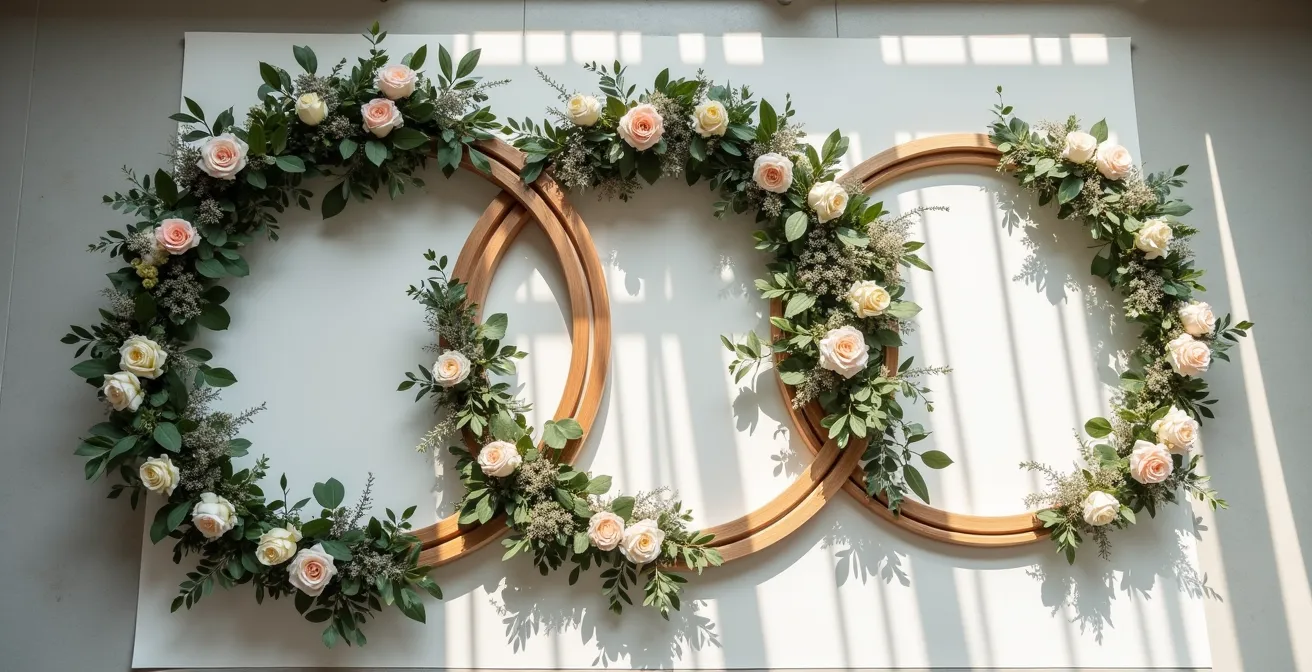
This process also involves careful flower selection. For instance, while beautiful, some blooms are too delicate for extensive handling. Professional florists know to keep fragile flowers like David Austin roses fully hydrated in cool water and often prepare all other, more robust flowers first to maximize the hydration time of the delicate varieties. The breakdown, transport, and reassembly are a choreographed performance that happens during the cocktail hour, completely unseen by guests. This ensures your investment works twice as hard, creating two distinct, breathtaking moments from a single, masterfully engineered creation.
Why Low Floral Centerpieces Are the Key to Better Guest Conversation?
While towering, dramatic centerpieces can create an initial “wow” factor, they often fail in their most fundamental role: facilitating a warm, engaging atmosphere for your guests. The primary purpose of a reception is to celebrate with loved ones, and that celebration is fueled by conversation. A tall, dense arrangement acts as a physical barrier, forcing guests to peer around a wall of flowers to speak with the person across from them. This subtle but constant obstruction stifles the natural flow of dialogue and can leave a table feeling disconnected.
The more sophisticated approach is to design the tablescape as a landscape. Low, lush centerpieces create a sense of intimacy and invite connection. They allow for clear sightlines across the table, encouraging easy, flowing conversation and a shared experience. This doesn’t mean sacrificing impact. A low design can be incredibly rich and detailed, a miniature garden for guests to explore visually throughout the meal. This strategy is also budget-intelligent; according to wedding florist cost data, low centerpieces typically cost $100-$300, while tall arrangements can easily climb to $250-$500 per table. That saved investment can be reallocated to a more impactful statement piece elsewhere, such as a hanging installation or a lavish bar design.
By prioritizing guest interaction, you are investing in the overall feeling and memory of the event. A beautiful table is lovely, but a table filled with laughter and animated conversation is unforgettable. The choice for low centerpieces is a choice for connection over obstruction, proving that true luxury lies in thoughtful hospitality.
Is a Full-Service Planner Worth the Investment for Weddings Under 150 Guests?
It’s a common misconception that a full-service wedding planner is a luxury reserved only for massive, 300+ guest events. For a couple commissioning art-gallery level florals, however, a planner is not a luxury; they are an essential conductor for your creative orchestra, regardless of guest count. The floral designer is the master of their medium, but the planner is the master of the entire production. They are the crucial link ensuring the floral vision is logistically sound, financially viable, and harmoniously integrated with every other vendor, from lighting to catering.
Florals represent a major investment; industry data confirms that wedding flowers typically account for 10% of the overall budget, a figure that can be significantly higher for art-focused weddings. A planner protects this investment. They vet the florist’s technical capabilities, ensuring they can actually execute the complex, foam-free installation you’ve dreamed of. They manage the master timeline, ensuring the venue is ready for the floral team’s extensive setup and breakdown. As one expert from The Knot’s Wedding Planning Guide states, “A planner ensures the budget is allocated effectively to maximize impact, vets the florist’s technical ability to execute the vision, and solves inevitable on-site problems.” They are your on-site problem solver, handling the inevitable challenges that arise so your floral artist can remain focused on their craft.
For a wedding under 150 guests, the planner’s role becomes even more focused on maximizing the impact per guest. They help you decide where to concentrate the budget for the greatest effect, ensuring that your investment in botanical art is seen, experienced, and remembered by everyone present.
Key Takeaways
- Embrace Seasonality: Choosing flowers at their natural peak provides superior quality and is the most intelligent use of your budget.
- Prioritize Engineering: The most breathtaking installations are built on a foundation of sophisticated, often sustainable, hidden mechanics.
- Design for Connection: Centerpiece height and table scent are critical elements of hospitality that directly impact your guests’ experience and conversation.
Why Garden Roses Are the Superior Alternative to Peonies for Romance?
While peonies have a firm grip on the title of “most romantic flower,” the discerning floral connoisseur knows that the garden rose offers a far greater spectrum of romance, fragrance, and versatility. To suggest a garden rose is not to offer a “second-best” option; it is to introduce a world of superior artistic possibility. The peony’s season is a brilliant but painfully brief 2-3 week flash. In contrast, garden roses, particularly the famed English varieties from breeders like David Austin, offer their beauty from late spring all the way through fall, providing immense flexibility.
This extended availability is just the beginning. The romanticism of the garden rose lies in its diversity. While peonies generally offer one primary “bomb” shape and a singular sweet scent, garden roses present a library of forms and fragrances. You can find ruffled cups, deeply quartered rosettes, and delicate single-petal varieties. Their scents range from classic tea rose to fruity citrus and complex myrrh. This allows a floral artist to create a much more nuanced botanical narrative. As experts highlight, roses like the ‘Juliet’ perfectly combine the cupped rosette form of old roses with modern color, while the ‘Constance’ offers layers of ballet pink in a billowy ballgown shape, providing a visual texture peonies cannot match.
The following table, with data sourced from master breeders like David Austin Roses, clearly outlines the advantages.
| Feature | Peonies | Garden Roses (David Austin) |
|---|---|---|
| Season | 2-3 weeks in May-June | Late spring through fall |
| Fragrance Variety | Single sweet scent | Multiple profiles: myrrh, citrus, tea |
| Bloom Forms | Round ‘bomb’ shape | Ruffled cups, quartered rosettes, singles |
| Cost (in season) | $10-25 per stem | $8-15 per stem |
Ultimately, the garden rose is the artist’s flower. It provides a richer palette of color, form, and fragrance, allowing for a deeply personal and sophisticated expression of romance that lasts all season long.
Your wedding deserves more than just decoration; it deserves art. The next step is to find a floral designer who speaks the language of botany and sculpture, and to begin the conversation about creating your unique botanical narrative.