
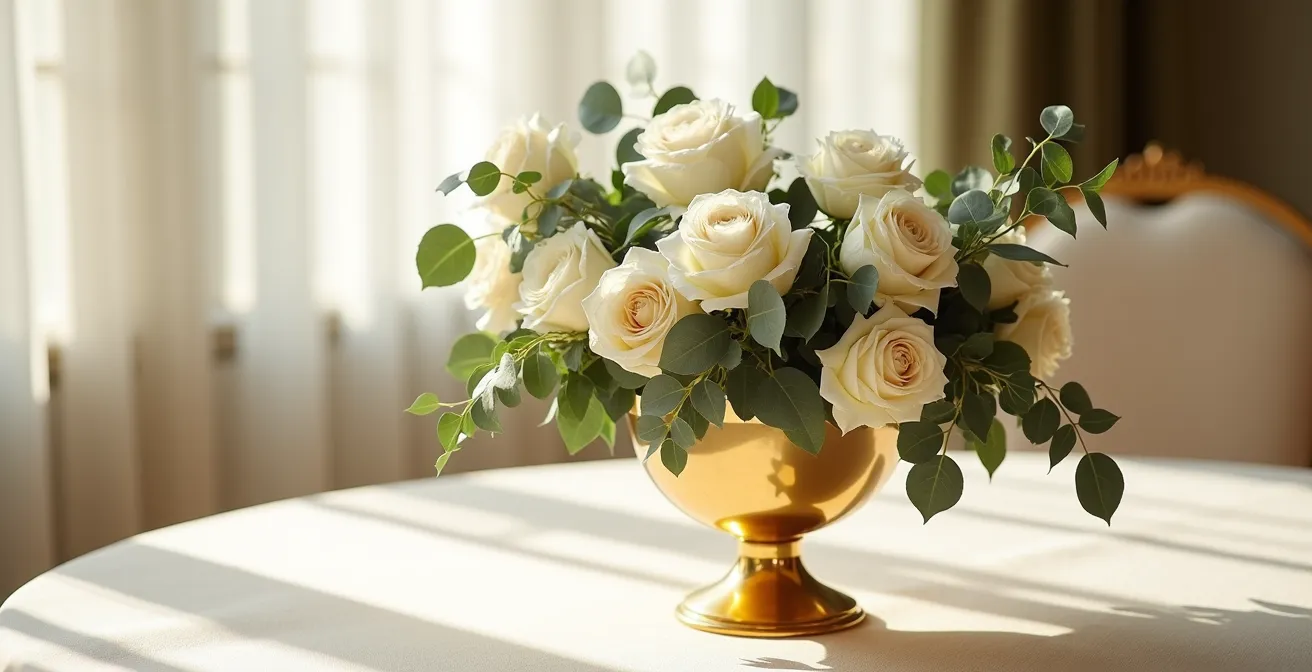
To achieve a truly timeless, luxurious tablescape, one must treat the gold compote not merely as a vase, but as a foundational artifact. Success lies not in simply filling it with flowers, but in mastering its structural mechanics, understanding the material dialogue between its metallic finish and other table elements, and leveraging its form to create compositions of elegant, balanced asymmetry reminiscent of a Dutch still life painting.
The pursuit of a classic, elevated wedding aesthetic often leads couples down a familiar path of Pinterest boards filled with lush florals. The gold compote vessel, with its elegant foot and wide mouth, has become a ubiquitous symbol of this style. Yet, many attempts fall short of the desired effect, appearing merely decorative rather than truly curated. The common advice focuses on what to put in the vessel, treating it as a simple container.
But what if the secret to that coveted, painterly quality—the very soul of a Dutch still life—lies not in the flowers themselves, but in a deeper understanding of the vessel as a historical and compositional anchor? This is where the perspective of a curator becomes essential. It requires moving beyond fleeting trends to appreciate the interplay of form, finish, and structure. The key is not simply to decorate a table, but to compose it.
This guide will deconstruct the art of styling gold compotes from a curator’s viewpoint. We will explore the foundational mechanics that give arrangements life, the subtle language of metallic finishes, the principles of visual balance, and the practical logistics of sourcing these key artifacts. By the end, you will understand how to orchestrate a tablescape that feels less like a temporary setup and more like a timeless, intentional collection.
For those who prefer a visual demonstration of creating beautiful centerpieces, the following video offers a wealth of inspiration and practical tips that complement the principles discussed in this guide.
To help you navigate the intricate details of curating your tablescape, this article is structured to build your expertise from the foundational techniques to the final, cohesive vision. Explore the sections below to master each element of styling gold compote vessels.
Summary: A Curator’s Guide to Gold Compote Vessels
- Chicken Wire or Tape: How to Arrange in Wide-Mouth Compotes?
- Brushed vs. Shiny Gold: Which Complements Your Flatware Best?
- Why Asymmetric Arrangements Look Better in Footed Compotes?
- Buy or Rent: Is It Cheaper to Source Your Own Gold Vessels?
- How to Pair Compotes With Bud Vases to Fill a Long Table?
- The Durability Truth About Matte Black Flatware Renters Won’t Tell You
- How to Use Gold Foil Stamping Without Affecting Invitation Readability?
- Why Low Floral Centerpieces Are the Key to Better Guest Conversation?
Chicken Wire or Tape: How to Arrange in Wide-Mouth Compotes?
The elegant, open form of a compote bowl is its greatest strength and its primary technical challenge. Unlike a tall, narrow vase that naturally supports stems, a wide-mouth vessel requires an internal scaffold—the structural mechanics—to achieve a lush, artful arrangement. Without it, stems will splay and the desired shape will collapse. The choice of mechanic depends entirely on the intended artistic style. While floral foam is a common option, professionals often turn to more sustainable and flexible methods like chicken wire or tape grids for greater control and a more organic feel.
As floral designer Amy from Flower Moxie has demonstrated, an 8×8 inch square of chicken wire, when folded into a soft “pillow” and secured in the compote, provides a multidimensional matrix for stems. This technique is ideal for wild, garden-style designs with cascading elements, as it allows for stems to be inserted at various angles and depths. It also offers the significant practical advantage of making water refills easy, a task that can be obstructed by a full tape grid. For more structured, dome-shaped arrangements where precise stem placement is paramount, a grid made from clear floral tape across the vessel’s opening provides a more rigid guide.
Your Action Plan: Selecting the Right Eco-Friendly Mechanic
- For wild, garden-style arrangements needing multi-angle support, use chicken wire folded into a pillow shape and secured with waterproof tape. This allows for natural movement and easy watering.
- For structured dome shapes with precise stem placement, create a tape grid across the compote opening using clear floral tape. This offers a rigid framework for classic forms.
- For minimalist Ikebana-inspired designs, place a kenzan (a reusable metal flower frog) in the bottom of the vessel for a sustainable, foam-free mechanic that holds a few key stems securely.
Brushed vs. Shiny Gold: Which Complements Your Flatware Best?
The term “gold” is deceptively simple. From a curatorial perspective, the finish of the metal is as important as its color. The choice between a shiny, brushed, or antique gold compote is not merely aesthetic; it is a decision about how the vessel will engage in a material dialogue with its surroundings, particularly the lighting and the flatware. Each finish possesses a distinct character and interacts with light in a fundamentally different way. A shiny, polished gold vessel will create sharp, dramatic specular highlights, making it a powerful statement piece under evening candlelight. In contrast, a brushed or matte gold finish diffuses light, casting a soft, romantic glow that is exceptionally beautiful in bright daylight or photographs.
This interplay of texture and light is central to creating a cohesive tablescape. The key is to think in terms of harmony or sophisticated contrast. Pairing a brushed gold compote with the soft texture of linen tablecloths and stoneware plates creates a unified, organic feel. Conversely, placing a shiny gold compote on a lacquered surface next to sleek, modern flatware amplifies a sense of high drama and glamour.
As the design team at J. Morris Flowers notes, gold compotes are available in a spectrum of styles, from sleek modern to romantic and classical. This allows for precise pairing. For a truly curated look, an antique gold finish with its inherent patina can be the perfect bridge, complementing both modern and vintage flatware by carrying a sense of history and provenance within its surface.
| Gold Finish | Best Lighting | Texture Pairing | Visual Effect |
|---|---|---|---|
| Shiny Gold | Evening candlelight | Satin, acrylic, lacquered surfaces | Dramatic specular highlights |
| Brushed Gold | Bright daylight | Linen, raw silk, stoneware | Soft, diffused romantic glow |
| Antique Gold | Mixed lighting | Vintage flatware, heirloom pieces | Built-in patina bridges both styles |
Why Asymmetric Arrangements Look Better in Footed Compotes?
The pedestal or foot of a compote does more than simply elevate the flowers; it creates a visual fulcrum, a pivot point that invites more dynamic and sophisticated compositions. While a simple, mounded arrangement can be lovely, the true artistic potential of a footed vessel is unlocked with asymmetry. An asymmetrical design, with its characteristic S-curve or L-shape, leverages the compote’s form to create a sense of movement and effortless grace that feels alive and natural, echoing the imperfect beauty of a Dutch still life painting.
The principle at play is visual weight. Instead of a static, centered mass of flowers, an asymmetrical arrangement balances a denser cluster of larger blooms (like peonies and garden roses) on one side with lighter, more delicate elements (like trailing jasmine or eucalyptus) extending in the opposite direction. The foot of the compote acts as the anchor point for this visual balancing act, allowing the arrangement to feel both expansive and securely grounded. This is why, as J. Morris Flowers’ design team observes, compotes are perfect for achieving “looser and cascading” looks with more space and air between the flowers.
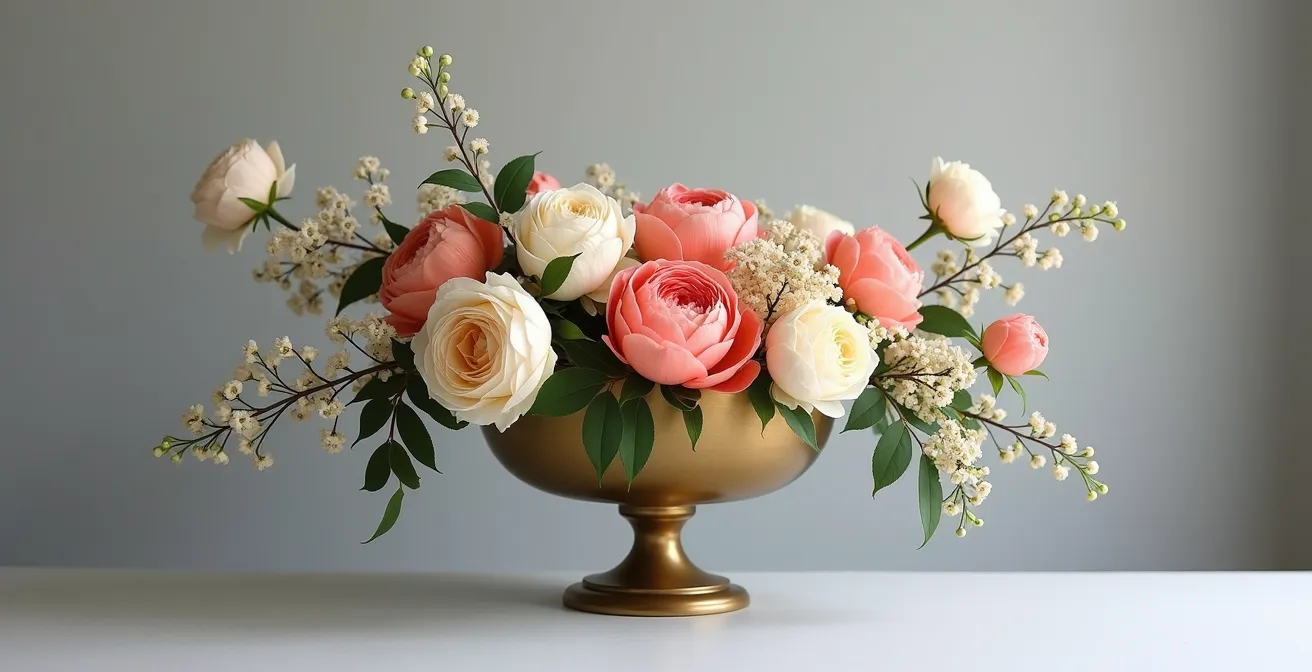
This style creates a dynamic energy on the table. The negative space within the arrangement becomes as important as the flowers themselves, inviting the eye to move through the composition. The result is an arrangement that feels less like a decoration and more like a small sculpture, a piece of living art that interacts with the space around it.
Buy or Rent: Is It Cheaper to Source Your Own Gold Vessels?
Once the artistic vision is clear, the practical question of acquisition arises. The decision to buy or rent your gold compotes is a complex equation that extends beyond the simple sticker price. While renting appears to be the most straightforward path, purchasing can, in certain scenarios, be a surprisingly cost-effective and even profitable endeavor. The key is to conduct a thorough cost-benefit analysis that accounts for the hidden costs and potential returns of each option.
Case Study: A Bride’s Cost-Benefit Analysis
A real-world example illustrates this point perfectly. A bride planning her wedding found that the florist’s rental price for gold vases was nearly double what she could purchase them for by strategically shopping Hobby Lobby’s 50% off sales. By choosing to buy, she not only controlled the exact style of her vessels but also created an asset. After the wedding, she successfully resold the vases on Facebook Marketplace, taking advantage of her location in a popular tourist wedding town. This allowed her to recover 60% of her initial investment, making the final cost of using her dream vases significantly lower than the original rental quote.
This case highlights the importance of looking at the total picture. Rental agreements often come with non-refundable damage waivers (10-15% of the rental cost), steep delivery fees, and strict cleaning policies with financial penalties. Purchasing, on the other hand, involves the upfront cost plus the “hidden” costs of your own time and effort in storing, packaging, and managing the resale process. A simple formula to consider is the break-even point: if the cost to rent the item for a single event is more than one-third of the purchase price, buying becomes a financially viable alternative, especially if there’s a strong local resale market.
How to Pair Compotes With Bud Vases to Fill a Long Table?
For long banquet or feasting tables, a single centerpiece, no matter how beautiful, can feel isolated. The goal of a curator is to create a cohesive visual experience that flows down the entire length of the table. This is achieved by transforming the centerpiece into a “tablescape,” a thoughtfully composed collection of elements. The most effective method is to pair the larger, statement gold compotes with clusters of smaller vessels, such as bud vases, to create rhythm and interest.
The strategy is to create a visual runner of florals and candlelight that ebbs and flows in height and density. Place the gold compotes at key intervals down the table—perhaps one in the center and two others a third of the way from each end. These serve as the major “beats” of your composition. Then, in the spaces between them, arrange small groupings of bud vases. Vary the height, shape, and material of these smaller vases; mix clear glass with metallic or ceramic finishes to add textural depth. Each bud vase should hold just a single, perfect stem or a small sprig of foliage, echoing the flowers used in the main compote arrangements.
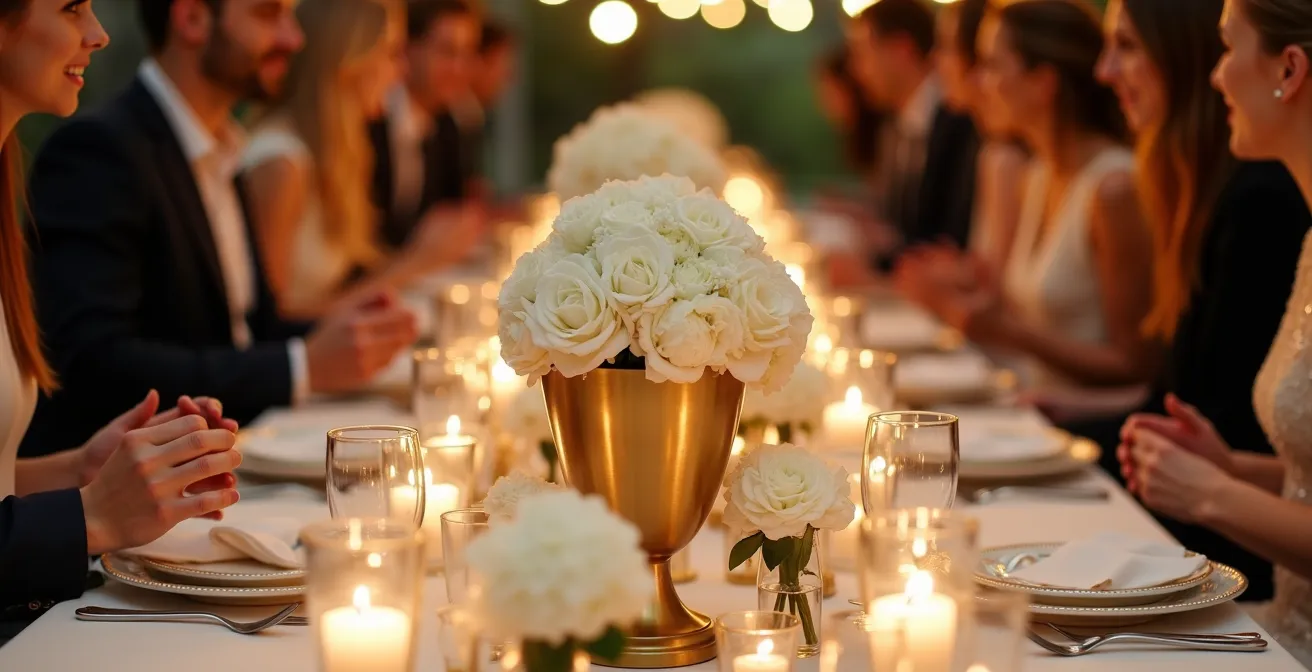
This approach has multiple benefits. It distributes color and life along the entire table, ensuring every guest has a beautiful view. The varied heights create a dynamic skyline, far more interesting than a monotonous line of identical arrangements. Finally, it allows you to stretch your floral budget. The compotes provide the “wow” factor, while the more affordable single stems in bud vases fill out the tablescape, creating a look that is both abundant and intelligently designed.
The Durability Truth About Matte Black Flatware Renters Won’t Tell You
The sophisticated contrast of gold and black is a powerful design choice, lending a modern edge to a classic tablescape. Pairing a gold compote with matte black flatware can be stunning, but this is where a curator’s knowledge of materials becomes critical. Not all finishes are created equal, and the durability of specialty flatware is a crucial consideration, especially when renting. The truth is that matte black flatware, typically created with a PVD (Physical Vapor Deposition) coating, is notoriously susceptible to scratching and scuffing from normal use and improper washing.
This is where the material dialogue between the compote and the cutlery becomes a practical matter. Event designers have found that a brushed or antique gold compote complements the texture of matte black flatware far better than a shiny, polished gold finish. The soft, diffused light of a brushed surface is more forgiving and helps to conceal any minor imperfections or scratches on the PVD coating. In contrast, the mirror-like surface of shiny gold can reflect and highlight every single scuff on the adjacent flatware, undermining the desired luxury effect. Furthermore, cast aluminum gold compotes tend to be more resistant to fingerprints than their shiny brass counterparts, making them a more durable choice for a high-touch event environment.
This consideration extends to cost. While standard flatware rentals are quite affordable, wedding industry pricing data reveals that specialty finishes come at a premium. Renting standard stainless steel might cost 35-45 cents per piece, whereas you can expect to pay upwards of 75 cents per piece for specialty finishes like matte black or gold. Given the higher cost and susceptibility to damage fees, choosing a complementary compote finish that minimizes the appearance of wear is both an aesthetic and a financial strategy.
How to Use Gold Foil Stamping Without Affecting Invitation Readability?
A truly curated event tells a consistent story from the first impression to the last. The “golden thread” of your design should begin long before guests arrive at the table—it should start with the invitation. Using gold foil stamping on your paper suite is a beautiful way to foreshadow the metallic elegance of the reception decor. However, the execution must be handled with restraint and precision to ensure that beauty does not come at the expense of readability.
The primary rule is to use gold foil as an accent, not a primary text element. Large blocks of text set in reflective foil are notoriously difficult to read, especially for older guests or in low lighting. The foil should be reserved for key design elements: a delicate monogram, a thin border, the couple’s names, or the header of the invitation. The crucial details—time, date, location—should always be printed in a high-contrast, legible ink like black, charcoal, or deep navy.
The second principle is material consistency. Just as you consider the finish of your compotes, you must consider the finish of your foil. A shiny, bright gold foil on the invitation creates an expectation that should be met with shiny gold elements on the table. If you’ve chosen a softer, brushed gold compote, opt for a matte or champagne gold foil for a more cohesive narrative. This “golden thread” technique should carry through to all day-of paper goods, such as menus, place cards, and table numbers that will be placed near the compotes. This creates a deeply satisfying sense of harmony and intentionality, where every element feels like it belongs to the same thoughtful collection.
Key Takeaways
- Treat the gold compote as a foundational artifact, not just a vase, focusing on its form and finish.
- Master internal structural mechanics like chicken wire or tape grids to achieve artful, stable arrangements in wide-mouth vessels.
- Create a “material dialogue” by thoughtfully pairing the compote’s gold finish (shiny, brushed, or antique) with the lighting, linens, and flatware.
Why Low Floral Centerpieces Are the Key to Better Guest Conversation?
In all the discussion of aesthetics, mechanics, and materials, it is easy to forget the ultimate purpose of a wedding reception table: to foster human connection. The most beautifully designed tablescape fails if it creates a barrier between guests. This is precisely why the low, spreading profile of a compote arrangement is not just an aesthetic choice, but a deeply functional one. It is the key to designing for conversation by preserving the most important element of the table: the sightline architecture.
Tall, towering centerpieces, while dramatic, act as floral walls, forcing guests to peer around them to speak with the person across the table. This subtle friction can stifle the natural flow of conversation and create a sense of isolation. A compote arrangement, by its very nature, keeps the bulk of the floral design below eye level when guests are seated. As event designer Kate Knowles discovered while planning a lunch, pedestal bowls are ideal because “you still get a little height but they are low enough that you can talk to guests across the table.” This intentional design allows for easy, uninterrupted eye contact, encouraging the laughter and shared stories that are the true heart of the celebration.
A compote bowl is easy to work with and ideal for creating a loose, abundant garden-inspired look that stays below guest sightlines.
– Jessica Cohen, Flower Magazine Arrangement Guide
From a curator’s perspective, the space above the arrangement—the open air that connects your guests—is the most valuable part of the composition. By choosing a low centerpiece, you are prioritizing people over petals. You are curating an atmosphere of intimacy and conviviality. The compote, therefore, is not just a vessel for flowers; it is a tool for engineering a more engaging and memorable guest experience.
Ultimately, styling a gold compote vessel for a timeless, luxury table is an act of thoughtful curation. It requires looking beyond the object itself to consider its context, its history, and its role in the greater human experience you are creating. By mastering these principles, you move from being a decorator to being a true composer of beautiful, memorable moments.