
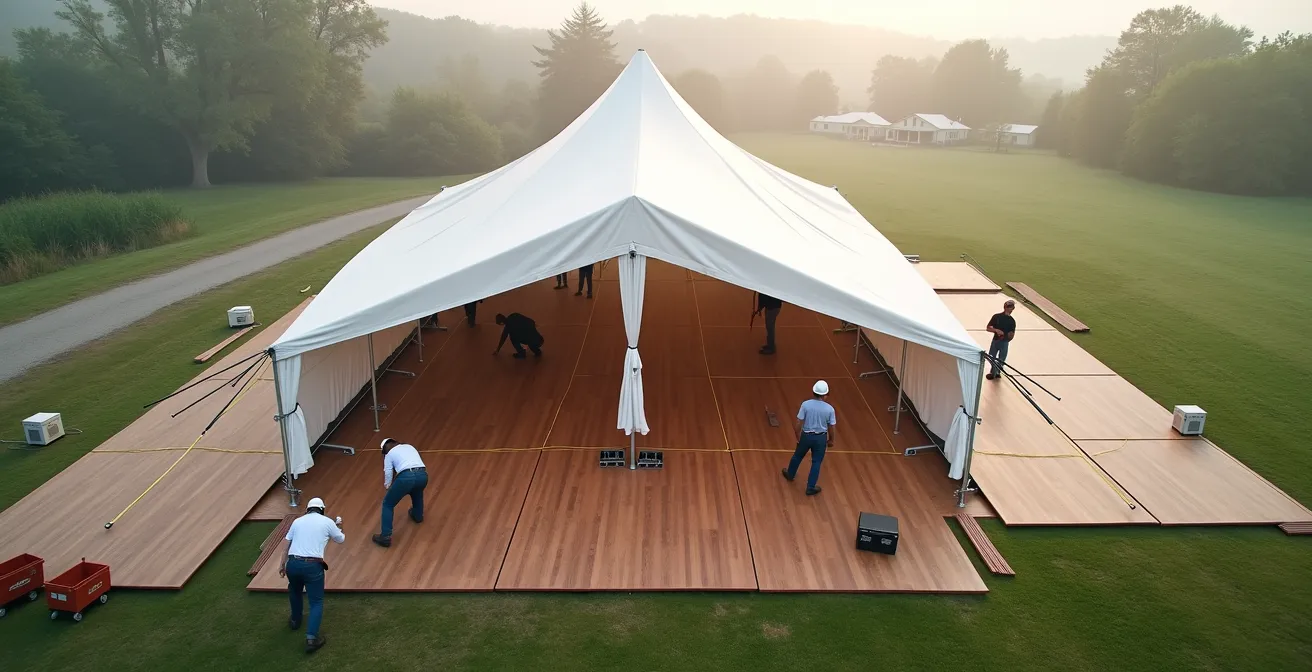
The high price of tent flooring is not a decorative expense but a calculated investment in risk mitigation that secures the entire event’s success.
- Flooring is often mandated by venues to transfer liability for lawn damage and guest safety away from them and onto your vendors.
- A professionally installed sub-floor is the only way to guarantee a dry, level, and safe surface, preventing weather disruptions and accidents.
Recommendation: Frame the flooring cost as an insurance policy. The ROI is measured not in dollars saved, but in catastrophic failures avoided—from guest injuries to a rained-out reception.
That moment of sticker shock is universal. You’ve found the perfect outdoor venue, envisioned a magical tented reception, and then the quote for flooring arrives. The figure often seems disproportionately high, leading many couples to ask the same logical question: is this massive expense really necessary? The common answers—that it looks nicer or protects shoes—feel flimsy when weighed against a cost that can rival that of the tent itself. This reaction is understandable, but it stems from viewing the floor as a decorative element rather than a structural one.
While aesthetics are a part of the equation, a proper hardwood floor is fundamentally about risk management. It’s the foundational investment that protects every other aspect of your reception, from guest safety to the flawless execution of your decor and entertainment. Thinking of it as an “upgrade” is a financial misstep. The reality is that forgoing a proper floor doesn’t save you money; it exposes your entire wedding investment to a host of preventable risks, including weather, liability, and technical failures that can derail the day.
This analysis will reframe the conversation. We will move beyond the superficial benefits and dissect the tangible, financial, and logistical returns of investing in a professional flooring system. Instead of asking if it’s “worth it,” we will analyze how it functions as a comprehensive insurance policy for your event. We will break down why venues mandate it, how it prevents catastrophic failures, and why it is the non-negotiable foundation for achieving the high-end, personalized look you’ve planned for.
This guide offers a complete financial and practical analysis of tent flooring. By exploring the core functions of this crucial element, you will gain a clear understanding of its role in ensuring the safety, comfort, and overall success of your event.
Summary: The Financial Case for Wedding Tent Flooring
- Why Venues Mandate Flooring to Protect Their Lawn?
- Stilettos on Grass vs. Wood: The Guest Comfort Factor
- How Raised Flooring Prevents Puddles Inside the Tent?
- How Wood Flooring Improves Band Acoustics Compared to Grass?
- Why You Need a Sub-Floor Before Laying Carpet Outdoors?
- Why “Month-Of” Coordination Often Costs More in Stress and Money?
- Why Vinyl Wraps Fail on Uneven or Carpeted Surfaces?
- How to Personalize Your Reception With a Custom Vinyl Dance Floor Wrap?
Why Venues Mandate Flooring to Protect Their Lawn?
When a venue mandates flooring, it’s rarely about aesthetics. It is a calculated business decision rooted in asset protection and liability transfer. A high-end wedding venue is a significant real estate asset, and their manicured lawn is a core part of its value proposition. With the average wedding venue cost in 2023 being $12,800, owners are acutely aware of the potential for damage. Hundreds of guests, heavy tables, and vendor traffic can easily turn a pristine lawn into a muddy, rutted expense that takes thousands of dollars and weeks to repair, impacting their ability to host future events.
By requiring a raised floor, the venue effectively creates a protective barrier over their most valuable outdoor asset. The responsibility for preventing lawn damage shifts from them to your rental company. More importantly, this requirement is a critical component of their risk management strategy. An uneven lawn presents numerous trip-and-fall hazards, and a flooring mandate helps mitigate their exposure to potential lawsuits. As the Downtown LA Law Group points out in their analysis of wedding accidents:
Most venues require ALL the vendors to have letters of indemnification and show proof of insurance
– Downtown LA Law Group, Wedding Slip and Fall Accidents – Lawsuit and Liability Information
This legal maneuver ensures that if an accident occurs related to the ground surface, the liability falls on the rental company that installed the floor (and their insurance), not the venue. Therefore, the flooring requirement isn’t just a rule; it’s a non-negotiable part of the venue’s financial and legal operating structure, protecting their property and insulating them from liability.
Ultimately, a venue’s flooring mandate is a clear signal that they prioritize a controlled and safe environment. While it appears as an added cost to you, for them, it’s an essential prerequisite for doing business.
Stilettos on Grass vs. Wood: The Guest Comfort Factor
The conversation around guest comfort often centers on minor inconveniences, such as high heels sinking into soft grass. While this is a valid point affecting the enjoyment and attire choices of your guests, the true “comfort factor” from an analytical perspective is about ensuring their physical safety. An uneven, damp, or soft ground surface is not just uncomfortable; it is a significant liability risk. A guest tripping over a hidden root or slipping on wet grass can result in serious injury, transforming your celebration into a legal and financial nightmare. The investment in a solid hardwood floor is an investment in risk mitigation.
A perfectly level, non-slip wood surface provides a stable foundation for all guests, regardless of their age, mobility, or footwear. This eliminates the inherent risks of a natural ground surface. Consider the following real-world scenario:
Case Study: The Hidden Cost of Negligent Flooring Installation
In one documented incident, a rental company was found at fault for negligently installing a temporary floor at a wedding. A guest sustained significant injuries to his knee, face, and teeth when he fell due to the improperly laid surface. The case was ultimately settled, with the rental company’s insurance bearing the cost, but it highlights the severe consequences of flooring failure. The critical takeaway is that the existence of a floor isn’t enough; its professional installation is paramount to ensuring safety.
The visual contrast between a stable floor and unpredictable turf is stark. A solid foundation provides confidence and security, allowing guests to move freely and safely.
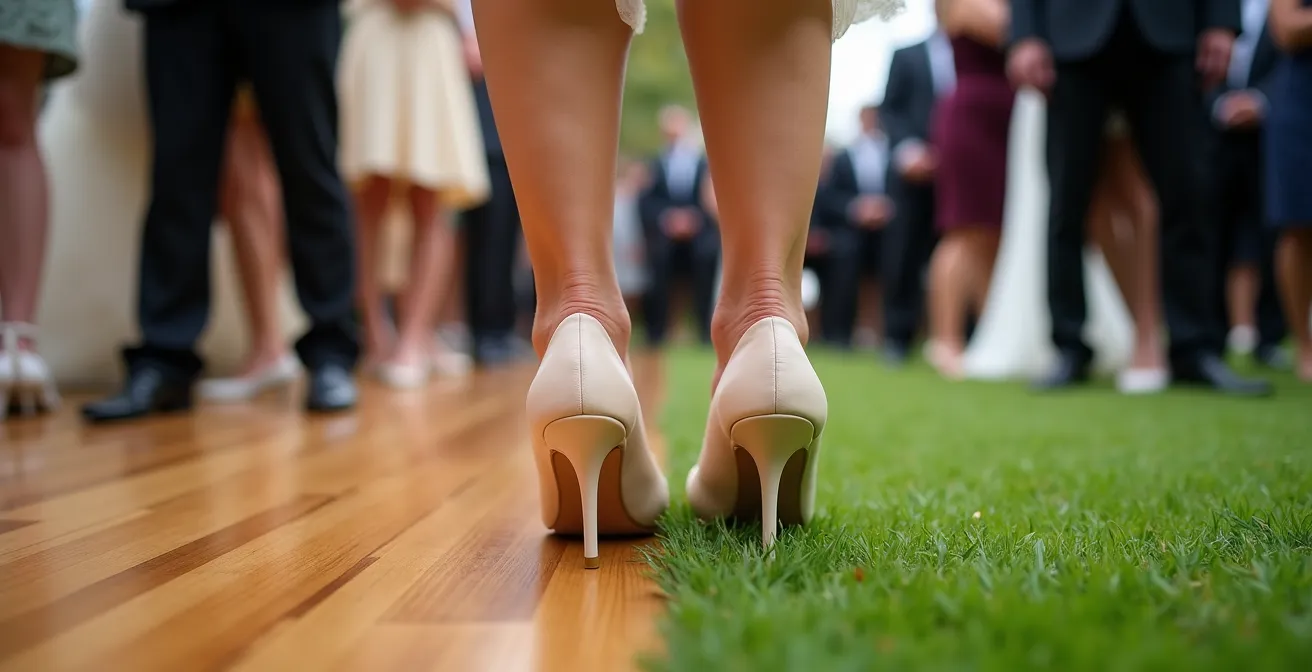
As the image illustrates, the difference is not merely aesthetic but structural. One surface provides predictable stability, while the other presents constant, variable risk. By providing a secure surface, you are not just enhancing comfort; you are actively preventing accidents and protecting yourself from the potential for devastating personal injury claims. This elevates flooring from a simple amenity to an essential safety feature of your event.
This investment directly translates into peace of mind, ensuring your memories of the day are of celebration, not of an unfortunate and preventable accident.
How Raised Flooring Prevents Puddles Inside the Tent?
An outdoor tent offers a beautiful setting, but it provides zero protection from ground-level water. A sudden downpour doesn’t have to fall directly on the tent to ruin an event; water flowing across the ground can quickly turn the interior into a muddy, puddled mess. This is where a raised sub-floor system becomes the single most critical element for weatherproofing your reception. It is the only effective method for managing water and ensuring a dry, usable space, no matter the weather.
A professional sub-floor isn’t just a layer of wood on the grass. It is an engineered system, often using adjustable pedestals, that elevates the entire floor structure several inches off the ground. This crucial gap creates a channel underneath the floor, allowing rainwater to flow harmlessly beneath the event space without ever touching the surface your guests walk on. Without this system, even a light rain can lead to water seeping under the tent walls, creating hazardous slick spots and soaking table legs, decor, and guest belongings.
The cost of this assurance is tangible. While basic interlocking tiles offer minimal drainage, a true raised system provides complete water management. The following table breaks down the options, clearly showing that effective water management comes with a higher initial investment.
| Flooring Type | Installation Time | Cost per Sq Ft | Water Management |
|---|---|---|---|
| Direct on Grass | None | $0 | No protection |
| Interlocking Tiles | 50 sq ft/hour | $3-$7 | Basic drainage |
| Raised Sub-floor System | 40 sq ft/hour | $6-$12 | Complete water channeling |
| Hardwood on Sub-floor | 30 sq ft/hour | $10-$15 | Full moisture barrier |
This data, based on an analysis of tent flooring options, demonstrates a clear correlation between cost and protection. While forgoing a floor is “free,” it offers no protection. A raised sub-floor, which industry data suggests can cost between $6 to $12 per square foot for the underlying plastic system alone, is the only option listed as providing “complete water channeling.” It is an absolute necessity for event integrity in any location with even a remote chance of rain.
Investing in a raised sub-floor isn’t paying for wood; it’s paying for the certainty that your multi-thousand-dollar event won’t be washed out by an unpredictable change in weather.
How Wood Flooring Improves Band Acoustics Compared to Grass?
While often overlooked, the surface beneath your guests’ feet plays a monumental role in the acoustic quality of your event, particularly for live music. Grass, carpet, and dirt are soft, porous materials that absorb and muffle sound waves. A live band playing in a tent on a natural surface will sound flat, indistinct, and lack energy. In contrast, a solid hardwood floor acts as a natural amplifier and reflector, creating a rich, vibrant, and immersive sound experience. This transformation of sound quality can be considered an investment in acoustic capital.
A hardwood surface provides the crisp reflection needed for high-frequency sounds (like cymbals and vocals) to be clear and defined. It also allows low-frequency sounds (like bass and drums) to resonate through the structure, letting guests “feel” the music. This creates a professional-grade audio environment that significantly elevates the performance of your band and the overall energy of the reception. A great band can sound mediocre without the right surface to project their music, diminishing the return on your entertainment investment.
Achieving this acoustic benefit isn’t accidental; it requires a meticulously installed foundation. A professional-grade sub-floor must be perfectly level and structurally sound to prevent vibrations from being lost or creating unwanted buzzing. The choice of wood and its installation method are also critical for optimizing resonance. The process is far more complex than simply laying planks on the ground.
Your Audit Checklist for Vendor’s Acoustic Preparedness
- Ground Preparation: Confirm with your rental company that they will level the ground surface and remove debris that could interfere with sound reflection.
- Structural Support: Ask if they use an adjustable pedestal or joist system to ensure a consistently elevated and level sub-floor, preventing sound gaps.
- Panel Connection: Inquire about the type of sub-floor panels used and how they connect, ensuring tight seals to prevent sound dampening.
- Hardwood Installation: Verify that they install acoustic-grade hardwood with appropriate spacing for optimal resonance, rather than just cosmetic planks.
- Edge Security: Ensure their plan includes securing all floor edges to prevent movement and vibration loss, which is crucial for maintaining sound quality.
The investment in a proper hardwood floor is therefore also an investment in the quality of your entertainment, ensuring the thousands of dollars spent on a live band translate into an unforgettable auditory experience for you and your guests.
Why You Need a Sub-Floor Before Laying Carpet Outdoors?
Many couples consider carpet a softer, more budget-friendly alternative to hardwood for a tented event. However, laying carpet directly on grass is a recipe for failure and hidden costs. Without a solid, raised sub-floor acting as a barrier, you are exposing your event to moisture damage, safety hazards, and potentially massive replacement fees. A sub-floor is not an optional add-on for outdoor carpeting; it is an essential structural foundation that protects the carpet itself.
The primary issue is moisture. Grass constantly releases moisture, which will be trapped under the carpet. This creates a damp, musty environment and can cause the carpet’s colors to bleed or transfer onto guests’ clothing. If it rains, the problem is magnified tenfold as water wicks up through the carpet, turning it into a giant, sodden sponge. This moisture also creates dangerous, slippery conditions and promotes the growth of mold and mildew, even during a single-day event. An impermeable sub-floor is the only way to create the necessary moisture barrier between the damp ground and the dry carpet.
Furthermore, the financial risks associated with unprotected carpet are substantial. Rental carpets are expensive assets, and any permanent damage will be passed on to you. A spilled glass of red wine is a common concern, but other event elements can cause catastrophic damage, as one real-world insurance claim illustrates:
A bubble machine combined with confetti permanently stains carpet, resulting in a $25,000 bill to replace it
– The Event Helper, Wedding Insurance Claims Examples
This staggering figure underscores the financial liability you assume when renting high-end decor. A proper sub-floor, by keeping the carpet elevated and protected from ground-in dirt and moisture, makes it easier to clean and reduces the risk of the kind of deep, permanent staining that leads to such claims. It provides a stable, cleanable base layer that protects the more vulnerable and expensive carpet on top.
In short, the cost of a sub-floor is a prerequisite for successfully using carpet outdoors. It is the necessary investment to protect the carpet from damage, ensure guest safety, and avoid unexpected, and potentially astronomical, post-event charges.
Why “Month-Of” Coordination Often Costs More in Stress and Money?
In the world of wedding planning, the term “month-of coordination” is often a misnomer for last-minute crisis management. Making critical decisions under pressure, without the benefit of foresight and research, almost always leads to higher costs and immense stress. This principle applies perfectly to the decision of whether to install tent flooring. Waiting until the last minute to decide, based on a grim weather forecast, is the financial equivalent of hiring a month-of coordinator: a reactive, expensive solution to a problem that could have been solved more affordably through early planning.
Rental companies price their inventory based on demand and availability. Attempting to book a full flooring system a week or two before your wedding, especially during peak season, puts you in a position of zero leverage. You will be subject to premium pricing, rush fees, and limited availability. The cost of securing that last-minute floor will be significantly higher than if you had booked it months in advance as part of your initial package. The financial benefit of foresight is well-documented; industry analysis shows that couples who plan early can save between $5,000 to $10,000 on their total wedding budget.
Committing to flooring early on treats it as a planned capital investment rather than an emergency operational expense. This proactive approach allows you to lock in pricing, ensure availability, and integrate the floor into your overall event design from the beginning. It eliminates the frantic, last-minute scramble and the associated stress of wondering if your dream outdoor wedding will be ruined by a muddy field. The peace of mind that comes from knowing your event is protected, regardless of the weather, is a significant, albeit non-financial, return on investment.
By deciding on flooring from the outset, you are not just booking a piece of equipment; you are buying certainty and control over your event’s outcome, which is a far more valuable commodity than any potential savings from waiting.
Why Vinyl Wraps Fail on Uneven or Carpeted Surfaces?
A custom vinyl wrap on a dance floor is a stunning personalization element, but its success is entirely dependent on the surface beneath it. Attempting to apply a vinyl wrap directly to grass, dirt, or even low-pile carpet is a guaranteed failure. The adhesive requires a perfectly smooth, stable, and non-porous surface to bond correctly. Without this, the wrap will bubble, peel, and lift, creating an unsightly and dangerous trip hazard within minutes of guests starting to dance. This is why a hardwood sub-floor is the absolute structural prerequisite for any vinyl wrap installation.
The reasons for failure are mechanical. Carpet fibers, no matter how short, create thousands of micro-gaps that prevent the vinyl’s adhesive from forming a complete seal. This allows air to get trapped, leading to bubbling. The slight movement and compression of the carpet pile with each footstep will constantly break the fragile adhesive bond, causing the edges to peel up. On natural ground, moisture and unevenness make a proper bond physically impossible. The wrap will lift and wrinkle almost immediately.
The visual evidence of this failure is dramatic. An improperly installed wrap quickly transforms from a beautiful centerpiece into a hazardous mess.
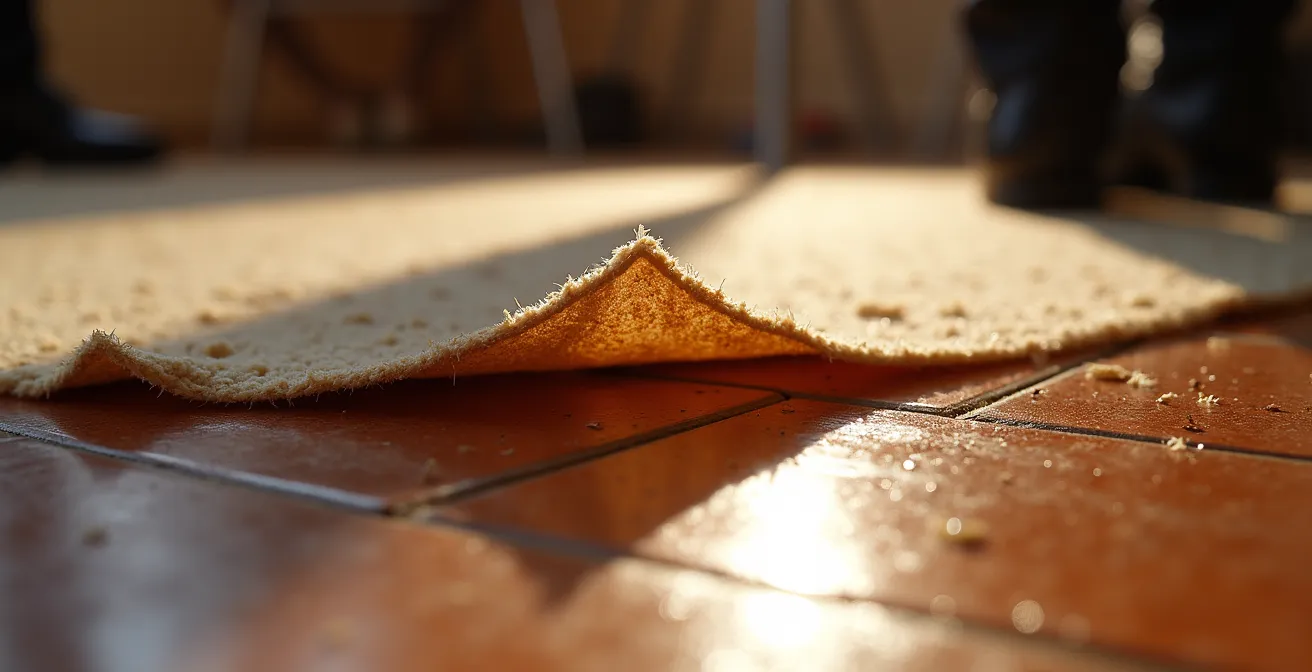
As this macro detail shows, the failure begins at a microscopic level, where the adhesive cannot grip the unstable, fibrous surface. A hardwood sub-floor provides the ideal foundation: it is rigid, perfectly level, and non-porous. It creates a sealed, monolithic surface that allows the vinyl wrap’s adhesive to achieve a complete, powerful bond, ensuring it remains smooth and safe throughout the entire event. There is no shortcut or alternative to achieve this result.
Therefore, the cost of the hardwood floor should be factored in as a necessary component of the cost of a vinyl wrap. One simply cannot exist without the other in an outdoor tent setting.
Key Takeaways
- Flooring is a risk management tool that protects against venue damage, guest injury, and weather disruptions.
- A raised sub-floor is the only system that provides a true moisture barrier and guarantees a dry tent interior during rain.
- High-impact decor like vinyl wraps and quality acoustics for live music are only possible with a solid, level hardwood foundation.
How to Personalize Your Reception With a Custom Vinyl Dance Floor Wrap?
Once you have made the foundational investment in a professional hardwood sub-floor, you unlock the potential for a truly transformative level of personalization: the custom vinyl dance floor wrap. This element elevates the dance floor from a simple functional space to the stunning visual centerpiece of your reception. It’s a high-impact design choice that directly enhances the value of other major investments, particularly your photography and videography. With couples typically budgeting an average of $3,000 for photography, a spectacular floor ensures that every wide shot of the reception is breathtaking.
A custom wrap allows you to infuse your personality and wedding theme directly into the heart of the event space. You can incorporate your monogram, a custom pattern, a meaningful quote, or a bold color that ties the entire decor scheme together. It creates a ‘wow’ moment for guests as they enter the tent and provides a unique, branded backdrop for all the key reception moments: the first dance, the parent dances, and the party. This is the payoff for the structural foundation you’ve built.
The process involves working with a design team to create the artwork and a professional installation team to apply it. The wrap is printed on large sheets of high-grade vinyl and meticulously applied to the clean, smooth hardwood surface 24 hours before the event to allow it to settle. This ensures a flawless, seam-free finish that looks like it was painted directly onto the floor. It is this final, perfect application that justifies the underlying investment in the sub-floor.
To ensure this element is executed perfectly, it’s crucial to provide your rental and design team with a clear brief. A detailed plan covering floor dimensions, design elements, and installation logistics is the final step in leveraging your flooring investment to create a truly unforgettable reception environment.
Frequently Asked Questions on Is Installing Hardwood Flooring in a Tent Worth the Massive Expense?
What type of surface is required for vinyl wrap installation?
A smooth, stable surface is essential. Professional installation requires either a hardwood sub-floor or specialized dance floor panels that provide a flat, non-porous surface for proper adhesion.
Can vinyl wraps be installed directly on outdoor surfaces?
No, vinyl wraps cannot be installed on grass, carpet, or uneven ground. They require a raised, level sub-floor system with moisture barriers to prevent adhesion failure.
What causes vinyl wrap failure during events?
Micro-movements from carpet fibers, moisture seepage, and uneven surfaces create air channels that break the adhesive seal, leading to dangerous bubbling and peeling within minutes of dancing.