
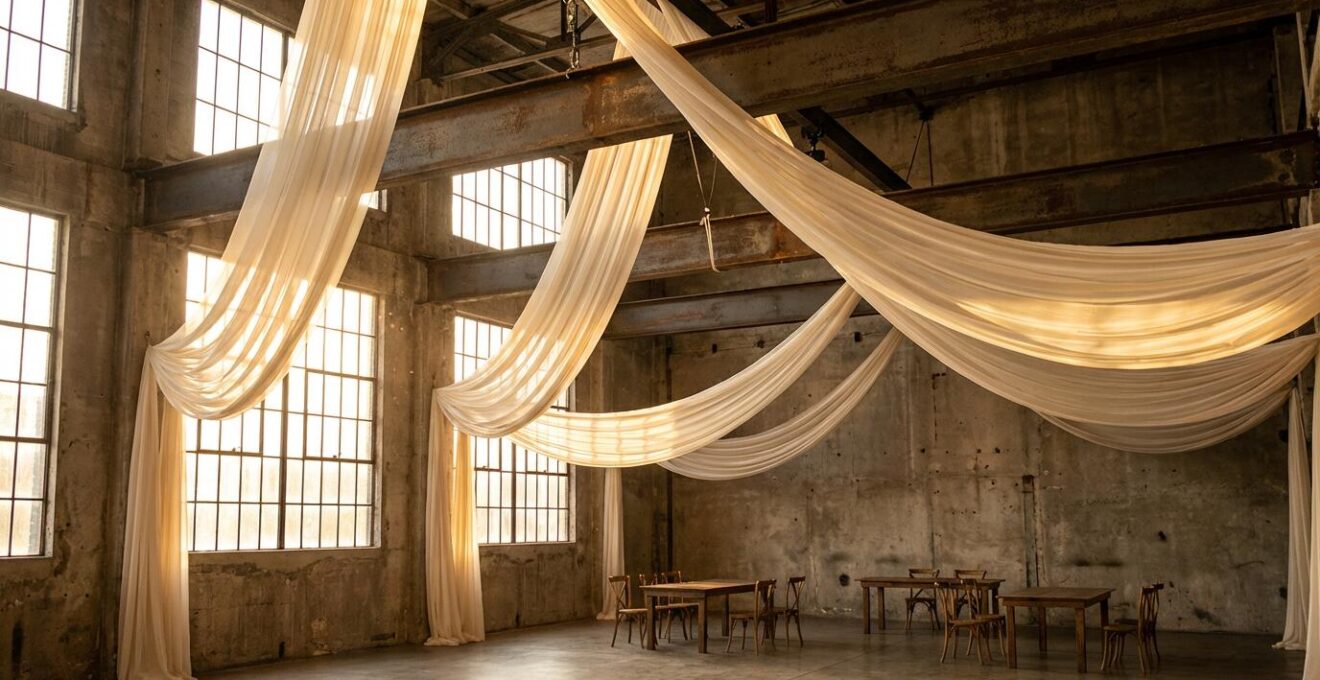
The key to a romantic industrial wedding isn’t just adding fabric; it’s selecting a textile whose physical properties—like silk chiffon’s—can fundamentally alter light and space.
- Silk’s unique fiber structure creates a soft, multi-dimensional luminosity that polyester cannot replicate, avoiding harsh glare in photos.
- Strategic placement, whether on ceilings or walls, has vastly different impacts on cost and spatial perception due to complex load distribution.
- Safety and legal compliance, especially fire retardancy regulations, are non-negotiable and can dictate your entire design.
Recommendation: Prioritize a discussion about material choice and professional installation with your designer and venue early in the planning process. The textile itself is as crucial as the design.
The allure of an industrial wedding venue—with its soaring ceilings, exposed brick, and raw, structural honesty—is undeniable. Yet, the very elements that create this dramatic backdrop can also feel cold or vast. The common solution is to introduce fabric drapery to “soften” the space. For couples envisioning a romantic, ethereal atmosphere in a warehouse or loft, this step is crucial. However, the conversation often stops at a generic recommendation for white fabric, missing the most critical element: the textile’s soul.
This is not merely a matter of decoration. It is an exercise in architectural softening and light manipulation, where the choice of material dictates the final aesthetic. While polyester is a common budget-friendly option, it behaves fundamentally differently from natural fibers. The true transformation, the kind that creates a breathing, luminous environment, lies in understanding the superior properties of a textile like silk chiffon.
This guide moves beyond simple styling tips. We will delve into the material science that makes silk chiffon the unparalleled choice for romantic drapery, the engineering principles required for safe installation, and the artistic techniques for layering fabric to create a truly dreamy effect. By understanding the ‘why’ behind the ‘how’, you can transform a stark industrial space into an intimate, glowing sanctuary that feels both grand and deeply personal.
This article provides a comprehensive look into the technical and artistic considerations of using fabric in non-traditional venues. Explore the sections below to master every aspect, from material selection to complex installations.
Summary: A Technical and Artistic Guide to Wedding Drapery
- Why Silk Chiffon Drapes Better Than Polyester for Romantic Ceilings?
- How to Install Ceiling Drapery Safely in Venues Without Rigging Points?
- Ceiling Swags or Wall Drapes: Which Maximizes Visual Impact for the Cost?
- The Flammability Regulation That Could Force You to Remove Drapes
- How to Layer Sheer Fabrics for a Dreamy, Ethereal Lighting Effect?
- How to Design a Chuppah That Is Both Structurally Sound and Photogenic?
- The “Greenhouse Effect”: Managing Heat in Clear-Span Marquees
- How to Engineer Suspended Floral Installations Safely in Marquees?
Why Silk Chiffon Drapes Better Than Polyester for Romantic Ceilings?
The choice between silk chiffon and polyester is not just about budget; it’s a decision that profoundly impacts the light, movement, and overall feeling of your space. While a surface-level cost analysis shows that polyester is significantly cheaper, its aesthetic performance falls short in creating a truly high-end, romantic atmosphere. The difference lies in the very physics of the fibers.
Silk chiffon’s superiority begins with its structure. As textile experts at Sinosilk note, “Silk exhibits an awe-inspiring drape and fluidity, gracefully cascading like a waterfall when draped.” This is because of its natural, lightweight properties that allow it to catch the slightest air current, adding a dynamic, living quality to the room. Polyester, a synthetic plastic, is inherently stiffer and hangs with less grace, offering a static and less luxurious feel. The tactile difference is immediate: silk is soft and smooth, while polyester can feel artificial and less refined.
The most crucial distinction, however, is in how these fabrics interact with light—a key component of romantic ambiance. This is where the material science becomes paramount for your wedding photography and guest experience.
This table breaks down the fundamental differences in light behavior, which is essential for creating a soft, luminous environment rather than a scene with harsh, unflattering reflections.
| Property | Silk Chiffon | Polyester |
|---|---|---|
| Fiber Structure | Triangular prism-like | Round fibers |
| Light Reflection | Multi-angle reflective surfaces | Artificial, duller luster |
| Photography Impact | Avoids hot spots under flash | Creates harsh reflections |
| Movement Quality | Fluid, responds to air currents | Stiffer drape, less movement |
Ultimately, silk’s triangular, prism-like fiber structure scatters light gently in multiple directions, creating an ethereal glow and preventing the “hot spots” of glare that plague photographers. Polyester’s round fibers reflect light more directly, resulting in a harsher, more artificial sheen. For a truly romantic and photogenic ceiling, the investment in silk chiffon pays dividends in pure visual magic.
How to Install Ceiling Drapery Safely in Venues Without Rigging Points?
Industrial venues like warehouses and lofts often lack the built-in rigging points common in traditional ballrooms. This presents a significant challenge: how do you suspend potentially hundreds of pounds of fabric and hardware from a ceiling not designed for it? The answer is never “just find a beam.” Safe installation is a matter of structural engineering, not just decorating.
Attempting a DIY installation without professional assessment is extremely hazardous. The first step is always to consult with the venue management and a professional rigging company. They can access architectural plans to identify load-bearing structures that are hidden from view. In many cases, temporary solutions must be engineered. These can include freestanding truss structures that create their own support system, or specialized, non-damaging clamps designed for steel I-beams. For lighter applications, powerful magnetic hooks rated for significant weight can sometimes be used on steel ceiling components, but their load capacity must be strictly respected.
The core principle of safe rigging is the Working Load Limit (WLL). Professionals calculate the total weight of the installation (fabric, cables, hardware) and apply a safety factor. For overhead suspension, industry standards require at least a 5:1 safety factor, meaning the rigging system must be able to hold five times the actual weight of the installation. This buffer accounts for dynamic forces and unforeseen stresses.
Never underestimate the weight of fabric. A single bolt of silk chiffon is light, but hundreds of yards of it, plus the steel cables and hardware needed to hang it, quickly adds up. A professional will map out attachment points to distribute this load evenly, preventing a catastrophic failure at a single, overloaded point. Ignoring these principles not only risks property damage and liability but also the safety of every person in the room.
Ceiling Swags or Wall Drapes: Which Maximizes Visual Impact for the Cost?
Once you’ve chosen your fabric and secured a safe installation method, the next strategic decision is placement. Should you invest in dramatic ceiling swags that draw the eye upward, or elegant wall drapes that create intimacy and conceal less-than-ideal architectural features? The choice has significant implications for both visual impact and your budget.
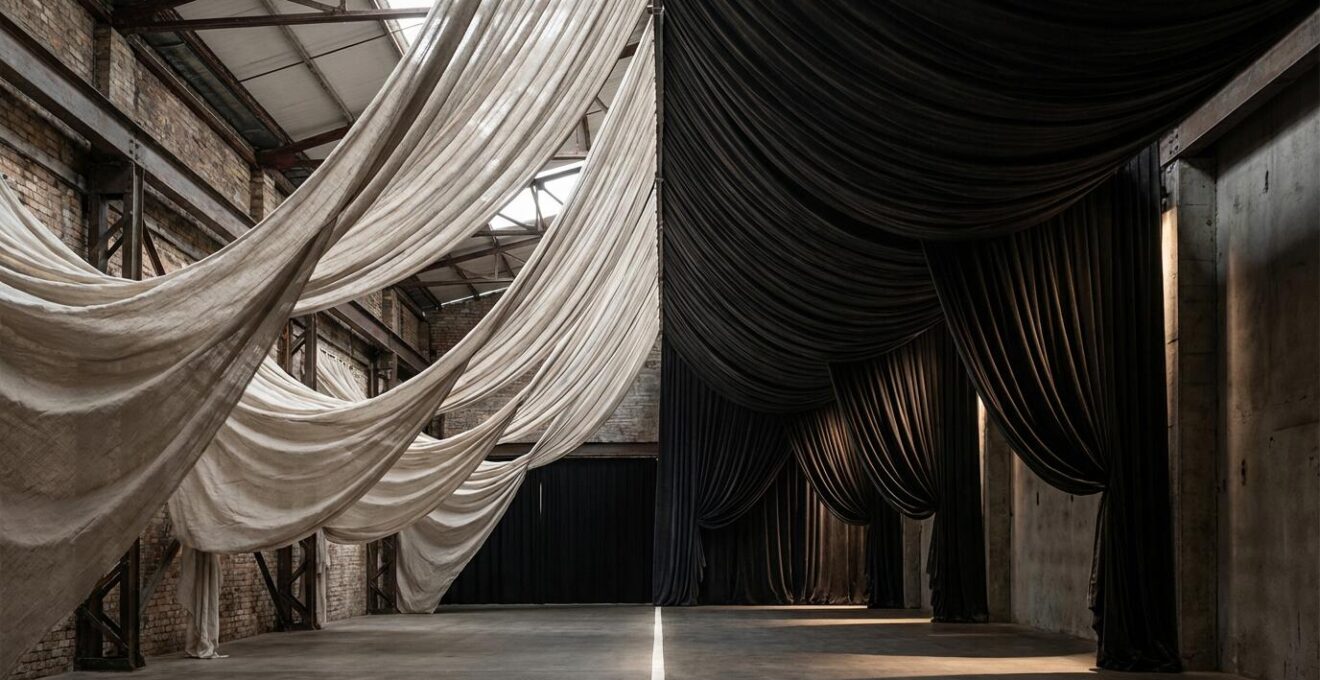
Ceiling swags are the quintessential choice for transforming a large, industrial space. They soften the hard lines of exposed ductwork and beams, lower the perceived ceiling height, and create a breathtaking, tent-like canopy. However, this option is almost always the more expensive and complex of the two. The installation requires more specialized labor (often involving lifts), extensive hardware, and a meticulous understanding of load distribution. For example, a recent analysis of multi-point suspensions shows that on a simple three-point truss, the center point bears a disproportionate 62% of the load. This uneven distribution means that ceiling rigging is a complex engineering task that directly translates to higher costs.
This image provides a clear visual distinction between the two approaches, helping to visualize their different effects on the space.
Wall drapes, on the other hand, offer a more budget-friendly way to achieve a major transformation. They are excellent for creating a clean, soft backdrop for a ceremony or head table, hiding unsightly walls, or sectioning off a large warehouse into more intimate zones. Installation is generally simpler, requiring less specialized equipment than ceiling work. This approach allows you to focus your budget on high-impact areas rather than covering an entire ceiling. For many couples, a combination works best: a stunning focal point of wall drapery behind the altar, with simpler, complementary elements elsewhere.
The decision comes down to your primary goal. If you want to fundamentally change the architecture of the entire room and create a grand, all-encompassing romantic feel, ceiling swags are unparalleled. If you need to maximize your budget while creating elegant, intimate moments within the larger space, wall drapes are the more strategic choice.
The Flammability Regulation That Could Force You to Remove Drapes
Beyond aesthetics and structural safety lies a critical, often overlooked, legal requirement: flame retardancy. Imagine investing thousands in a breathtaking drapery installation, only to have the fire marshal demand its immediate removal on your wedding day. This scenario is a real risk if you neglect to ensure your fabrics meet local and national fire codes.
Most public assembly venues, including wedding venues, are required by law to use only fabrics that are certified as flame retardant. The most common standard in the United States is the NFPA 701 test. This is not a suggestion; it’s a legal mandate designed to prevent rapid fire spread in a crowded space. There are two types of compliant fabrics: Inherently Flame Retardant (IFR) fabrics, where the flame resistance is woven into the fiber itself, and Flame Retardant (FR) fabrics, which are chemically treated.
It’s crucial to understand that this is not a one-time certification. For chemically treated fabrics, certification standards indicate that the flame retardancy is often certified for only one year and can be compromised by washing or exposure to the elements. When renting or purchasing drapes, you must obtain a valid Certificate of Flame Retardancy from your supplier. This document is what the fire marshal will ask to see.
Navigating these regulations can be complex, as requirements can vary by city and state. The process requires proactive diligence from the very beginning.
Action Plan: Ensuring Flame Retardancy Compliance
- Contact Authorities: Reach out to the local fire department or the state fire marshal’s office to understand the specific regulations for your venue’s location.
- Verify Standards: Confirm if NFPA 701 certification is sufficient or if any additional city or state-specific standards must be met.
- Request Certificate: Demand a valid Certificate of Flame Retardancy from your fabric supplier or rental company at the time you place your order. Do not proceed without it.
- Schedule Re-testing: If using FR-treated fabrics that have been in use for a while, ensure they have been re-tested and re-certified within the last year using the NFPA 705 field test method.
- Document Everything: Keep a file with all compliance documents, including the certificate and correspondence with officials, to present to the venue and fire marshal upon request.
Do not assume your decorator or rental company is handling this. Explicitly ask for the certification and verify its validity. This single piece of paperwork is the key to ensuring your beautiful design is also a safe and legal one.
How to Layer Sheer Fabrics for a Dreamy, Ethereal Lighting Effect?
Creating a truly “dreamy” atmosphere goes beyond simply hanging fabric; it involves the art of light manipulation through layering. A single layer of sheer chiffon is beautiful, but the real magic—the deep, ethereal luminosity—is born from combining multiple layers of translucent textiles. This technique adds visual depth, diffuses light more effectively, and creates a soft, complex texture that captivates the eye.
Professional decorators understand that chiffon’s airy quality is an invitation to play with depth. As noted by wedding fabric specialists, decorators often achieve this by pairing chiffon with other textiles. Layering it with voile or even a mystique satin can introduce different levels of opacity and shimmer, preventing the design from looking flat. The key is to vary the density and texture of the fabrics to build a rich visual narrative.
The most powerful tool in layered design is backlighting. Placing light sources *behind* the fabric panels transforms them from simple decorative elements into radiant, glowing planes. This technique, when done correctly, eliminates harsh shadows and bathes the space in a soft, non-directional light that is incredibly flattering for both guests and photography.
This close-up view demonstrates how backlighting interacts with layered fabric to create a soft, radiant glow from within.

To achieve this effect, consider using multiple swags of chiffon hung at slightly different depths from the ceiling or wall. When you place LED uplighters or string lights behind these layers, the light is scattered and softened with each layer it passes through. This creates a gentle gradient and a sense of movement. For an even more dynamic look, you can mix fabrics of slightly different opacities or even subtle color variations, like ivory and blush, to create a painterly effect. The goal is to make the light itself feel like a tactile, integrated part of your decor.
How to Design a Chuppah That Is Both Structurally Sound and Photogenic?
The chuppah is more than just a decorative arch; it is the sacred and symbolic centerpiece of a Jewish wedding ceremony. Designing one in an industrial space requires a delicate balance between creating a photogenic focal point and ensuring it is structurally sound, especially if the ceremony is outdoors or in a drafty warehouse.
From a photographic perspective, the drapery is key. To achieve the lush, cascading look seen in magazines, you need an ample amount of fabric. A common mistake is underestimating the quantity required. As a rule of thumb, professional recommendations suggest using fabric that is two to three times the length of the structure you are draping. For a standard 8-foot tall chuppah pole, this means using a panel that is 16 to 24 feet long to create elegant pooling and swags. Using whisper-light silk chiffon will ensure the drapes move gracefully without adding excessive weight.
Structural integrity, however, must be the primary concern. A chuppah, particularly one laden with fabric and florals, can act like a sail in a breeze. The structure must be built to withstand potential wind loads, even indoors where air conditioning or open bay doors can create significant drafts. A freestanding frame made of weighted steel or a heavy-duty truss is far safer than a flimsy, lightweight kit. The base of each of the four poles must be heavily weighted with sandbags or decorative weights, concealed by fabric or floral arrangements.
When attaching the fabric, use discreet zip ties or floral wire at multiple anchor points along the poles and canopy, not just at the top. This prevents a single gust of wind from pulling the entire panel loose. For outdoor or very breezy locations, it’s also wise to create strategic, almost invisible venting gaps in the fabric to allow air to pass through rather than push against the structure. This dual focus on abundant, beautiful fabric and robust, weighted engineering ensures your chuppah will be a safe and stunning sanctuary for your ceremony.
The “Greenhouse Effect”: Managing Heat in Clear-Span Marquees
While industrial lofts are a primary focus, many couples use clear-span marquees to create a similar “blank canvas” feel, especially for larger guest counts. These structures, often with clear vinyl roofs or walls, present a unique challenge: the greenhouse effect. On a sunny day, they can trap heat, making the internal temperature uncomfortable. Here again, the choice of drapery fabric plays a critical role, not just for aesthetics, but for climate control.
Polyester, being essentially a plastic, does not breathe. It traps heat and moisture, contributing to a stuffy, humid environment. Silk, conversely, offers superior performance in temperature regulation. As experts from Sino Silk explain, “Silk boasts natural breathability, ensuring optimal air circulation and facilitating moisture evaporation.” This natural property allows heat to escape and air to circulate, helping to maintain a more comfortable temperature for your guests. Silk’s ability to keep you cool in hot weather and provide insulation in the cold makes it an intelligent choice for any enclosed event space.
The fabric’s performance extends beyond just feel; it impacts the visual comfort of the space as well. The way a fabric manages heat and light is intrinsically linked.
This table outlines how silk and polyester perform under different temperature conditions, highlighting silk’s versatility and superiority for guest comfort in a marquee setting.
| Temperature Condition | Silk Performance | Polyester Performance |
|---|---|---|
| Hot Weather | Keeps you cool, breathable | Not breathable, traps heat |
| Cold Weather | Provides natural insulation | Limited insulation properties |
| Air Circulation | Facilitates moisture evaporation | Restricts airflow |
| Light Diffusion | Natural light scattering | Can create glare spots |
By lining the ceiling of a clear-span marquee with swathes of silk chiffon, you achieve two goals simultaneously. Aesthetically, you soften the metal frame and create a romantic, billowy canopy. Practically, you create an insulating air gap between the hot vinyl roof and the space below, while the fabric’s breathability prevents the oppressive feeling of trapped heat. This thoughtful use of material transforms the marquee from a potential “hotbox” into a comfortable and elegant environment, ensuring your guests remember the beauty of the day, not the heat.
Key Takeaways
- The physical properties of silk chiffon, from its prism-like fibers to its natural breathability, make it functionally superior to polyester for creating a romantic and comfortable atmosphere.
- Safe installation in industrial venues is a non-negotiable engineering task that requires professional assessment, adherence to a 5:1 safety factor, and a clear understanding of load distribution.
- Flame retardancy is a critical legal requirement. Always obtain a valid NFPA 701 certificate from your supplier to avoid having your decor removed on the wedding day.
How to Engineer Suspended Floral Installations Safely in Marquees?
The ultimate expression of romance in an industrial or marquee setting is often the combination of soft drapery with lush, suspended floral installations. These breathtaking “floral clouds” or chandeliers create an unforgettable focal point. However, integrating heavy, water-soaked floral arrangements with fabric requires an even higher level of engineering precision. The principles of safe rigging are paramount.
The first step, before any design is considered, is to determine the total weight of the proposed installation. This isn’t just the weight of the flowers; as rigging professionals emphasize, you must calculate the total weight of all components. This includes the flowers, the water-soaked floral foam, the structural base (like a metal grid or chicken wire), the cables, and any integrated lighting. A seemingly light floral arrangement can easily weigh several hundred pounds once fully assembled and hydrated. This total weight is the starting point for all safety calculations.
Just as with fabric drapery, this total weight must be used to determine the Working Load Limit (WLL), applying a strict safety factor. The rigging points on the marquee’s frame or the industrial venue’s beams must be certified to handle this load. It is never acceptable to simply hang a heavy installation from the same hardware used for lightweight fabric. Often, a separate, more robust rigging system is required specifically for the floral element, which then must be carefully integrated with the drapery design.
A common professional technique is to build the floral installation on a pre-rigged truss or frame on the ground, then hoist the entire structure into place. This allows florists to work safely and ensures the mechanics are sound before the arrangement is suspended over guests’ heads. The fabric drapery can then be artfully woven around this secure structure. This integrated approach ensures that the final design is not only beautiful but, more importantly, structurally sound and completely safe for everyone below.
By approaching your venue’s transformation with an appreciation for both the art of design and the science of materials and engineering, you are empowered to create a space that is not only visually stunning but also safe, comfortable, and truly unforgettable. To begin this journey, start a detailed conversation with your venue, your designer, and a professional rigging specialist, using this knowledge to ask the right questions.