
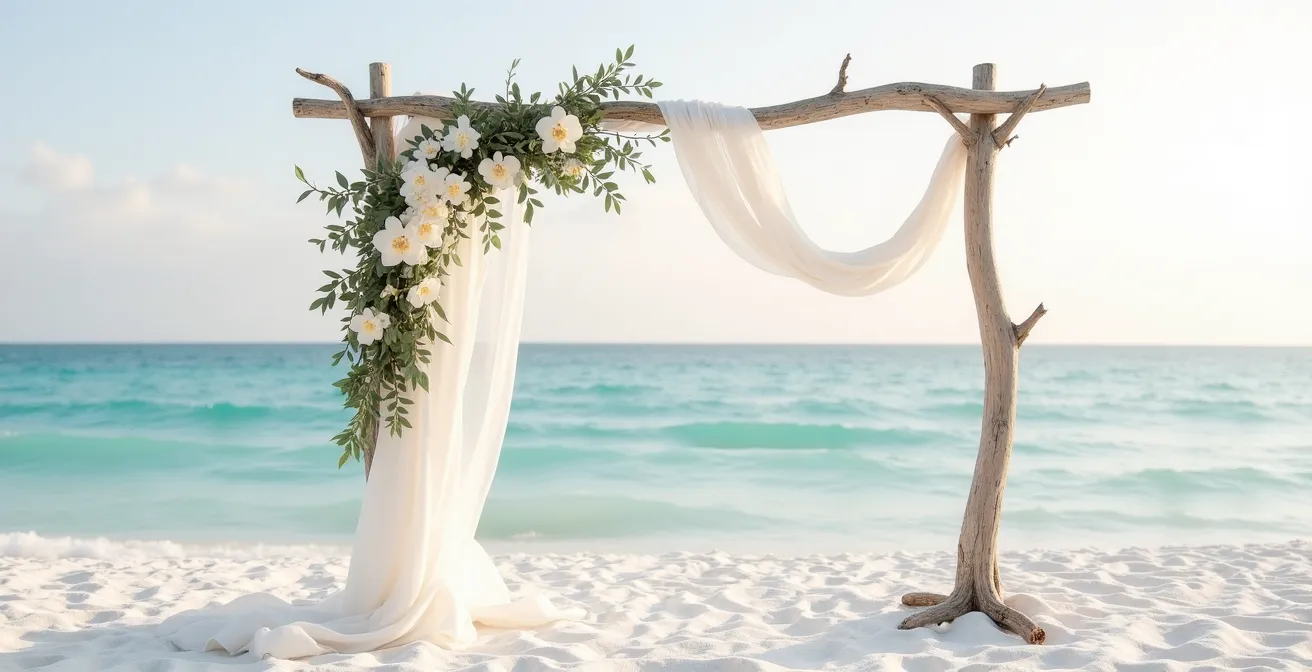
A sophisticated driftwood arbor isn’t about draping fabric; it’s about mastering structural integrity and environmental harmony.
- Secure anchoring and tripod stabilization are non-negotiable for safety and achieving a high-end look.
- Choose resilient, wind-resistant florals and use professional attachment techniques for a style that lasts through the ceremony.
Recommendation: Focus first on a sound structure, then layer decor that complements—not competes with—the coastal view.
A driftwood arbor, silhouetted against a shimmering ocean horizon, is the quintessential icon of a coastal wedding. It promises a ceremony that is both organic and elegant, perfectly in tune with the natural beauty of the setting. Couples envision a romantic frame for their vows, draped in flowing fabric and adorned with delicate blooms. Yet, what many discover is that the reality of a beach environment—with its persistent wind, shifting sands, and intense sun—can quickly turn this dream into a logistical challenge. The internet is filled with beautiful images, but offers little guidance on the practicalities.
The common advice often stops at “drape some fabric” or “add a few flowers.” But the difference between a breathtaking feature and a windswept, amateurish-looking structure lies in details the pictures don’t show. It’s not about fighting the elements, but elegantly working with them. The secret to a truly sophisticated coastal arbor isn’t found in the quantity of decorations, but in the structural integrity and environmental harmony of its design. It’s an art form that balances raw nature with refined execution.
This guide moves beyond surface-level inspiration. We will deconstruct the professional approach to creating a driftwood arbor that is not only beautiful but also resilient and photogenic. We’ll explore how to source materials ethically, secure a heavy structure in the sand, select florals that can withstand the elements, and make design choices that elevate the entire aesthetic. It’s about building a foundation of strength and stability, so your creative vision can truly shine.
This article provides a comprehensive roadmap for styling your driftwood arbor with sophistication. We will cover the essential considerations from structural engineering to the finest decorative details, ensuring your centerpiece is flawless.
Table of Contents: Crafting Your Perfect Coastal Wedding Arbor
- Where to Source Authentic Driftwood Ethically for Large Structures?
- How to Attach Fresh Flowers to Irregular Wood Without Water Sources?
- How to Anchor a Heavy Arbor in Sand to Prevent Tipping?
- Naked Wood or Draped Fabric: Which Better Complements a Sea View?
- How to Transform Your Ceremony Arbor Into a Sweetheart Table Backdrop?
- How to Design Boho Installations That Look High-End Instead of Messy?
- How to Style Rattan Chargers Without Your Table Looking Too Casual?
- How to Design a Chuppah That Is Both Structurally Sound and Photogenic?
Where to Source Authentic Driftwood Ethically for Large Structures?
The soul of your arbor is the driftwood itself—its silvered patina and organic shapes tell a story of the sea. Sourcing large, structural pieces ethically is the first step toward an authentic design. While combing beaches is a romantic notion, collecting driftwood is regulated in many state and national parks. For large-scale structures, it’s often more practical and responsible to purchase from professional suppliers who gather wood from private lands or areas where collection is permitted. These suppliers often pre-sort wood by size, which is a significant advantage for a large project like an arbor.
If you choose the DIY route, remember that construction requires a plan. Sort your collected pieces into categories: two strong, straight pieces (around 7 feet) for the legs, a distinctive top piece (around 6 feet), and smaller branches for stability and decoration. For instance, the professional model from Maine Salty Girl uses sturdy tripod legs and a top piece made of varying branches, a design built for both beauty and portability. When assembling, drilling pilot holes and using heavy-duty bolts is crucial for the main frame. For decorative accents, using rusty wood screws can enhance the weathered, authentic appearance.
You can also find affordable hardware through unexpected channels. Organizations like Habitat for Humanity ReStores can be a treasure trove for bolts, screws, and other hardware, potentially bringing the total construction cost under $5 for those on a tight budget. The key is to prioritize structural soundness from the very beginning, ensuring your beautiful creation is also a safe one.
Ultimately, whether you buy or build, selecting driftwood with character and strength provides the perfect raw canvas for your sophisticated coastal vision.
How to Attach Fresh Flowers to Irregular Wood Without Water Sources?
Attaching fresh flowers to a sun-drenched, windswept driftwood arbor presents a unique challenge: how do you keep them looking vibrant without a water source? The secret lies in a combination of smart floral choices and professional techniques. Direct sun and salty air can quickly wilt delicate blooms, so resilience is key. Research shows that certain tropical flowers maintain their beauty in harsh beach conditions, with succulents, orchids, and plumerias being particularly resilient against heat and sunlight. Sturdier blooms like proteas, roses, and carnations also perform well.
The attachment method itself is crucial for both hydration and stability. Florists often use cages of floral foam soaked in water, which act as a hidden water source throughout the ceremony. These arrangements are then firmly secured to the irregular wood using discreet but strong materials like zip ties or floral wire. This ensures the flowers are anchored against gusts of wind.
For a minimalist and sophisticated look, individual blooms can be attached directly to the wood. This requires a delicate but secure technique, as seen in the detail below.
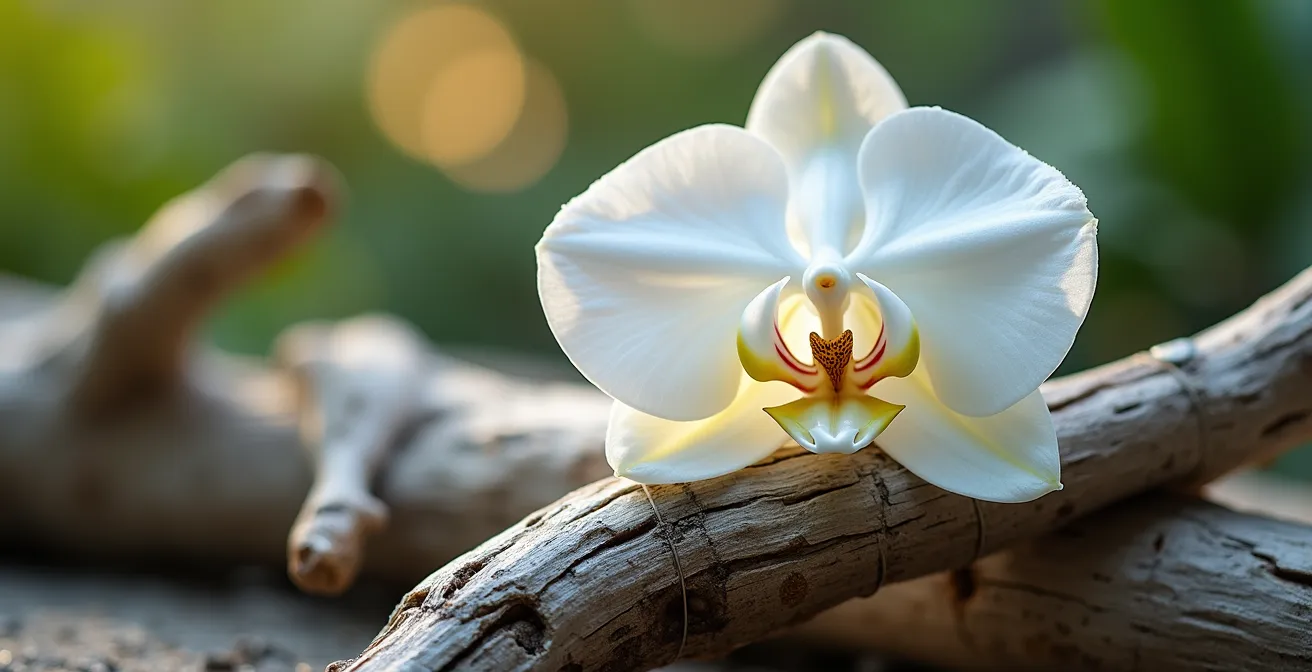
As this image illustrates, a single, perfect bloom like a Phalaenopsis orchid can be delicately secured with clear fishing line. This method is almost invisible, creating the illusion that the flower is growing naturally from the wood. It’s a testament to the idea that sophisticated design often relies on subtle, well-executed mechanics. To keep these bouquets fresh, a light misting of water just before the ceremony can make a world of difference.
By choosing the right flowers and using professional attachment strategies, your floral decor will look just as stunning at the end of the ceremony as it did at the beginning.
How to Anchor a Heavy Arbor in Sand to Prevent Tipping?
An unsecured arbor on a sandy beach is a recipe for disaster. Wind is a constant, and the ground itself is unstable. Ensuring your beautiful driftwood structure remains upright is the single most important aspect of its construction. Professional rental companies are adamant about this; for example, one Florida-based company states that their specialty driftwood arbor requires staking and can only be set up by their team in sand or grass. This isn’t just about protecting their inventory—it’s a critical safety measure.
For a DIY arbor, the most reliable method for creating a self-standing structure is the tripod base. Instead of simply digging the two main legs into the sand, you create a much wider, more stable footprint. This involves attaching three additional pieces of driftwood to the bottom of each main leg to form a triangular support. These “feet” distribute the weight and provide multiple points of contact with the ground, dramatically reducing the risk of tipping. For added security, a horizontal crossbar connecting the tripod feet on each side can further reinforce the structure.
Before any fabric or flowers are added, the arbor’s stability must be thoroughly tested. A well-built tripod system should feel completely rigid and unyielding. This structural integrity is the invisible foundation of a high-end look; it allows for confident and creative decoration, free from the worry of a sudden collapse.
Your Action Plan: The Tripod Stabilization Method
- Create the support base: Use 6 driftwood pieces (3 per side) to form a triangular tripod stand for each main leg.
- Secure attachments: Drill directly through the driftwood feet into the main arch legs for a strong, secure connection.
- Position for stability: Arrange the feet to form a stable, wide triangle on each side of the arch.
- Add reinforcement: Connect the tripod feet on each side with horizontal crossbar pieces for additional stability.
- Reinforce connections: Use multiple screws at all tripod joints if necessary to eliminate any wobble.
- Conduct a stability test: Vigorously test the empty frame’s stability before adding any fabric, florals, or decorative elements.
By prioritizing a robust anchoring system, you ensure your ceremony’s focal point is a symbol of strength and beauty, not a source of anxiety.
Naked Wood or Draped Fabric: Which Better Complements a Sea View?
Once your arbor is structurally sound, the great aesthetic debate begins: should the beautiful, weathered driftwood stand on its own, or should it be softened with draped fabric? There is no single right answer; the choice depends entirely on the atmosphere you wish to create. A “naked” arbor makes a strong, graphic statement. It acts as a natural frame for the horizon, allowing the rugged texture of the wood and the expansive sea view to take center stage. This minimalist approach is perfect for couples who want to highlight the raw beauty of their coastal setting with an organic, sculptural element.
On the other hand, draping the arbor with fabric introduces softness, movement, and a touch of traditional romance. Sheer materials like chiffon or organza don’t obstruct the view but rather filter it, creating a dreamy, ethereal glow as the sun shines through. The real magic happens when the sea breeze catches the fabric, causing it to billow and dance. This dynamic movement adds a layer of life and romance to your ceremony backdrop, creating incredible photographic moments. It transforms the arbor from a static structure into an interactive part of the environment.
The following comparison breaks down the key styling options to help you decide.
| Style Option | Visual Effect | Best For | Decoration Elements |
|---|---|---|---|
| Naked Driftwood | Strong graphic composition, frames horizon | Minimalist ceremonies, natural beauty focus | Minimal – perhaps single orchid accents |
| Fabric Draped | Soft, romantic, filters light and view | Traditional weddings, ethereal atmosphere | Flowing chiffon, silk ribbons |
| Living Draping | Organic, wind-resistant, natural cascade | Garden-style beach weddings | Italian Ruscus, Silver Dollar Eucalyptus garlands |
| Mixed Elements | Layered, sophisticated, versatile | Large ceremonies, dramatic backdrops | Combination of fabric, florals, and greenery |

As you can see, the choice isn’t just between wood or fabric, but a spectrum of possibilities. You can even opt for “living draping” with garlands of eucalyptus or Italian Ruscus for an organic cascade that is more wind-resistant than fabric. Ultimately, the best choice is one that feels authentic to your personal style and enhances, rather than competes with, the magnificent sea view.
Whether you choose bold minimalism or romantic softness, an intentional design choice will always result in a more sophisticated and memorable outcome.
How to Transform Your Ceremony Arbor Into a Sweetheart Table Backdrop?
A well-designed driftwood arbor is too beautiful to be used for just 30 minutes. Repurposing it as a stunning backdrop for your sweetheart table at the reception is a smart, sustainable, and stylish choice. This transition requires some forethought in the initial design and coordination on the day of the wedding. The key is to plan for a modular and mobile structure. Some professional designs, for instance, feature a multi-piece arbor with a layered top that is beautiful yet easier to move than a single, massive piece.
The transformation from day to night also offers an opportunity to evolve the decor. While sun-bleached florals and light fabrics are perfect for a daytime ceremony, the evening reception calls for a different mood. This is the perfect time to introduce lighting. Winding delicate LED fairy lights around the branches of the arbor can create a magical, starry effect as dusk falls. For a warmer, more romantic glow, placing hurricane vases with candles at the base of the arbor adds ambiance safely. Be sure to use enclosed vases to protect the flame from any lingering sea breeze.
This day-to-night shift can also apply to the color palette. You might consider swapping out some of the lighter ceremony florals for deeper, richer tones for the reception, or adding colored glass containers with tea lights for a pop of evening color. The most important element is planning. Ensure your wedding coordinator or venue staff are aware of the plan to move the structure and have the necessary help to do so safely. A seamless transition depends on this coordination.
By planning ahead, your driftwood arbor can serve as a breathtaking focal point for both your vows and your first meal as a married couple, creating a cohesive and elegant theme throughout your celebration.
How to Design Boho Installations That Look High-End Instead of Messy?
The “bohemian” or “boho” aesthetic is a popular choice for coastal weddings, but there’s a fine line between effortlessly chic and simply messy. The key to achieving a high-end boho look lies in three principles: intentionality, quality, and restraint. A messy look often results from an accumulation of random, low-quality decorative items. A sophisticated boho design, however, is a curated collection of a few high-impact, natural elements.
Instead of scattering many different types of flowers, a high-end approach might focus on one or two unique, textural elements. For example, using clusters of pampas grass, king protea, or sculptural air plants makes a stronger, more cohesive statement than a busy mix of smaller blooms. The same principle applies to textiles. Rather than multiple clashing patterns, choose one high-quality, hand-woven macrame hanging or a single, beautifully dyed silk runner. The luxury is in the craftsmanship of the individual pieces.
Another way to elevate the boho aesthetic is by choosing elements that are both beautiful and practical for the environment. Succulent arrangements are a perfect example. As an alternative to traditional flowers, they offer a unique, modern, and sculptural quality. Their natural drought resistance makes them ideal for a hot, sunny beach setting, so they look pristine all day long. Arranging various succulents in a shallow dish with sand and small pebbles creates a miniature beachscape that is both on-theme and incredibly chic. It’s a choice that feels both organic and thoughtfully designed—the very essence of high-end boho.
By focusing on curated, high-quality elements and exercising restraint, your boho-inspired decor will feel artistic and luxurious, not disorganized.
How to Style Rattan Chargers Without Your Table Looking Too Casual?
Rattan chargers are a fantastic way to bring natural texture and warmth to your coastal wedding tablescape. However, their rustic charm can sometimes risk making the setting feel too casual, like a daytime picnic rather than an elegant reception. Elevating the look is all about creating a sophisticated contrast through layering and material choice. The rattan provides the organic base; what you place on top of and around it will define the overall tone.
To achieve a polished finish, place the rattan chargers beneath high-quality plates. Crisp, neutral-toned ceramic or fine porcelain creates an immediate sense of refinement. The contrast between the charger’s woven texture and the plate’s smooth surface is visually interesting and instantly upscale. The choice of cutlery also plays a major role. Instead of standard stainless steel, opt for flatware in gold, matte black, or even wood to complement the earthy feel while adding a touch of modern elegance. Similarly, using soft linen or cotton napkins in muted, organic tones like sage green, terracotta, or off-white adds a layer of softness and sophistication.
For those concerned about the durability or uniformity of natural rattan, high-quality alternatives exist. Some suppliers offer faux rattan chargers made from durable acrylic, which capture the woven look but provide a more polished, consistent finish perfect for upscale events. According to professionals at Artera Home, the key to an elegant look is to pair the chargers with a soft, organic color palette and high-quality textiles. By carefully curating these surrounding elements, your rattan chargers become a chic, textural foundation for a tablescape that is both coastal-inspired and undeniably elegant.
By pairing rattan with refined materials and a thoughtful color palette, you can create a reception table that feels both naturally beautiful and exceptionally stylish.
Key Takeaways
- Structure is paramount: Master anchoring and stabilization before any decoration.
- Work with nature, not against it: Choose wind-resistant florals and use draping to capture the breeze.
- Sophistication is in the details: Elevate rustic elements like rattan with high-quality pairings and intentional layering.
How to Design a Chuppah That Is Both Structurally Sound and Photogenic?
A chuppah, like an arbor, serves as a sacred and beautiful centerpiece for a wedding ceremony. When designed for a coastal setting, it must meet the dual demands of being both structurally sound and breathtakingly photogenic. The principles are the same: stability is the foundation of beauty. The frame, whether made of bamboo, polished copper, or weathered driftwood, must be robust and securely anchored. For a chuppah, which is often viewed from all sides, a 360-degree design approach is essential. Each side should be given equal attention, ensuring it looks beautiful from every guest’s perspective.
The photogenic quality of a chuppah comes from the interplay of its structural lines with soft, decorative elements. Flowing chiffon or a family tallit draped over a sturdy frame can create a romantic, airy effect, especially when the breeze brings it to life. Floral design is also critical. Adorning the posts with colorful orchids, roses, or other hardy blooms adds elegance and a celebratory feel. This is where professional expertise becomes invaluable. According to industry experts, wedding industry professionals confirm that specialized florists significantly improve floral longevity, as they can recommend varieties that withstand heat, wind, and humidity.
Ultimately, a successful chuppah or arbor design is one where the engineering is so well-executed that it becomes invisible, allowing the beauty and symbolism to take center stage. The structure and the decoration are not separate concerns; they are two parts of a single, harmonious whole. A photogenic design is, by necessity, a well-built one. It is the confidence in its stability that allows for true creative expression, resulting in a centerpiece that is as safe as it is stunning.
Now, begin planning your structure with these principles in mind to ensure your coastal wedding centerpiece is as strong as it is stunning.