
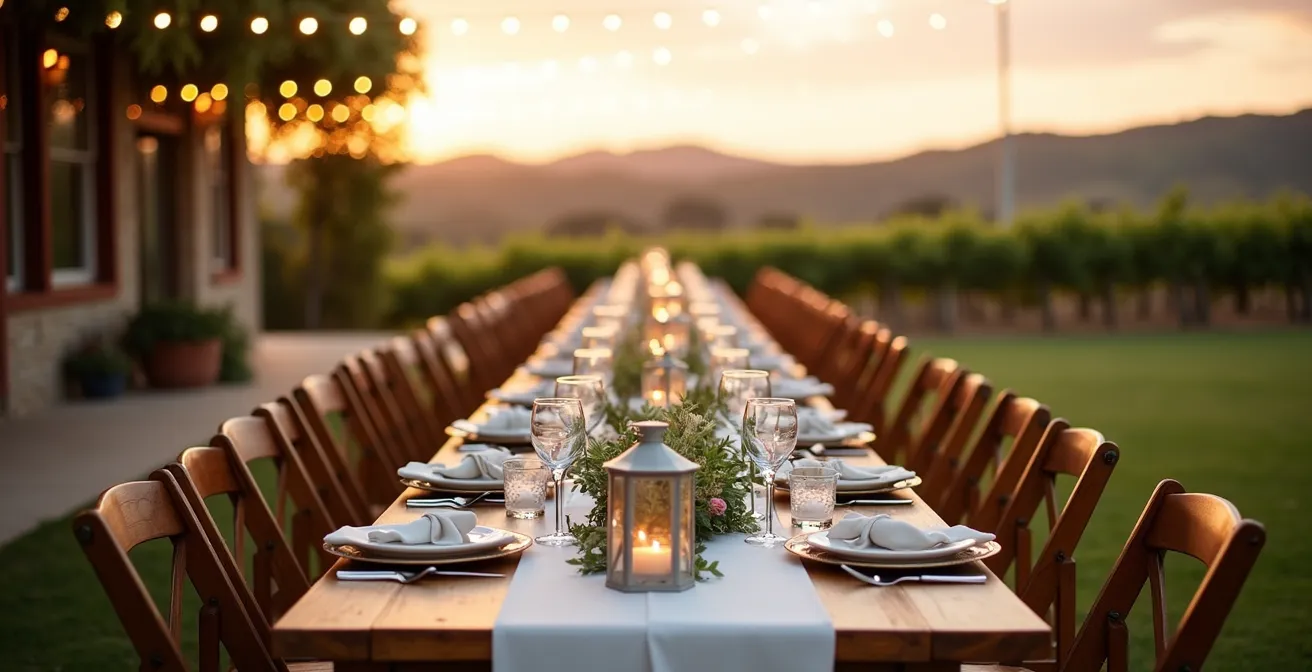
An unforgettable al fresco dinner relies not on hoping for good weather, but on engineering for bad weather; mastering the physics of wind, condensation, and sound is the true secret.
- Wind comfort is lost long before it becomes dangerous; plan for thresholds around 11 mph, not just structural safety limits.
- Anticipate the “dew point”—the moment falling temperatures cause condensation, soaking linens and chilling guests—by choosing synthetic fabrics.
Recommendation: Shift your mindset from creating a “backup plan” to designing a “second, equally magical experience” from the start.
The vision is intoxicating: long tables draped in linen, guests laughing under a canopy of stars, and the gentle clinking of glasses in the warm evening air. This idyllic al fresco dinner is the pinnacle of event elegance. Planners and couples spend countless hours selecting floral arrangements, curating menus, and perfecting playlists. Yet, most overlook the invisible forces that can dismantle this perfect picture in minutes.
The common advice is to “have a backup plan” or “check the forecast,” but this approach is dangerously superficial. It treats nature as a minor inconvenience rather than the most powerful and unpredictable guest at the table. What if the key to a successful outdoor event wasn’t just about beautiful decor, but about mastering the fundamental physics of an open-air environment? The real art lies in understanding the science of wind, the dynamics of condensation, and the principles of sound travel before they become problems.
This guide moves beyond generic checklists to provide a meteorology-aware strategy. We will dissect the critical environmental factors one by one, offering engineering-based solutions to preemptively counter each risk. By learning to anticipate and control these variables, you can ensure your starlit dinner remains a triumph of planning, not a victim of circumstance.
To achieve this, we will explore the specific thresholds and phenomena that determine the success or failure of an outdoor event. The following sections break down each challenge, from wind speed and acoustics to contingency planning, providing the actionable knowledge needed to host with confidence.
Summary: Planning a Resilient Al Fresco Celebration
- At What Wind Speed Does Al Fresco Dining Become Unsafe?
- The Dew Point Phenomenon That Soaks Your Linens After Sunset
- Why You Need Twice the Speakers for an Open-Air Toast?
- Blankets or Heaters: Which Is More Effective for a 60°F Evening?
- How to Light a Dinner Table When There Is Nothing to Hang Lights From?
- The Force Majeure Clause: What Happens If Your Vendor Cancels Last Minute?
- Carpet, Petals, or Vinyl: Which Aisle Runner Works on Grass and Heels?
- How to Create a Rain Plan You Actually Love and Won’t Resent Using?
At What Wind Speed Does Al Fresco Dining Become Unsafe?
The most common mistake in planning an outdoor dinner is underestimating the impact of wind. While most people worry about rain, a persistent breeze is far more likely and can be just as disruptive. The critical question isn’t just about safety, but about comfort. Aerodynamic instability begins to affect the guest experience long before any structural danger arises. While event safety guidelines indicate that wind speeds exceeding 20-25 mph pose a risk to temporary structures like tents, the threshold for comfort is much lower.
For true al fresco enjoyment, we should look to more nuanced metrics. According to the Netherlands’ rigorous NEN 8100 wind comfort standards, areas for frequent sitting like restaurant terraces are only considered comfortable when hourly mean wind speeds remain below 11 mph. Above this speed, conversation becomes difficult, napkins take flight, and the convective heat loss from guests’ bodies accelerates, making them feel cold even on a mild evening. The real danger to your event isn’t collapse; it’s the slow erosion of comfort and ambiance.
Understanding these thresholds allows for proactive planning. Here are the key wind speed levels to monitor:
- Below 11 mph: Ideal conditions. All activities are comfortable.
- 11-15 mph: The “annoyance” threshold. Paper items need weights, and tall, slender centerpieces are at risk.
- 15-20 mph: The “disruption” zone. Lightweight decor can be damaged, and guests will feel the chill. This is where aerodynamic instability becomes a major factor for table settings.
- Above 20 mph: The “danger” zone begins. Safety concerns for temporary structures emerge, and the event’s viability is seriously compromised.
The Dew Point Phenomenon That Soaks Your Linens After Sunset
Even on a perfectly calm and clear day, a hidden threat awaits your beautiful tablescapes: the dew point. This is the temperature at which the air becomes saturated with moisture, causing condensation to form on surfaces. As the sun sets and the ambient temperature drops, it will inevitably cross the dew point threshold. The result? Your crisp, elegant linens become mysteriously damp, clammy, and cold to the touch, creating a deeply unpleasant experience for your guests.

This phenomenon, driven by Dew Point Dynamics, is a matter of physics, not a sign of rain. The key to combating it lies in fabric selection. Natural fibers like cotton and linen are highly hygroscopic, meaning they readily absorb moisture from the air, making them the worst possible choice for an evening outdoor event. They become saturated quickly and dry very slowly. Synthetic materials, however, offer a much more resilient solution.
Understanding fabric performance in high-humidity conditions is essential for any outdoor planner. This table breaks down the crucial differences:
| Fabric Type | Moisture Absorption | Drying Time | Best Use Case |
|---|---|---|---|
| Cotton/Linen | High (hygroscopic) | Slow | Avoid for evening events |
| Polyester blends | Low | Fast | Ideal for dew-prone settings |
| Silk | Moderate | Moderate | Protected areas only |
| Tencel blends | Moderate | Fast | Luxury alternative for outdoor use |
Why You Need Twice the Speakers for an Open-Air Toast?
One of the most overlooked aspects of an al fresco dinner is audio. A heartfelt toast or a gentle background melody can be completely lost to the open air, a phenomenon known as acoustic dispersion. Unlike an indoor space where walls and a ceiling reflect sound waves back toward the audience, an outdoor setting has no boundaries. Sound radiates outwards and upwards, dissipating rapidly. This means a standard two-speaker setup that works perfectly in a ballroom will be woefully inadequate for a 100-guest dinner under the stars.
To compensate for this, outdoor events typically require two to three times more audio equipment than their indoor counterparts. The goal is not to be louder, but to achieve even, intelligible coverage at a comfortable, conversational volume. Blasting music from two large speakers at the front only creates a deafening experience for the tables nearby and leaves those in the back hearing nothing but a muffled echo. Wind further complicates this by creating “sound shadows” and phase cancellation, rendering speech unintelligible.
The professional solution is a distributed audio system. This involves placing numerous smaller, low-volume speakers strategically throughout the space, often every two to three tables. Each speaker is calibrated to cover a small, specific zone. This approach ensures that every guest can hear toasts, speeches, and music clearly, as if the sound were originating from right beside them. It’s a significant investment in equipment and expertise, but it’s the only way to guarantee that the emotional high points of the evening are shared by everyone, not just those sitting near the DJ booth.
Blankets or Heaters: Which Is More Effective for a 60°F Evening?
As evening temperatures dip, ensuring guest comfort becomes a top priority. A 60°F (15°C) evening might sound mild, but after sitting for an hour, it can feel unpleasantly chilly. The default solution for many is to rent propane “mushroom” heaters. However, their effectiveness is dramatically reduced by the very element you are most likely to encounter outdoors: wind. The principle of convective heat loss means that any breeze will simply blow the warm air generated by heaters away before it can reach your guests.
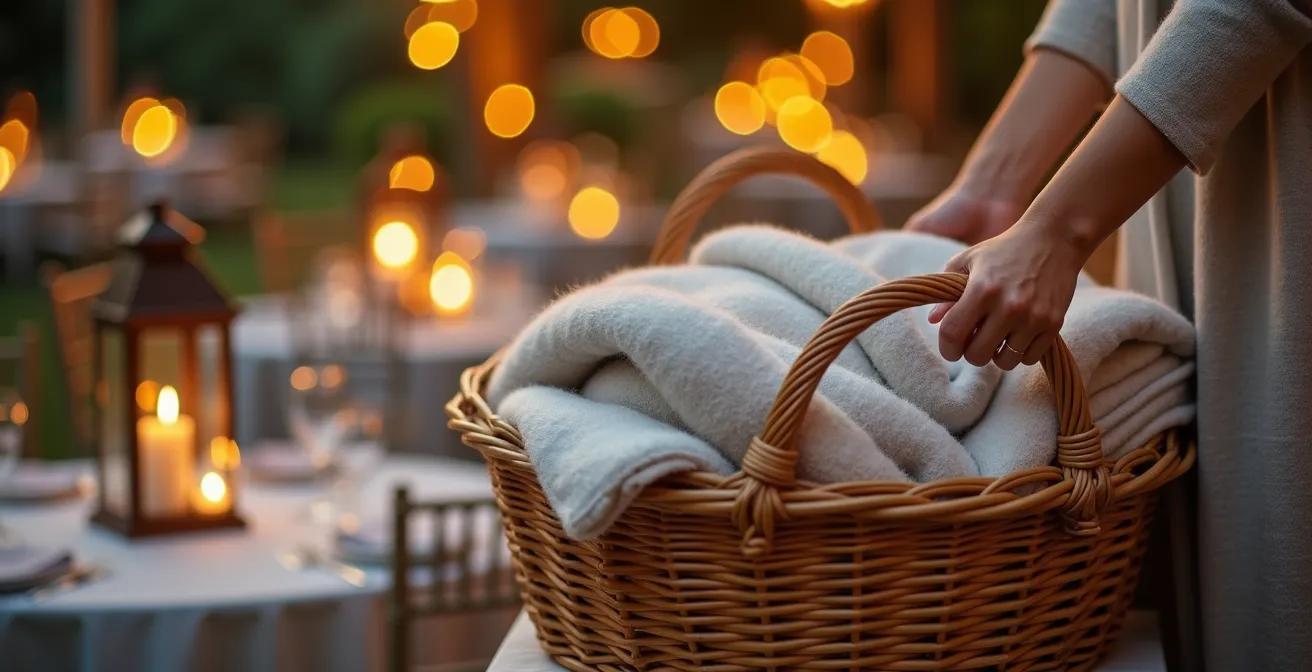
A far more effective and reliable solution is surprisingly simple: high-quality blankets. While heaters fight a losing battle against the open air, a blanket works by trapping an individual’s own body heat, an effect that is completely immune to wind. As Wedding Planning Expert from the Professional Wedding Planning Guide notes, the psychological impact is also significant:
The visual cue of a beautifully presented blanket bar, or the glow of a fire pit, makes guests feel warmer and more cared for, raising their comfort level even before the temperature drops.
– Wedding Planning Expert, Professional Wedding Planning Guide
A direct comparison reveals the stark difference in performance, especially once wind becomes a factor:
| Heating Method | Calm Conditions | Light Breeze | Moderate Wind | Cost Range |
|---|---|---|---|---|
| Propane Heaters | 95% effective | 50% effective | 25% effective | $75-150/unit |
| Electric Infrared | 90% effective | 75% effective | 60% effective | $100-200/unit |
| Quality Blankets | 100% effective | 100% effective | 100% effective | $15-30/blanket |
How to Light a Dinner Table When There Is Nothing to Hang Lights From?
One of the biggest logistical challenges of an open-field dinner is lighting. Without trees, tents, or structures to hang string lights from, many planners feel lost. The solution is to shift your thinking from top-down to ground-up. An array of creative, ground-based lighting techniques can create a magical atmosphere that is both practical and breathtaking, turning the lack of anchor points into a design opportunity.
The most professional and effective technique for lighting tables in an open space is pin spotting. This involves placing narrow-beam spotlights on tripods or discreet stands far away from the dining area (20-30 feet). Each light is then precisely aimed to illuminate the center of a single table, making the centerpieces and place settings pop without blinding guests. This creates a dramatic, high-contrast look where the tables appear to glow in the darkness.
Beyond pin spotting, a layered approach using various ground-based sources is key to creating depth and ambiance. Instead of one single source, combine multiple types of light to build a rich visual environment. Here are some effective strategies:
Your Action Plan: Ground-Up Lighting Solutions
- Ambient Glow: Place battery-powered LED uplights at the base of any available features, like distant trees or architectural elements, to create a soft, ambient wash of reflected light.
- Table Illumination: Install uplights underneath tables dressed with sheer or light-colored linens. This makes the entire table glow from within, providing soft, diffused task lighting.
- Centerpiece Magic: Weave micro-LED “fairy lights” on thin copper wire directly through floral arrangements and centerpieces for an invisible, sparkling light source.
- Focused Drama: Use tripods to position narrow-beam spotlights far from the tables, pin-spotting each centerpiece for a high-end, theatrical effect.
- Layer for Depth: Always combine different lighting types—ambient (overall glow), task (table lamps or under-table lighting), and accent (pin spots)—to avoid a flat, one-dimensional look.
The Force Majeure Clause: What Happens If Your Vendor Cancels Last Minute?
While we can plan for many weather-related challenges, some events—a hurricane, a wildfire, a flash flood—are simply beyond control. This is where the Force Majeure clause in your vendor contracts becomes critically important. This legal provision allows a party to be freed from liability if an extraordinary event prevents them from fulfilling their contractual obligations. However, its application is widely misunderstood and can be a source of major conflict if not handled correctly.
The most crucial distinction to understand is the difference between a true Force Majeure event and simple vendor failure. As one Event Contract Legal Expert clarifies in the Event Planning Legal Guide, this distinction has significant financial implications:
The crucial difference between a true Force Majeure event and vendor failure is that the latter is breach of contract, not Force Majeure, and triggers different legal rights including the vendor being responsible for replacement costs.
– Event Contract Legal Expert, Event Planning Legal Guide
If a caterer cancels because their kitchen staff quit, that’s a breach of contract. If they cancel because a hurricane has made roads impassable, that’s Force Majeure. In the first case, they are likely liable for finding and funding a replacement. In the second, both parties are typically excused from performance without penalty. Given this, having a clear protocol to follow the moment a vendor invokes Force Majeure is essential to protect yourself.
Checklist for Force Majeure Activation
- Written Confirmation: Immediately secure a written cancellation from the vendor that explicitly cites the specific Force Majeure event as the reason.
- Documentation: Photograph and document the conditions that are preventing performance (e.g., road closures, storm damage, power outage reports). This evidence is crucial.
- Insurance Notification: Formally notify your event insurance provider of the situation, typically within 24 hours as required by most policies.
- Activate Backup Vendors: Immediately contact your pre-arranged “shadow” vendors. This is not the time to start searching for replacements.
- Guest Communication: Trigger your pre-written guest communication plan with clear, concise updates on the new venue, timing, or postponement.
Carpet, Petals, or Vinyl: Which Aisle Runner Works on Grass and Heels?
The walk down the aisle is a focal point of any ceremony, but on a natural grass surface, it’s a minefield of practical challenges. Heels sink into the soft earth, morning dew can turn a fabric runner into a soggy, dirty mess, and seemingly romantic options like rose petals become a slippery hazard. Choosing the right aisle runner is an act of contingency engineering, balancing aesthetics with the physics of foot traffic on uneven, moist ground.
The common choice of a standard carpet runner is often a mistake. It acts like a sponge, absorbing moisture from the grass and tracking dirt and grass stains easily. Rose petals, while beautiful for a moment, quickly turn to a slippery pulp underfoot. A far superior option for both safety and appearance is a heavy-duty white vinyl runner. It provides a stable, water-resistant surface that is easy to clean and offers a firm foundation for heels.
For the ultimate heel-safe solution, however, professionals turn to an engineered system. The best practice involves first installing a temporary interlocking flooring system, such as EventDeck, directly onto the grass. This creates a solid, level sub-base. The decorative aisle runner is then placed on top of this flooring. This two-part system guarantees total stability for even the sharpest stiletto heels while maintaining the pristine aesthetic of a traditional runner.
This comparative table highlights the performance of each surface type on a typical grass lawn:
| Surface Type | Heel Safety | Moisture Response | Maintenance | Cost/Linear Foot |
|---|---|---|---|---|
| Rose Petals | Poor – slippery | Turns to pulp | Single use only | $5-10 |
| Standard Carpet | Moderate | Acts like sponge | Tracks dirt heavily | $8-15 |
| White Vinyl | Good – stable | Water resistant | Wipes clean easily | $10-20 |
| EventDeck + Runner | Excellent | Fully weatherproof | Professional grade | $25-40 |
Key Takeaways
- Wind comfort is the real metric, not just safety. Plan for comfort thresholds around 11 mph.
- Combat evening condensation (dew point) by choosing synthetic, low-absorption linens like polyester blends.
- Outdoor audio requires a distributed system of many small speakers to overcome sound dispersion; a standard two-speaker setup will fail.
- Blankets are always more effective than heaters in windy conditions because they trap body heat directly.
How to Create a Rain Plan You Actually Love and Won’t Resent Using?
The concept of a “Plan B” is often treated with dread—a sad, necessary compromise. This mindset is the single biggest mistake in outdoor event planning. A truly resilient plan doesn’t have a disappointing backup; it has two incredible, fully-realized options. The modern approach is to rebrand the rain plan as “The Rain Experience” and to design it with as much creativity, budget, and intention as the primary outdoor setting.
This means allocating real funds to the indoor or tented space from the beginning. Instead of a plain white tent, consider a clear-span tent to bring the outdoor scenery in, or a sailcloth tent for architectural elegance. Design the space with its own unique and magical atmosphere, using lighting, drapery, and lounge furniture to create a cozy, intimate, and romantic environment that feels like an intentional choice, not a fallback. The goal is for guests to walk in and think, “I’m almost glad it rained.”
The decision to activate this plan should be made decisively and early. Hesitation leads to a frantic, last-minute scramble. Most professional planners recommend executing the rain plan when forecasts show a 40% chance of rain or higher for the key hours of the event. This provides enough time to transition decor, coordinate with vendors, and prepare the space flawlessly. By embracing the potential for rain and designing a stunning alternative, you remove the fear and replace it with confidence, ensuring a beautiful experience no matter what the sky decides.
By shifting your focus from hoping for the best to engineering for the worst, you transform from a planner into a master of the elements. Your flawless al fresco dinner will be remembered not for its luck with the weather, but for its brilliant and resilient design. Begin implementing these proactive strategies today to ensure your event is a guaranteed success.