
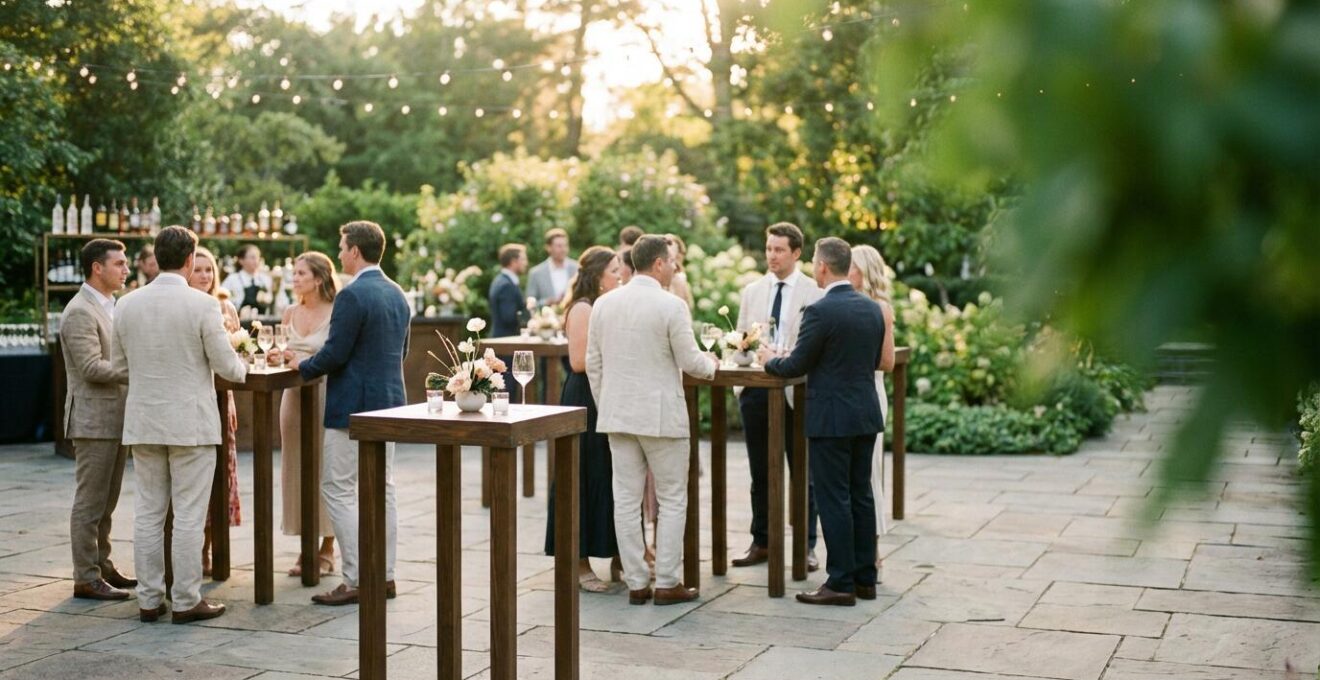
The cocktail hour’s success is not about filling time, but about masterfully managing guest energy and connection.
- Intentional layout and interactive “hubs” are more effective at encouraging mingling than simply placing tables.
- The choice between grazing tables and passed hors d’oeuvres dictates guest movement and overall social dynamics.
Recommendation: Treat the cocktail hour as a strategic bridge. Focus on guest-centric design choices that guide the transition from the ceremony’s emotion to the reception’s celebration.
As a hospitality director, I’ve observed that the most masterful weddings are defined by their transitions. The moment between the final “I do” and the grand reception entrance is often treated as a logistical pause—a time for photos, a quick drink, and a few canapés. But this perspective misses a golden opportunity. The cocktail hour is not a waiting room; it is the strategic and emotional bridge of your entire wedding day. It’s the first impression of your celebration, setting the tone for the entire evening.
The common advice focuses on checklists: signature drinks, a good playlist, and enough food. While these are important, they are merely the ingredients. The true art lies in the recipe—the intentional design of the guest experience. It’s about orchestrating an environment that encourages organic connection, manages the social energy of the room, and ensures every single guest, from your college friends to your elderly relatives, feels seen, comfortable, and engaged. The goal is to transform passive waiting into an active, memorable part of the celebration.
But what if the key wasn’t adding more “entertainment,” but in making smarter, more sophisticated choices about time, space, and flow? This guide moves beyond the platitudes to explore the strategic principles of a flawlessly executed cocktail hour. We will delve into how timing dictates energy, how table arrangements can spark conversation, and how even the smallest details can foster a welcoming and vibrant atmosphere that will have your guests buzzing long before dinner is served.
This article provides a complete framework for designing that experience. We will explore everything from the optimal duration and layout to specific strategies for catering to all your guests and curating an atmosphere that builds anticipation for the night ahead.
Summary: A Strategic Guide to the Perfect Cocktail Hour
- Why Extending Cocktail Hour Beyond 90 Minutes Is a Risky Move?
- How to Arrange Cocktail Tables to Encourage Mixing Between Families?
- Stationary Grazing Tables or Passed Hors d’Oeuvres: Which Serves Guests Faster?
- The Seating Error That Leaves Your Elderly Guests Exhausted Before Dinner
- How to Transition Music from Romantic Ceremony to Party Mode During Cocktails?
- Why Low Floral Centerpieces Are the Key to Better Guest Conversation?
- Why 60% of Wedding Favors Get Left Behind and What to Give Instead?
- How to Curate Bespoke Table Styling That Encourages Guest Interaction?
Why Extending Cocktail Hour Beyond 90 Minutes Is a Risky Move?
The first principle of exceptional hospitality is managing your guests’ energy and expectations, and this begins with time. While it may be tempting to extend the cocktail hour to accommodate a lengthy photo session, this is often a strategic error. The industry standard is clear: the typical cocktail hour at weddings lasts for 60 minutes. This duration is not arbitrary; it is the sweet spot for maintaining a vibrant social atmosphere. Guests arrive energized from the ceremony, ready to mingle and celebrate. A concise, well-paced hour capitalizes on this initial excitement.
Pushing beyond the 90-minute mark introduces significant risks to the guest experience. Social momentum begins to wane, and what was once lively chatter can become forced conversation. Guests, especially those with children or elderly attendees, may become visibly restless or fatigued. The initial supply of appetizers gets depleted, leading to longer lines at the bar and a general sense of “waiting around.” The worst-case scenario is a noticeable drop in energy, creating an uphill battle for your DJ or band to rebuild momentum when the reception finally begins. The cocktail hour should feel like a spirited overture, not a lengthy intermission.
The solution is not to rush your photos, but to plan them with ruthless efficiency. Work with your photographer to create a detailed shot list and timeline that fits within a 60-to-75-minute window. Consider a “first look” before the ceremony to capture many of your couple and wedding party portraits. By respecting your guests’ time and energy, you ensure the transition to the reception is seamless and filled with anticipation, not exhaustion.
How to Arrange Cocktail Tables to Encourage Mixing Between Families?
A successful cocktail hour is measured by the buzz of conversation and the sight of guests from different parts of your lives connecting. This doesn’t happen by accident; it’s a result of strategic spatial design. The traditional approach of scattering high-top tables can feel static. Instead, think like an event designer and create “interactive hubs” or “conversational pods” that naturally draw people together. The goal is to engineer an environment that makes mingling feel organic and effortless, breaking down the invisible barriers between family and friend groups.
Instead of uniform rows of tables, vary your setup. Combine a few high-tops with clusters of comfortable armchairs and smaller side tables. This creates different zones for different energy levels, allowing some guests to stand and chat while others relax. An excellent case study comes from The Mansion at Mountain Lakes, which designs “Interactive Hubs” by placing seating around micro-experiences like a live painter, a caricaturist, or an audio guestbook station. The shared activity becomes an instant, low-pressure icebreaker, giving strangers a natural reason to start a conversation. You are no longer just providing furniture; you are curating connection points.
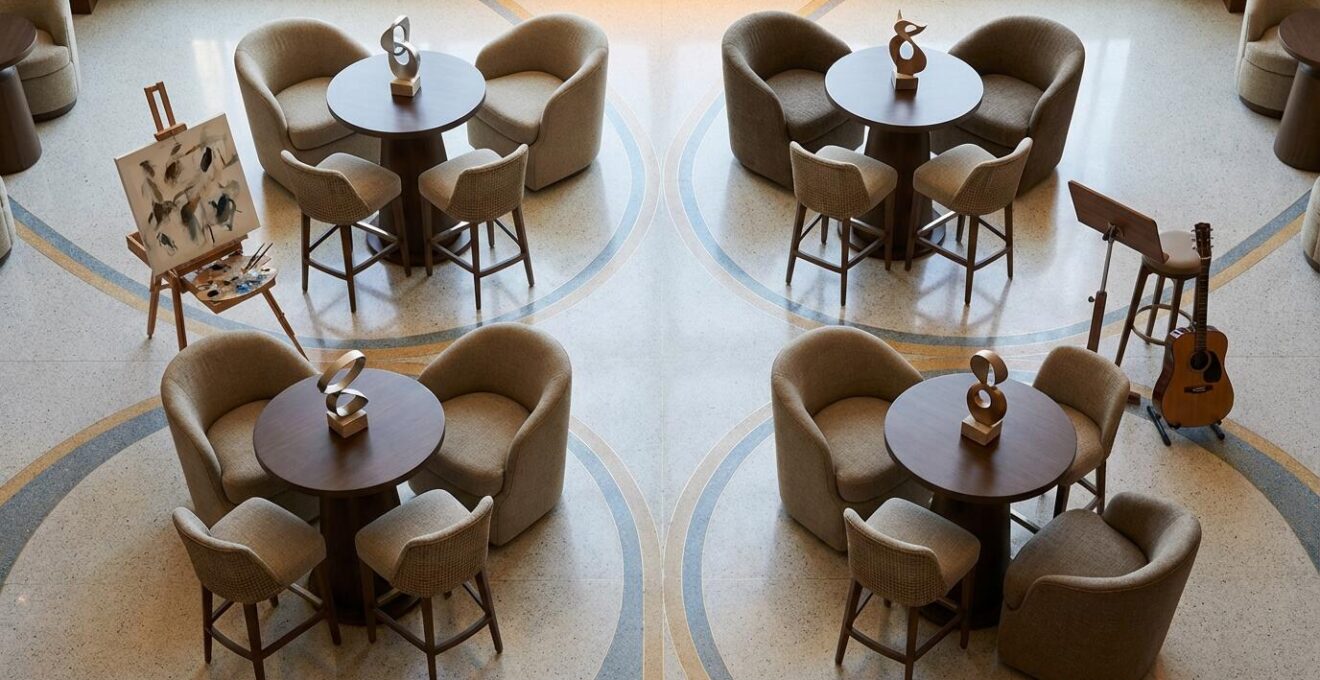
This layout, seen from above, demonstrates how a thoughtful arrangement can guide guest flow. The pathways between pods encourage movement, while the clusters themselves provide comfortable landing spots. By breaking up the open space, you create a more intimate and welcoming atmosphere. Guests are more likely to strike up a conversation with someone new when they are part of a small, comfortable group rather than adrift in a large, undifferentiated room. This guest-centric approach to layout is fundamental to transforming your cocktail hour from a holding area into a dynamic social event.
Stationary Grazing Tables or Passed Hors d’Oeuvres: Which Serves Guests Faster?
The question of how to serve food during cocktail hour goes beyond mere logistics; it fundamentally shapes guest behavior and the flow of your event. Stationary grazing tables create a spectacular visual focal point, an explosion of abundance that generates an immediate “wow” factor. Passed hors d’oeuvres, on the other hand, bring the service directly to the guests, ensuring everyone is reached and encouraging continuous movement and mingling throughout the space. Each approach has distinct advantages, and the best choice depends on the specific atmosphere you wish to cultivate.
A grazing table is self-serve, eliminating wait times and allowing guests to eat at their leisure. However, it requires guests to move towards a central point, which can sometimes create bottlenecks or leave more introverted guests on the periphery. Passed hors d’oeuvres excel at guest coverage, as servers can navigate the entire room, seeking out those who may be shy or deep in conversation. The following comparison breaks down the key differences.
| Aspect | Stationary Grazing Tables | Passed Hors d’Oeuvres |
|---|---|---|
| Guest Movement | Creates central gathering point | Encourages mingling throughout space |
| Service Speed | Self-serve, no waiting | Depends on server circulation |
| Visual Impact | Strong ‘wow factor’ focal point | Less visual presence |
| Guest Coverage | Guests must approach table | Servers reach all guests |
| Food Variety Display | All options visible at once | Discovery element with each pass |
| Best For | Creating abundance atmosphere | Ensuring shy guests are served |
To get the best of both worlds, many venues are adopting a hybrid model. As a case study, Clarks Landing Yacht Club has found success by combining a smaller, visually stunning grazing table with a variety of unique passed hors d’oeuvres. This “Wow & Flow” approach provides that initial Instagrammable moment and central gathering spot, while the circulating servers ensure that the flow of conversation is never interrupted and that every guest feels personally attended to. This strategy balances visual impact with impeccable, guest-centric service.
The Seating Error That Leaves Your Elderly Guests Exhausted Before Dinner
A truly sophisticated cocktail hour is one where every guest feels comfortable and considered. One of the most common oversights is providing inadequate or poorly placed seating, a mistake that particularly affects elderly guests or those with mobility issues. Standing for over an hour can be exhausting, leaving them drained before the reception even begins. The key is to provide dedicated comfort zones that are both accessible and integrated, rather than isolated, from the main celebration. This thoughtful gesture of hospitality ensures they can fully enjoy the entire evening.
The placement of this seating is critical. As a rule, wedding planners recommend seating elderly guests away from speakers and high-traffic areas, while keeping them close to restrooms and exits. This minimizes noise and disruption, allowing for comfortable conversation. Furthermore, the type of seating matters immensely. Low, modern lounge furniture can be difficult to get in and out of. Prioritize standard dining-height chairs, preferably with armrests, to provide support and stability.
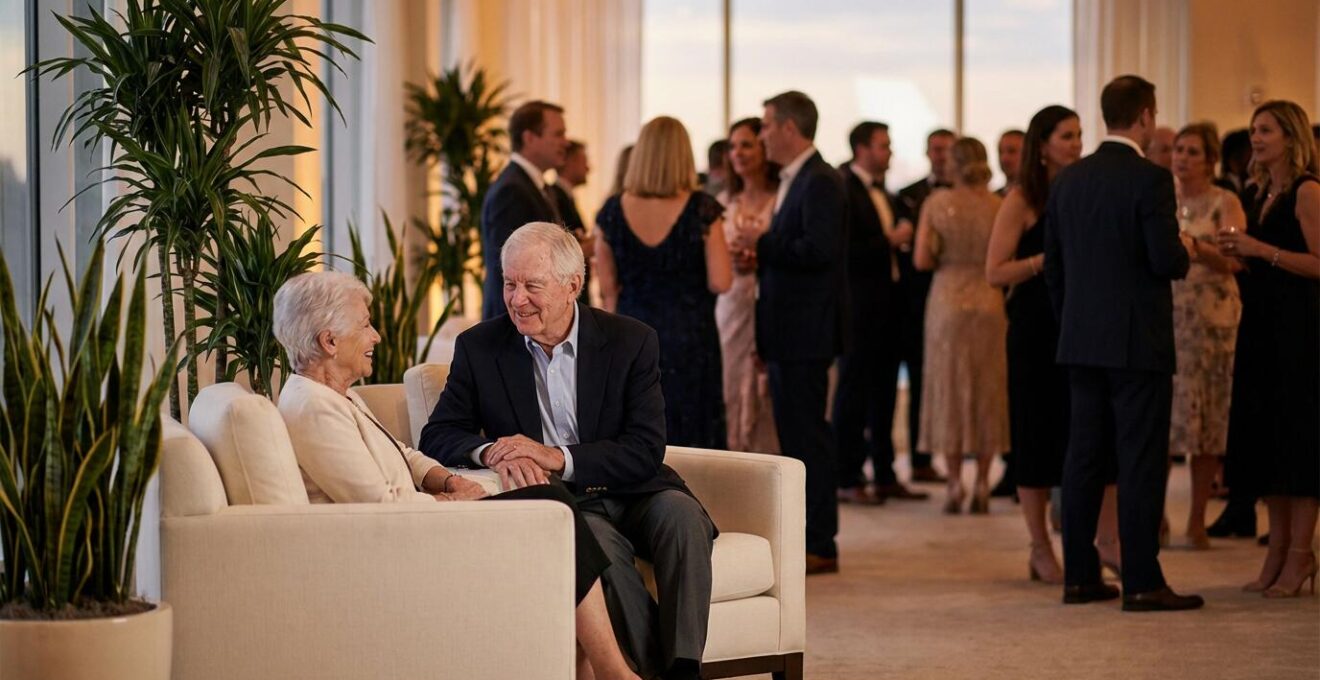
Creating these thoughtful spaces doesn’t require sacrificing style. As shown here, elegant armchairs can be clustered together, with tall plants or decorative screens acting as natural acoustic buffers. By reserving a few of these areas, you remove the stress of your older guests having to search for a comfortable spot. This small act of guest-centric design speaks volumes about your care and consideration, ensuring all your loved ones have the stamina to celebrate with you all night long.
Your Checklist for Elderly Guest Comfort
- Provide chairs with armrests to assist with sitting down and standing up.
- Position seating within easy walking distance of restrooms and venue exits.
- Create acoustically buffered zones using tall plants or decorative screens near seating.
- Opt for standard dining-height chairs over low lounge furniture.
- Formally reserve these comfortable seating areas to prevent them from being occupied by others.
How to Transition Music from Romantic Ceremony to Party Mode During Cocktails?
Music is the invisible conductor of your cocktail hour, subtly guiding the emotional arc from the tender romance of the ceremony to the high-energy celebration of the reception. A jarring or monotonous playlist can disrupt this flow. The most effective approach is a strategic “Tempo Ramp-Up,” a technique used by professional musicians to gradually build the energy in the room. This isn’t about simply pressing play on a generic list; it’s about curating a sonic journey that mirrors and encourages the rising social excitement.
A perfect case study for this is the method employed by professional groups like Flavor Band Atlanta. They begin the cocktail hour with slower, atmospheric music—such as instrumental soul or light jazz—at around 70-90 beats per minute (BPM). This creates a sophisticated, relaxed backdrop for the initial conversations. As the hour progresses and guests settle in, they transition to more upbeat indie pop or lounge tracks in the 90-110 BPM range. For the final 15-20 minutes, just before the reception doors open, they introduce light funk or disco at 115-125 BPM, signaling a shift in energy and building anticipation for the party to come.
This gradual increase in tempo is seamless and organic, lifting the room’s energy without ever overpowering conversation. A key element is volume control; the music should always be at a level that allows guests to talk comfortably without shouting. To further enhance the experience, consider using “nostalgic bridges”—modern lounge covers of classic songs that both younger guests and the parent generation will recognize. This creates shared moments of recognition and bridges generational tastes. By mapping the musical energy to the natural energy of the crowd, you create a sophisticated and engaging transition that feels entirely effortless.
Why Low Floral Centerpieces Are the Key to Better Guest Conversation?
Every element on a cocktail table should serve a purpose, and centerpieces are no exception. While tall, dramatic floral arrangements can be stunning, they often create a physical barrier that hinders the primary goal of the cocktail hour: connection. When guests have to peer around a large vase to make eye contact, conversation becomes stilted and awkward. Low centerpieces are the elegant solution, creating a beautiful focal point without sacrificing the all-important line of sight. This simple choice directly facilitates more natural, engaging, and intimate conversations.
Low arrangements draw guests closer together, creating a shared space on the table that encourages interaction. They allow for the placement of fragrant, subtle flowers whose scent can be enjoyed without being overwhelming. High centerpieces not only block views but also reduce the usable surface area of the table, leaving less room for drinks and plates. The advantages of a lower profile are clear and directly impact the social dynamics of the room.
| Factor | Low Centerpieces | High Centerpieces |
|---|---|---|
| Guest Eye Contact | Unobstructed, natural | Blocked or awkward angles |
| Drink Placement | Creates shared territory | Reduces usable table space |
| Conversation Flow | Draws guests closer together | Creates physical barrier |
| Scent Impact | Allows subtle fragrant flowers | Scent dispersed too high |
| Interactive Potential | Easy to incorporate elements | Too tall for interaction |
To take this concept a step further, consider making your centerpieces interactive. Lily & Lime Events has seen great success with the “bud vase bar” concept. Instead of one static arrangement, several small bud vases with single stems are placed on each table. Guests are invited to choose a flower to wear or take with them. This transforms the centerpiece from a passive decoration into an active ice-breaker and a living element that evolves throughout the hour. It’s a brilliant example of guest-centric design, using a simple detail to spark joy and connection.
Key Takeaways
- The ideal cocktail hour duration is 60-90 minutes to maintain guest energy and prevent fatigue.
- Strategic layout with varied seating and “interactive hubs” is more effective for mingling than uniform table placement.
- A hybrid food model, combining a visual grazing table with passed hors d’oeuvres, offers the best balance of “wow” factor and guest service.
Why 60% of Wedding Favors Get Left Behind and What to Give Instead?
The sentiment behind wedding favors is lovely, but the reality is often disappointing. After a beautiful evening, tables are frequently littered with forgotten trinkets—small items that, lacking immediate use or personal meaning, are simply left behind. This common phenomenon highlights a shift in guest values from material takeaways to memorable experiences. The most successful “favors” are no longer objects given at the end of the night, but experiences integrated directly into the event itself, particularly during the dynamic and social cocktail hour.
Instead of a packaged goodie, consider an “experience favor.” Wedding Spot has noted a significant increase in guest engagement when couples offer something that is created and enjoyed on-site. This could be a caricature artist capturing guests’ likenesses, a live poet composing personalized haikus on a vintage typewriter, or even a classic photo booth that provides instant, tangible memories. These items become cherished keepsakes precisely because they are tied to a specific, joyful moment from your wedding day, rather than being a generic token.
Other creative alternatives can be seamlessly woven into the cocktail hour flow. A “Taste and Take” station next to your signature cocktail bar, offering mini bottles of a key liqueur or syrup with a recipe card, connects the favor directly to the sensory experience. For an outdoor event, immediate-use items like elegant fans or pashminas for an evening chill are both practical and thoughtful. You can also create “progressive favors,” where guests receive a custom glass during the cocktail hour with instructions to use it at a specific reception activity, like a whiskey tasting bar. The key is to shift the mindset from “what to give” to “what to experience.”
How to Curate Bespoke Table Styling That Encourages Guest Interaction?
The final layer of a masterfully designed cocktail hour lies in the details—the small, thoughtful elements of table styling that can turn a simple high-top into a catalyst for conversation. Beyond the flowers and linens, bespoke styling is about adding a touch of personality and intrigue that invites guests to engage with their surroundings and, by extension, with each other. These elements serve as subtle, organic conversation starters, creating moments of discovery and connection without feeling forced or contrived.
A simple yet brilliant example is the use of “Discovery Coasters,” a strategy noted by Clarks Landing. Instead of standard coasters, couples design a set with different fun facts, “two truths and a lie” prompts about their story, or lighthearted questions. Guests naturally pick them up, read them, and are immediately given a low-stakes reason to engage with the person next to them. It’s a small detail that has an outsized impact on the social atmosphere, transforming a passive object into an active tool for interaction.
This principle of discovery can be expanded in numerous ways. You can create themed table “pods” that relate to your story, such as a “Travel Table” adorned with vintage maps and travel guides, or a “University Table” with subtle nods to your alma mater. Placing unique objects on each table—like a vintage camera, a small puzzle, or a beautiful art book—can also spark curiosity and conversation. The goal is to embed your personality into the decor in a way that invites participation. By styling your tables with intention and a touch of whimsy, you provide the final, crucial ingredient for an environment where conversations flow as freely as the champagne.
Ultimately, elevating your cocktail hour is about seeing it through the eyes of your guests. By moving beyond a simple checklist and embracing a philosophy of intentional, guest-centric design, you can transform this transitional moment into one of the most memorable parts of your wedding day. Begin today by outlining the flow and energy you want to create for this crucial hour.