
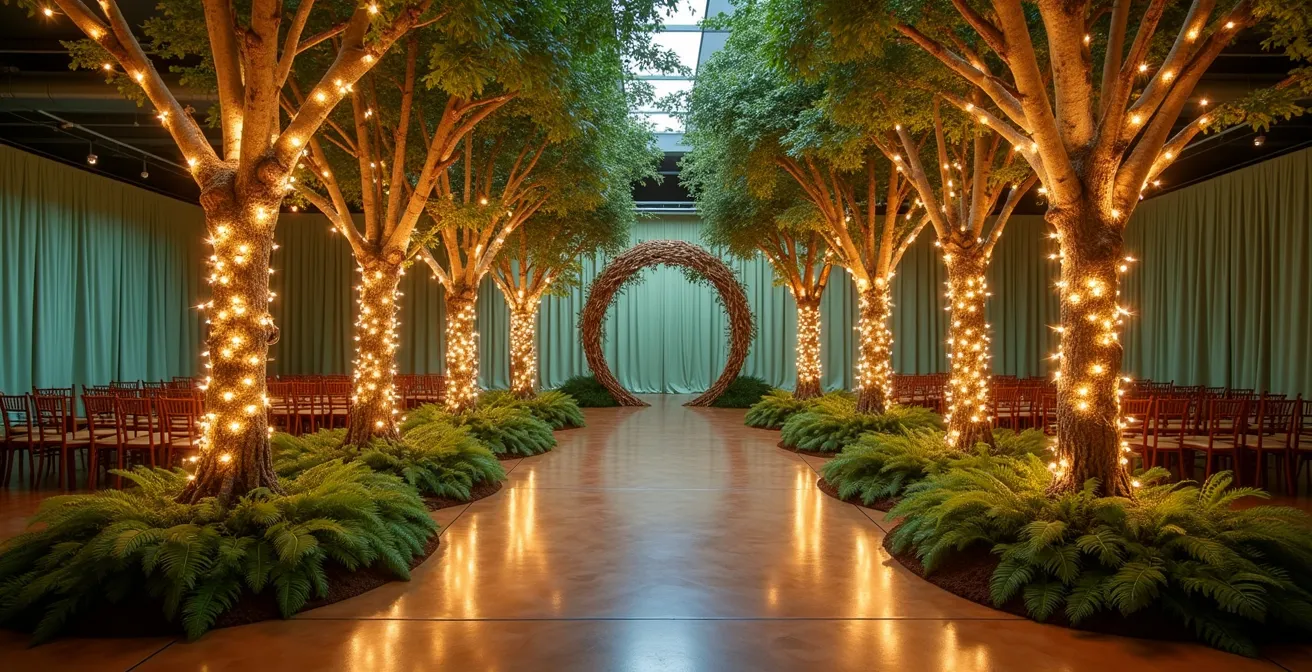
Creating a breathtaking indoor forest wedding is less about decoration and more about strategic environmental engineering.
- Success hinges on choosing logistically sound trees and solving the “no soil, no bugs” problem from the ground up.
- Layering light, scent, and texture is what creates a truly believable, multi-sensory illusion that transports your guests.
Recommendation: Prioritize fire safety compliance and guest sightlines from day one to ensure your enchanted forest is both magical and functional.
The dream of a “Twilight” wedding, a mystical ceremony held under a canopy of ancient trees, is a powerful one. Many couples, captivated by this enchanted forest vibe, seek to bring the soul of the woods into the controlled elegance of an indoor ballroom. The common advice is to simply fill the space with greenery and fairy lights. But this approach often falls short, resulting in a theme that feels more like a garden center than an ethereal grove, and ignores the critical challenges of soil, pests, and safety.
The true transformation of a space from ballroom to bewitching forest is not an act of decoration; it’s a feat of environmental engineering. It requires a holistic strategy that engages every sense and anticipates every logistical hurdle. The secret lies in moving beyond surface-level aesthetics to architect a layered illusion. This involves carefully selecting structural elements, designing a multi-sensory experience with light and scent, and solving the practical problems of an indoor installation with professional precision. It’s about creating an environment so complete that your guests forget they are indoors at all.
This guide will deconstruct the process, moving layer by layer. We will explore the foundational choices for your trees, build the forest floor without a speck of dirt, and then layer in the atmospheric elements of scent and light that bring the illusion to life. By the end, you will have a blueprint for engineering a forest that is not only breathtakingly beautiful but also smart, safe, and seamlessly executed.
For those who prefer a visual summary, the following video offers a beautiful immersion into a wedding that masterfully captures the enchanting forest atmosphere, complementing the practical advice in this guide.
To help you navigate the creation of your own indoor woodland, this article is structured to build your forest from the ground up. The following sections cover everything from the structural “bones” of your forest to the final, magical touches.
Summary: Engineering an Indoor Enchanted Forest
- Real Trees vs. Fabricated Trunks: Which Is Feasible for a One-Day Event?
- How to Use Moss and Pine Scent to Deepen the Forest Illusion?
- Moss, Ferns, or Leaves: What to Use at the Base of Indoor Trees?
- Why Gobo Patterns of Leaves Are Essential for a Forest Theme?
- How to Place Trees Without Blocking Sightlines for Speeches?
- How to Transform Your Venue Walls With Strategic LED Uplighting?
- Citronella Torches: Effective Pest Control or Just a Smoky Eyesore?
- Why Dried Palms Are the Secret to Sculptural, Modern Floral Installations?
Real Trees vs. Fabricated Trunks: Which Is Feasible for a One-Day Event?
The very foundation of your indoor forest is, of course, the trees. This first decision dictates budget, logistics, and the overall realism of your design. While the romance of real, potted trees is undeniable, their weight, potential for pests, and complex transportation make them a significant logistical challenge for a single-day event. Fabricated trunks, on the other hand, are engineered specifically for this purpose. They are lightweight, inherently fire-safe, and designed for rapid setup and breakdown.
The choice is a balance between absolute authenticity and practical feasibility. Real trees offer a perfect visual and a natural, subtle scent, but require a larger crew and careful coordination with the venue regarding floor-loading and cleanup. Fabricated trunks, often made from molds of real trees, can achieve 85-90% realism while eliminating nearly all logistical headaches. They are the professional’s choice for creating a grand-scale forest indoors, allowing for taller, more dramatic structures without the associated risks of weight and soil.
To make an informed decision, it’s crucial to compare the two options across key event-planning metrics. As this cost-benefit analysis for woodland themes shows, the true cost extends far beyond the initial price tag.
| Aspect | Real Trees (Potted) | Fabricated Trunks |
|---|---|---|
| Initial Cost | $150-300 per tree | $200-500 per tree |
| Transportation | Heavy, requires special vehicle | Lightweight, easy transport |
| Fire Safety | Requires flame retardant treatment | Pre-treated, venue compliant |
| Setup Time | 2-3 hours with crew | 30-60 minutes |
| Post-Event | Must return or resell | Easy storage or rental return |
| Visual Impact | 100% authentic | 85-90% realistic |
Ultimately, safety and compliance are non-negotiable. Whether you choose real or artificial elements, your venue’s fire code is the supreme authority. Neglecting this step can lead to last-minute, heartbreaking changes to your design.
Action Plan: Venue Fire Code Compliance Checklist
- Contact your venue coordinator to request specific fire code restrictions on all foliage and decorative materials.
- For artificial elements, demand documentation of their flame-retardant certification from your rental company.
- If using real branches, ensure they are kiln-dried and treated with a certified fire-retardant spray at least 72 hours before the event.
- Verify that your decor plan does not alter the venue’s approved occupancy limits or block any fire exits.
- Submit a detailed decor plan, including materials and layout, to the venue for written approval at least 30 days in advance.
How to Use Moss and Pine Scent to Deepen the Forest Illusion?
A truly immersive environment speaks to more than just the eyes. A forest has a distinct, earthy scent—a combination of damp earth, decaying leaves, and the sharp aroma of pine or cedar. Replicating this olfactory experience, a practice known as scent-scaping, is the secret to making your indoor forest feel profoundly real. Simply lighting a few scented candles won’t suffice; it can create “hotspots” of fragrance and introduce fire hazards. A professional approach uses diffusion technology to create a subtle, consistent ambiance.
Commercial-grade nebulizers or cold-air diffusers are the tools of choice. These devices break down essential oils into a micro-mist that hangs in the air, creating a uniform scent without heat. By placing these units strategically—hidden within foliage or behind fabricated tree trunks—you can fill the space with the authentic scent of a forest. The key is subtlety. The goal is for guests to perceive the scent subconsciously, reinforcing the visual cues around them. A blend of cedarwood, pine, and a touch of vetiver can create a complex, realistic, and enchanting aromatic profile.
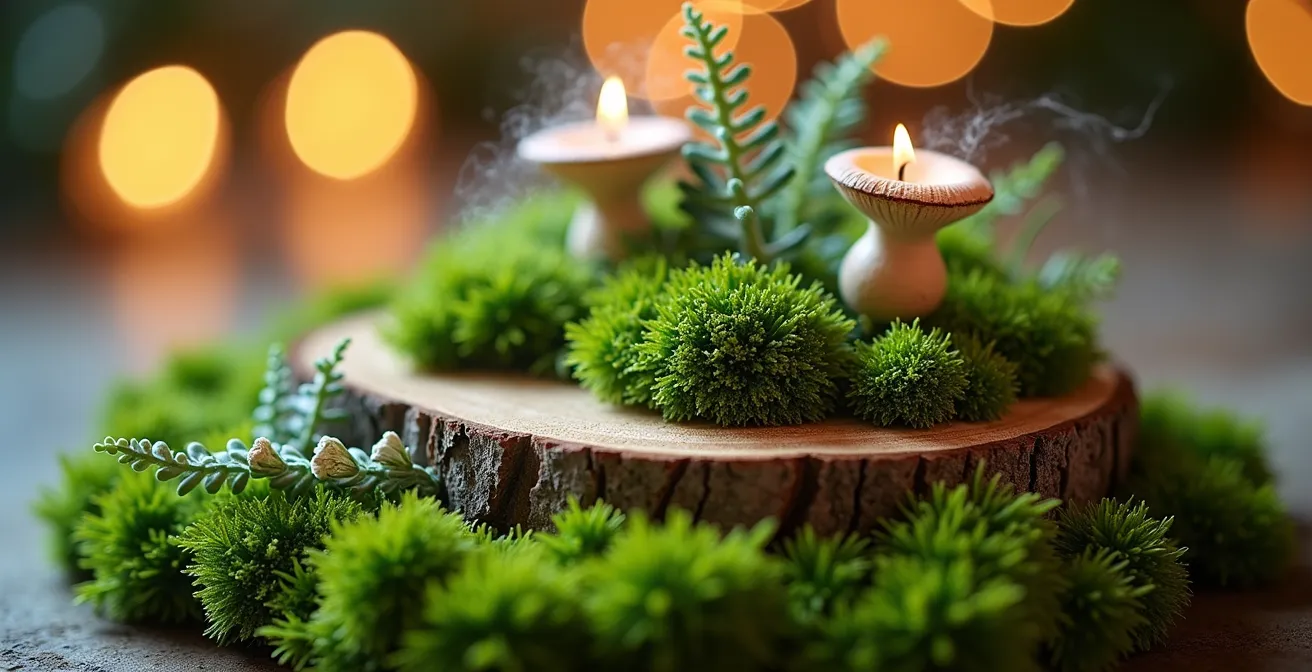
As shown in the image above, this sensory layering can be brought down to a micro-level. Centerpieces can become miniature scent-scapes, with preserved moss and small, untreated wood slices infused with essential oils. This provides a localized fragrance experience for guests at their tables, drawing them deeper into the illusion without overwhelming the larger space.
Case Study: Scent-Scaping an Enchanted Forest
Ashley and Ricky’s 2019 wedding demonstrated the power of scent-scaping by creating distinct aromatic zones. They used commercial-grade nebulizers with cedarwood and pine essential oils in the ceremony area, transitioning to lighter notes near the dining space. By investing $450 in professional diffusion equipment rental and avoiding heated diffusers, they created a subtle, immersive experience. Their approach also included infusing untreated wood slices with essential oils 48 hours prior, creating localized scents at each table without triggering allergies or overpowering guests.
Moss, Ferns, or Leaves: What to Use at the Base of Indoor Trees?
With the “no soil” rule as a primary constraint, creating a believable forest floor requires a layered, textural approach. The goal is to hide the mechanical bases of your fabricated trees and cover the ballroom floor with something that looks and feels organic. The solution lies in using a combination of preserved natural materials and clever fabrication. This is not just about scattering some leaves; it’s about building a no-soil floor-scape from the ground up.
The process involves several layers:
- The Foundation: Start with custom-printed vinyl floor wraps. These can feature photorealistic textures of earth, moss, or a leafy forest floor, immediately erasing the ballroom carpet or wood and setting the stage.
- The Body: Arrange large mats of preserved moss over the vinyl. Use a variety of shades—deep green, sage, hints of brown—to create natural color variation and depth. Preserved moss provides the authentic texture and look without the mess or moisture of live moss.
- The Detail: Scatter dried and preserved ferns, skeleton leaves, and small, treated driftwood pieces asymmetrically. This touch of organic “imperfection” is what makes the scene feel natural rather than staged.
- The Containment: Use shallow, custom-built planter boxes (4-6 inches deep) around the base of each tree. These boxes contain your layered materials and, most importantly, hide the weighted plates or stands that keep the trees secure.
This multi-layered technique is not only visually effective but also cost-efficient. According to wedding decor industry analysis, preserved moss and ferns can cost 40% less than using fresh materials over the course of planning and event setup, given their longevity and durability.
Why Gobo Patterns of Leaves Are Essential for a Forest Theme?
An indoor forest has no natural canopy and no sunlight filtering through leaves. This is perhaps the biggest challenge to creating a believable illusion. The solution is to paint with light. Gobo projectors are the single most powerful tool for this task. A gobo (an acronym for “Goes Before Optics”) is a small metal or glass stencil placed inside a specialized spotlight that projects a specific pattern onto a surface. For a forest theme, gobos with leaf, branch, and dappled light patterns are essential.
By projecting these patterns onto the venue’s walls, ceiling, and even the dance floor, you create the dynamic illusion of a forest canopy. This light-based architecture adds immense depth and dimension. You can layer different patterns—a dense leaf pattern on the walls, a soft, sprawling branch pattern on the ceiling—to build a multi-dimensional environment. When combined with a slow, almost imperceptible rotation, the light can even mimic the gentle sway of branches in the wind. This technique transforms flat, boring venue walls into an active part of your forest landscape.
Choosing the right gobo technology depends on your budget and desired effect. Metal gobos are best for simple, sharp patterns, while more expensive glass gobos allow for color and intricate, photorealistic detail. The investment in professional lighting creates a transformative effect that foliage alone can never achieve.
The options for projection lighting vary significantly in cost and impact, as detailed in this guide to gobo pricing for events. Understanding these choices is key to budgeting effectively.
| Gobo Type | Cost | Effect Quality | Best Use |
|---|---|---|---|
| Metal Gobo | $109 original + $75 duplicates | Sharp edges, monochrome | Simple leaf patterns |
| Glass Gobo | $149 original + $96 duplicates | Crisp detail, color options | Complex forest scenes |
| LED Projector Rental | $99-150 per unit | Energy efficient, cool | 4-6 units for full venue |
| Dynamic Projection Mapping | $2000-5000 full service | Moving branches effect | Premium installations |
How to Place Trees Without Blocking Sightlines for Speeches?
You’ve engineered the perfect trees and lighting. Now, where do you put them? A common mistake is to scatter trees evenly throughout the space. This clutters the room, creates a visual barrier, and, most critically, blocks guests’ sightlines to important moments like the head table, the speeches, and the first dance. A successful layout is not random; it is a strategic zoning plan that creates the feeling of a forest while maintaining the functionality of an event space.
Think of your venue as a landscape with distinct zones. Your goal is to create dense “forest” areas and open “clearings.”
- Zone 1: The Forest Perimeter. Place your tallest, most dense clusters of trees (7-8 ft) along the outer walls of the venue. This creates a powerful sense of enclosure and depth without obstructing any central views.
- Zone 2: The Dance Floor Frame. Use a few medium-height trees (5-6 ft) to define the corners of the dance floor. This frames the space for key moments and photography without walling it in.
- Zone 3: The Dining Clearings. The central dining area must remain open. Keep all arrangements on tables low (under 2 ft) to ensure every guest can see and interact with others and view the head table.
- Zone 4: The Stage Backdrop. Position a beautiful arrangement of trees behind the head table or speaker’s podium. This creates a lush, atmospheric backdrop without putting any obstructions between the speakers and the audience.
This zoned approach ensures every guest has a “good seat” and can fully experience the event’s emotional moments. Using free 3D modeling software like SketchUp can be an invaluable tool to test sightlines from every single table before the first tree is even brought into the venue.
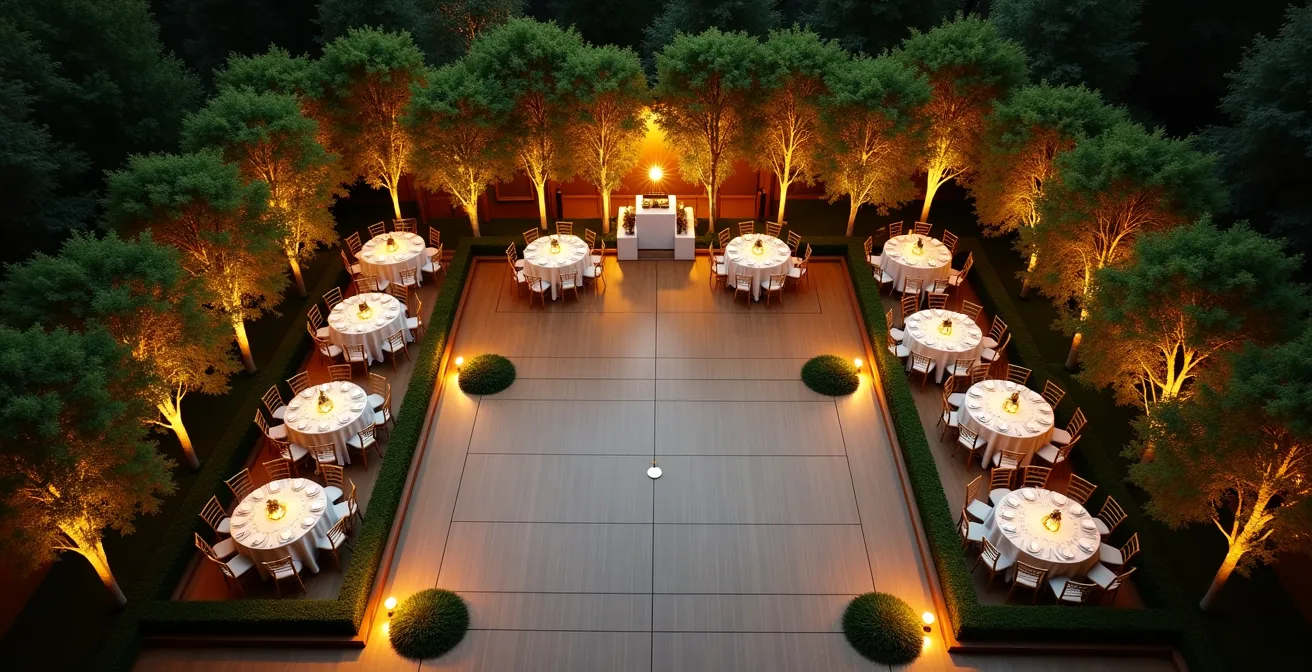
As this aerial view demonstrates, a well-designed layout guides the eye and the flow of traffic, creating an experience that is both immersive and practical. The forest enhances the event, rather than getting in the way of it.
How to Transform Your Venue Walls With Strategic LED Uplighting?
While gobo projectors create the “canopy,” LED uplighting is what paints the “atmosphere” of your forest. Uplighting involves placing powerful LED fixtures on the floor, aimed up at walls or architectural features. For a forest theme, this technique is used to wash the venue’s perimeter in rich, organic colors, completing the transformation that the gobos began. It’s the difference between a room with trees in it and being inside a living, breathing forest at magic hour.
The color palette is critical. Avoid a single, flat shade of green, which can look artificial. Instead, use a tri-color forest palette that mimics the complexity of natural light. A combination of deep emerald green, warm amber, and subtle cool blue creates dimension and a dynamic visual experience. The amber light can represent setting sunlight, the green provides the lush foliage color, and the blue can hint at moonlight or shadow. By programming the lights on a DMX controller, you can even have them transition slowly throughout the evening, moving from a warm “golden hour” during cocktails to a cooler, “moonlit” feel for dancing.
The key to a professional look is hardware concealment. LED units should be invisible. Position them behind the bases of your fabricated trees, nestled within clusters of faux foliage, or tucked behind architectural columns. For a truly seamless installation, using battery-powered wireless LED units is a worthy investment, as it completely eliminates the visual clutter and tripping hazard of cables. This strategic use of colored light is the final step in erasing the memory of the original ballroom walls.
Key takeaways
- Fabricated trees are often superior to real ones for indoor logistics, safety, and rapid, one-day event setup.
- True immersion is multi-sensory; engineered scent-scaping and layered lighting are just as crucial as the foliage itself.
- A successful design engineers solutions for soil, bugs, and fire codes from the very beginning, treating them as design parameters, not afterthoughts.
Citronella Torches: Effective Pest Control or Just a Smoky Eyesore?
One of the explicit goals of an indoor forest theme is to have all the beauty with none of the bugs. The question of pest control is therefore paramount. Some might be tempted to use traditional outdoor solutions like citronella torches, but for an indoor event, this is a disastrous choice. Not only are they an obvious fire hazard, but the smoke they produce is an eyesore, an irritant to guests, and a primary cause of false fire alarms in event venues. According to fire code compliance data from 2024, indoor venues report that a staggering 73% of false fire alarm triggers are caused by smoke-producing decor items, including torches and incense.
An engineered approach to bug prevention is far more effective and elegant. The strategy is one of prevention, not reaction.
- Material Treatment: The first line of defense is ensuring no pests enter the venue in the first place. Any real wood elements, like branches or logs, must be professionally kiln-dried at 140°F for at least 48 hours. This process eliminates any resident insects or eggs without the use of chemical pesticides.
- Aromatic Deterrents: The same essential oils used for scent-scaping can double as natural pest deterrents. Cedarwood and peppermint oils, diffused at a low concentration through the venue’s HVAC system or via nebulizers, create a pleasant forest scent for humans that naturally repels most common insects.
- Eliminate Flame: Replace all real flame elements, including candles and torches, with high-quality LED flickering candles. This completely removes the risk of fire and smoke, protecting your guests and ensuring the venue’s smoke detectors remain silent.
This three-step protocol is a clean, safe, and sophisticated solution that makes the “no bugs” promise a reality without compromising the aesthetic or safety of your event.
Why Dried Palms Are the Secret to Sculptural, Modern Floral Installations?
While the core of the theme is a lush, green forest, the floral installations offer an opportunity to introduce modern, sculptural artistry. Here, dried and preserved elements—particularly large dried palm leaves—are a secret weapon for environmental designers. Far from being drab or lifeless, these materials provide architectural structure, unique textures, and an ethereal quality that fresh flowers often lack. They are the key to elevating your arrangements from simple bouquets to true art pieces.
Think of dried fan palms or monstera leaves as the canvas. By spray-painting them in deep forest greens, rich browns, or even metallic tones, you can create dramatic, large-scale backdrops for your ceremony arch or head table. Layering these with other dried materials like bleached ferns, wispy lunaria, and textural seed pods builds a complex and sophisticated look. This approach embraces the full life cycle of the forest, incorporating the beauty of decay and preservation into the design.
This method also carries significant practical and sustainable benefits. As a sustainable wedding trends analysis reports, dried and preserved elements remain display-ready for 6-12 months, compared to just 4-7 days for most fresh flowers. This longevity not only reduces event waste by up to 85% but also means you can resell or repurpose these stunning sculptural pieces after your wedding, recouping a portion of your investment. It’s a design choice that is both artistically forward and intelligently practical.
By embracing an engineering mindset, you can successfully transform any indoor space into the enchanted, immersive, and perfectly executed forest of your dreams. The next logical step is to begin sourcing the creative partners and materials that can bring this multi-layered vision to life.