
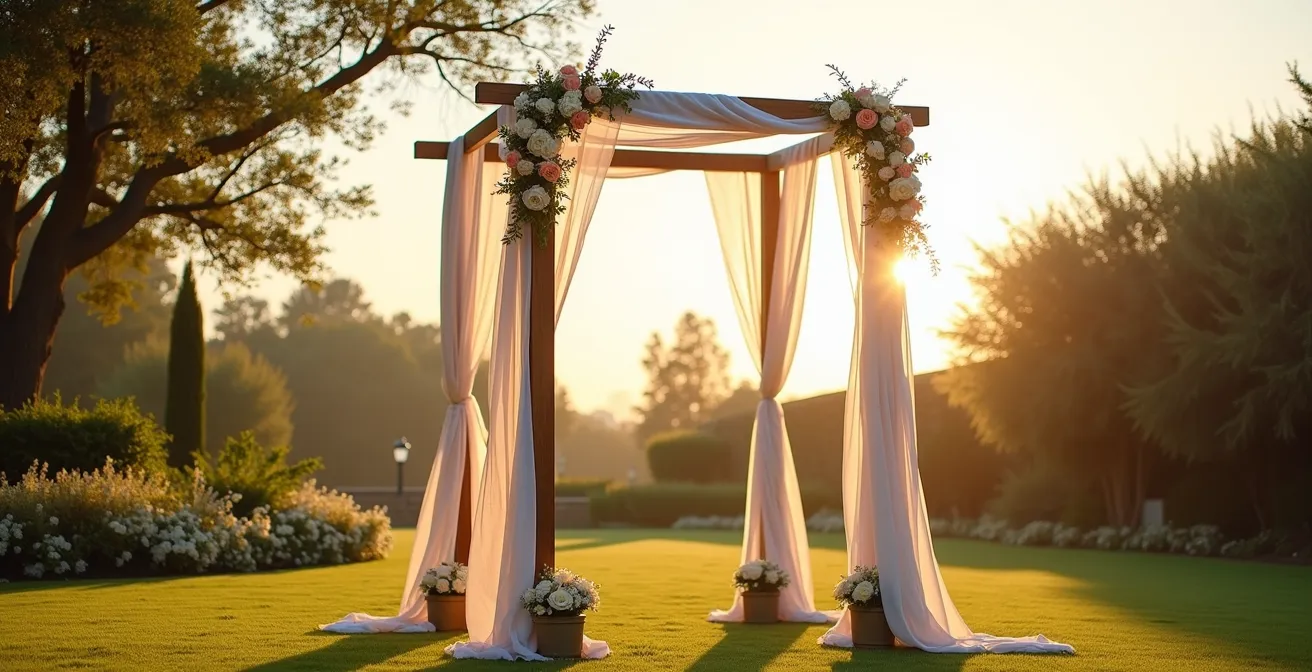
A chuppah’s beauty is not just in its flowers, but in the unseen engineering that guarantees its stability and frames the couple perfectly.
- Structural integrity, achieved through proper weighting, is non-negotiable for outdoor ceremonies to counteract environmental forces like wind.
- Photogenic qualities are a direct result of technical choices in fabric for light diffusion and precise height for unobstructed guest sightlines.
Recommendation: Approach your chuppah design not as mere decoration, but as an act of sacred micro-architecture where form and function are inseparable.
The chuppah stands as the sacred heart of the Jewish wedding ceremony, a symbol of the new home the couple will build together. For couples planning an outdoor celebration, the vision is often one of ethereal fabric and lush florals set against a natural backdrop. Yet, this romantic ideal is poised on a knife’s edge, threatened by the practical realities of wind, uneven ground, and the physics of light. The greatest fear is not just a skewed photograph, but a structural failure—a chuppah that leans, sways, or worse, collapses.
Conventional advice often centers on aesthetics: matching florals to the theme or choosing a pretty fabric. While important, this approach overlooks the fundamental truth that a successful chuppah is a feat of temporary architecture. It must be engineered to withstand its environment. The difference between a breathtaking centerpiece and a ceremony-day disaster lies in understanding the forces at play. It’s about calculating load-bearing capacity, selecting materials for their physical properties, and respecting the laws of geometry and physics.
But what if the key to a photogenic chuppah was not in opposing these forces, but in mastering them? This guide departs from purely decorative advice to offer an architect’s perspective. We will deconstruct the chuppah into its core components, examining the engineering principles that ensure it is not only structurally sound but also interacts perfectly with light and space. We will explore why weighting is a matter of physics, how an aisle runner’s material dictates its function, and how a few inches in height can make or break the view for every single guest. This is the blueprint for a chuppah that is as safe as it is beautiful.
This article provides a detailed framework for designing your ceremony space, ensuring every element is both structurally sound and visually perfect. The following sections break down the critical engineering and aesthetic decisions you will face.
Summary: The Architect’s Guide to Chuppah Design
- Why You Must Weight Your Chuppah Bases Even on a Calm Day?
- Carpet, Petals, or Vinyl: Which Aisle Runner Works on Grass and Heels?
- Open Sky or Fabric Top: Which Canopy Style favors Best Lighting?
- The Height Mistake That Blocks Guests’ View of the Couple
- How to Cluster Flowers on the Arbour for Maximum Visual Impact?
- How to Use Silk Chiffon Drapery to Soften Industrial Venue Architecture?
- How to Engineer Suspended Floral Installations Safely in Marquees?
- How to Style a Driftwood Arbor for a Sophisticated Coastal Wedding?
Why You Must Weight Your Chuppah Bases Even on a Calm Day?
The most common and dangerous assumption in outdoor event design is that a calm day requires no structural reinforcement. This overlooks a critical aerodynamic principle: the Venturi effect. When even a gentle breeze is forced to move between or around objects—like buildings, trees, or even the guests themselves—it accelerates. In fact, structural engineering analysis shows wind tunneling can amplify wind forces significantly. A simple 5 mph breeze can become a powerful 15 mph gust at the precise location of your chuppah, turning a fabric-draped canopy into a sail. Without proper ballast, the structure’s center of gravity becomes dangerously high, risking tipping or complete failure.
The solution is not just weight, but correctly applied weight. The principle of leverage dictates that the ballast must be positioned at the absolute lowest point on each support pole to create maximum stability. This counteracts the rotational force (torque) applied by the wind to the top of the structure. The goal is to create an immovable foundation, ensuring the sacred space remains secure regardless of unpredictable air currents. The following table compares common methods for achieving this critical stability.
| Method | Weight Range | Cost | Aesthetic Impact | Setup Time |
|---|---|---|---|---|
| Sandbags | 30-50 lbs | $5-10 each | Bulky, needs covering | 5 minutes |
| Water Weights | 40 lbs (full) | $20-30 each | Sleeker profile | 10 minutes |
| Steel Base Plates | 60-100 lbs | $75-150 each | Most elegant | 2 minutes |
| Concrete Planters | 50-80 lbs | $40-60 each | Decorative option | 15 minutes |
To translate these principles into action, a systematic approach to weighting is required. This ensures that the chosen method is adequate for the specific height and design of your chuppah.
Action Plan: Weight-to-Height Safety Ratio
- Assess Structure: For every foot of height on a fabric-covered structure, add a minimum of 10 lbs of base weight.
- Position Weights: Place all weights (sandbags, water weights, plates) at the absolute lowest point of each pole to maximize stability and leverage.
- Select Budget Option: Use sandbags (30-50 lbs each) for a cost-effective solution, but plan to conceal them with decorative covers, fabric, or floral arrangements.
- Consider Cleaner Aesthetics: Opt for water weights (approx. 40 lbs when full) which offer a sleeker profile and are easily drained post-event.
- Upgrade for Invisibility: For a premium and seamless look, invest in custom steel base plates (60+ lbs) which provide substantial weight with a minimal footprint.
Carpet, Petals, or Vinyl: Which Aisle Runner Works on Grass and Heels?
The processional walk down the aisle is a pivotal moment, but on an uneven grass surface, it can become a hazardous journey, especially for anyone in heels. The choice of aisle runner is not merely aesthetic; it is a question of engineering a safe and stable walking surface. Different materials interact with soft turf in vastly different ways. Loose petals, while romantic, offer zero structural support and can become slippery when crushed or damp. A standard carpet runner laid directly on grass will bunch, ripple, and fail to prevent heels from sinking into the soil.
The illustration below highlights the critical difference in how various surfaces provide support. A successful aisle runner for a lawn must create a solid, level plane that distributes weight evenly, preventing heels from puncturing the surface.
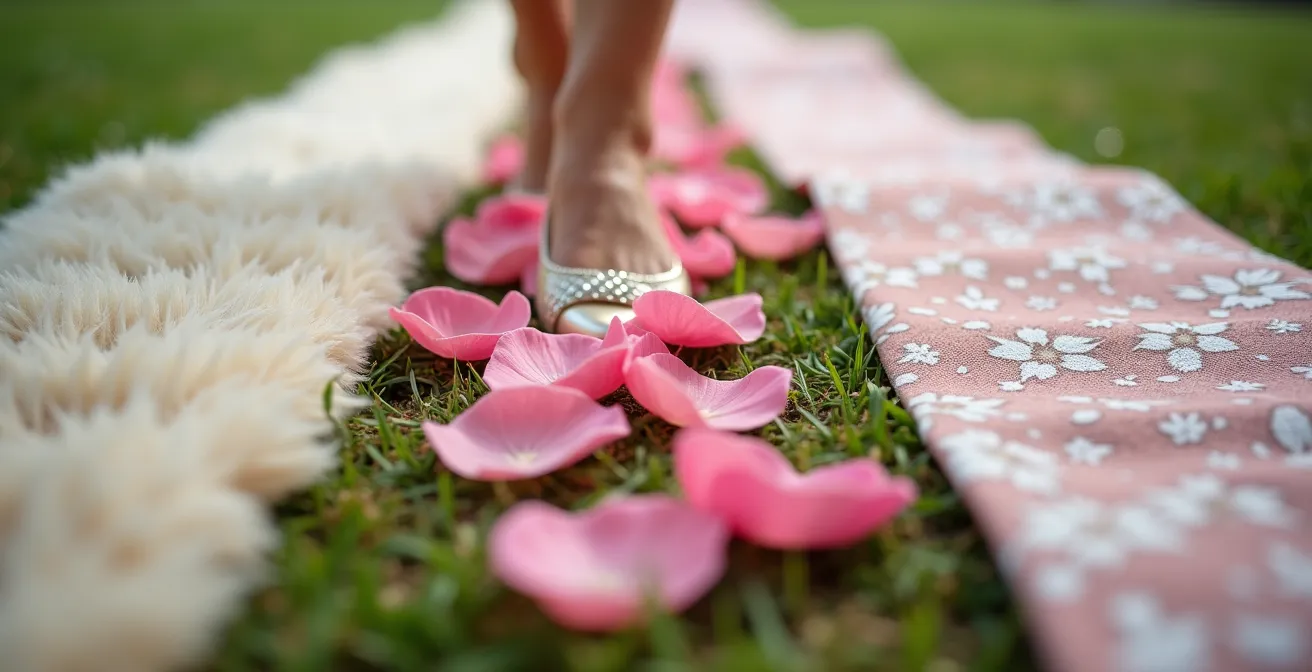
As you can see, creating a stable path requires a foundational element. A truly functional solution often involves a sub-layer, such as interlocking tiles or a plywood base, over which the decorative surface is laid. This two-part system separates the aesthetic from the structural, ensuring a safe and elegant processional. For those seeking a single-material solution, a high-density artificial turf or a heavy-gauge vinyl runner offers the best balance of stability and ease of setup.
The decision involves a trade-off between stability, setup complexity, and environmental impact. The following matrix provides a clear comparison of the performance of each option on a grass surface.
| Runner Type | Heel Support (1-10) | Moisture Resistance | Setup Complexity | Environmental Impact |
|---|---|---|---|---|
| Carpet + Plywood Base | 9/10 | Poor (absorbs water) | High (requires subfloor) | Moderate |
| Fresh Petals | 3/10 | Poor (becomes slippery) | Low | Biodegradable |
| Vinyl + Interlocking Tiles | 8/10 | Excellent | Medium | Non-biodegradable |
| Artificial Turf | 7/10 | Good | Low | Reusable |
Open Sky or Fabric Top: Which Canopy Style favors Best Lighting?
The canopy of the chuppah does more than define the sacred space; it is the primary light modifier for your ceremony photos. The choice between an open-sky design and a fabric-covered top has profound implications for the quality and consistency of light falling on the couple. An open top seems natural, but it surrenders all control to the sun. If placed under trees, it creates “dappled light”—a pattern of harsh, moving hotspots and deep shadows that are a photographer’s nightmare. Even in open air, direct overhead sun at midday creates unflattering “raccoon eyes” as shadows fall sharply from the brow bone.
A fabric canopy acts as a professional-grade light diffuser, much like a photographer’s softbox. It transforms the harsh, directional sunlight into a soft, flattering, and even source of illumination. According to professional wedding photographers, a canopy made of white or off-white translucent material like chiffon or voile creates a beautiful, gentle light that wraps around faces, minimizes harsh shadows, and produces a far more romantic and forgiving image. This controlled lighting environment ensures consistency in your photos, regardless of passing clouds or the sun’s position.
The key is selecting the right fabric for its light-diffusing properties. The goal isn’t to block the light, but to soften it. Your choice should depend on the time of day and expected sun intensity.
- White or Off-White Chiffon: A single layer provides approximately 30% light diffusion, making it ideal for ceremonies under bright, direct sun.
- Voile Fabric: Offering around 20% diffusion, voile strikes a perfect balance for partly cloudy days or when the sun is less intense.
- Organza: This fabric is more transparent, providing minimal (10%) diffusion. It’s best reserved for late afternoon “golden hour” ceremonies where the light is already soft and warm.
Furthermore, the chuppah’s orientation relative to the sun is a critical final step. Positioning the structure with the sun behind the couple creates a beautiful backlighting effect, while orienting it 45 degrees to the sun’s path avoids direct glare on their faces.
The Height Mistake That Blocks Guests’ View of the Couple
A chuppah’s height is a delicate balance. Too low, and it feels cramped and insignificant. Too high, and it loses its sense of intimacy. However, the most common architectural mistake is designing its height without considering the sightlines of the guests, particularly those seated in the back rows. A chuppah with a low-hanging front crossbar or thick decorative elements can completely obscure the couple’s faces for a significant portion of the audience. The structure, intended to frame the couple, ends up hiding them.
The optimal height is not a fixed number but a calculation based on three variables: the couple’s height, the number of guest rows, and whether a platform is used. Each row of seating adds to the required vertical clearance. A simple rule of thumb is to add at least two inches of clearance for every row of guests. A platform elevates the couple, dramatically improving sightlines, but the chuppah must be raised proportionally. This geometric consideration is vital for ensuring every guest feels connected to the ceremony.
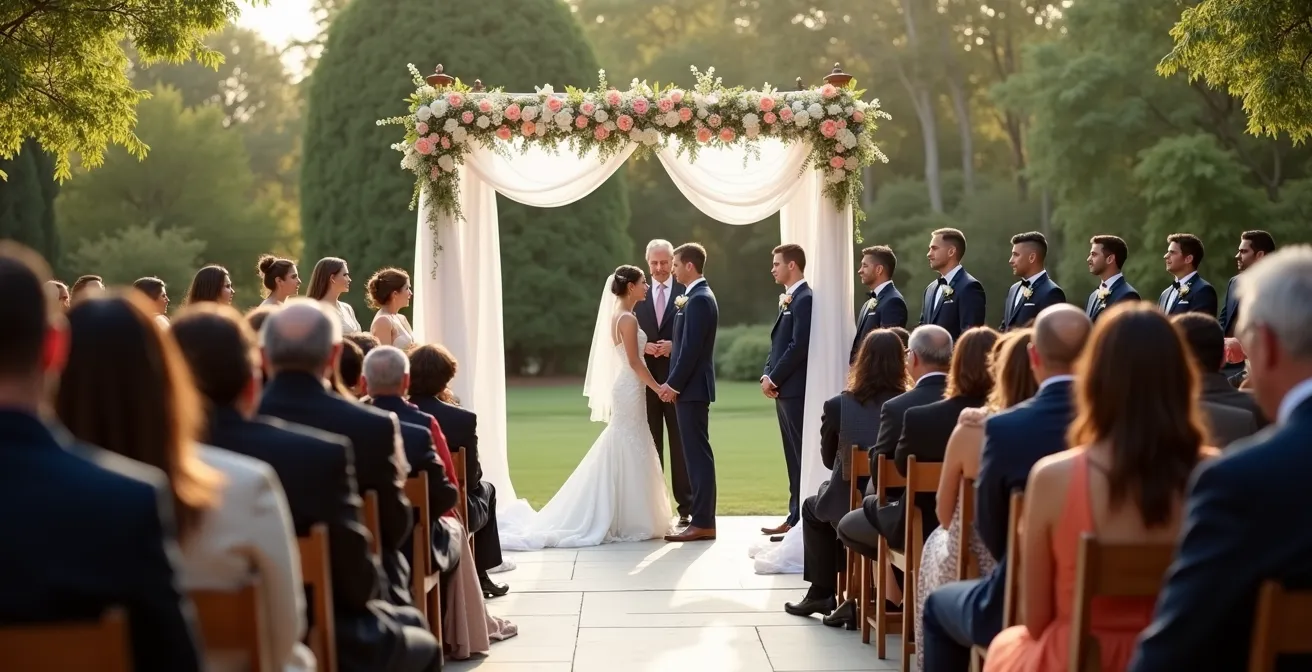
As the diagram shows, a properly scaled chuppah allows for a clear line of sight from the back row to the couple. Beyond guest views, modern wedding coverage introduces another factor: videography. A chuppah that is too low can severely limit a videographer’s ability to get clean, sweeping shots. For this reason, many wedding videographers recommend maintaining an 18-24 inches minimum clearance above the couple’s heads. Finally, using slimmer vertical posts (a maximum of 4 inches in diameter) minimizes the obstruction of side views, ensuring that even guests seated at an angle have a clear perspective.
How to Cluster Flowers on the Arbour for Maximum Visual Impact?
When it comes to floral design on a chuppah, more is not always better. The most impactful and photogenic arrangements are not random explosions of color but are strategically placed according to established principles of composition. Simply covering every surface creates a busy, unfocused look. The architect’s approach is to use florals to accentuate the structure’s form, guide the eye, and create intentional focal points. Two powerful principles for achieving this are the Rule of Thirds and the Golden Ratio.
Instead of centering a floral cluster, placing it at the intersection of imaginary lines that divide the frame into thirds creates a more dynamic and visually pleasing composition. This is a foundational rule in photography and design. An even more sophisticated approach, often used by high-end floral designers, is applying the Golden Ratio (approximately 1.618 to 1). This involves placing the main floral mass about 62% of the way up a vertical post or 38% inward from a corner. This asymmetrical placement feels organic and naturally balanced to the human eye, resulting in arrangements that photograph beautifully from any angle.
Beyond placement, the engineering of the floral clusters themselves is crucial for creating depth and impact. A flat arrangement lacks dimension. A truly professional look is achieved by building in layers:
- Layer 1 (Background): Start with a base of foliage like eucalyptus or ruscus to create the overall shape and structure.
- Layer 2 (Mid-Layer): Add your primary, larger blooms like roses, peonies, or hydrangeas. These are the stars of the arrangement.
- Layer 3 (Foreground): Finish with delicate, textural accent flowers and elements like spray roses, astilbe, or hanging amaranthus. These add depth and a sense of movement.
This layering technique, combined with strategic placement, creates a composition that is rich, dimensional, and intentionally designed for maximum visual impact, especially for the camera.
How to Use Silk Chiffon Drapery to Soften Industrial Venue Architecture?
Industrial venues—with their exposed brick, concrete floors, and steel beams—offer a beautifully raw and modern canvas. However, many couples wish to introduce a layer of softness and romance to balance the space’s inherent masculinity. The instinct can be to hide or cover these industrial elements, but this often results in a design that feels disconnected and awkward. The more sophisticated architectural approach is to create a dialogue between the hard and soft elements.
Silk chiffon is the perfect material for this task. Its extreme softness, translucency, and fluid movement provide a powerful contrast to the rigid, textured surfaces of the venue. This design philosophy is eloquently captured by a leading professional in the field. As a Professional Wedding Designer at Life in Bloom Chicago notes, the goal is not to conceal, but to celebrate the contrast. The following quote captures this perfectly:
Don’t hide industrial elements. Use the extreme softness and translucency of chiffon to accentuate the raw texture of brick, concrete, or steel, creating a powerful and intentional design dialogue.
– Professional Wedding Designer, Life in Bloom Chicago Wedding Design Guide
Achieving this dialogue involves specific draping techniques. “Puddling” chiffon on the floor at the base of a brick wall creates a sense of luxury and softness grounded by the rough texture. Using high-powered magnets to create vertical pleating on a steel column can soften its hard lines without hiding its structural nature. For a more dramatic transformation, creating a tented ceiling with swags of fabric can lower the perceived height of a cavernous space, making it feel more intimate. Finally, placing LED uplighting behind sheer fabric panels can turn a stark concrete wall into a series of glowing, ethereal partitions, blending the industrial with the romantic in a truly intentional way.
Key Takeaways
- Structural integrity is paramount; a chuppah’s beauty is irrelevant if it is not safe. Always calculate for wind load and use appropriate base weights.
- Photogenic qualities are engineered through technical choices, such as using fabric as a light diffuser and calculating height for clear guest sightlines.
- The most sophisticated designs create a dialogue between elements—soft fabric against hard architecture, or organic florals placed with geometric precision.
How to Engineer Suspended Floral Installations Safely in Marquees?
Suspended floral installations, or “floral clouds,” are one of the most breathtaking elements in modern wedding design. However, hanging significant weight overhead in a temporary structure like a marquee is an advanced feat of engineering that carries serious risks if not executed with professional precision. The primary concern is weight—not just the initial weight of the flowers and mechanics, but their “wet weight.” Once florals are hydrated in foam, professional florists calculate that arrangements become up to 40% heavier. A design that seems manageable when dry can quickly exceed the safe load capacity of a marquee’s rigging points once prepped.
Marquee tents are not permanent buildings. Their structural frames have specific, certified load points, and exceeding their capacity can lead to catastrophic failure. For any suspended element, a professional and insured rigger is not a luxury; they are a necessity. These experts understand how to distribute weight across multiple points, use the correct hardware (like truss and rated shackles), and ensure that the installation is secure against any potential movement or environmental factors. They work with the marquee provider to identify certified load points and will often require a stamped engineering plan for any installation of significant weight or span.
The cost of professional rigging should be considered a fundamental part of the budget for any suspended installation, just like the flowers themselves. Compromising on safety by attempting a DIY solution or using an uninsured vendor introduces an unacceptable level of risk to the event and all guests in attendance. The beauty of a floating floral cloud is only possible because of the unseen, rigorous engineering that holds it safely in place.
How to Style a Driftwood Arbor for a Sophisticated Coastal Wedding?
A driftwood arbor is a natural choice for a coastal wedding, perfectly echoing the wild beauty of the seaside. However, there is a fine line between “rustic charm” and simply looking “messy.” The key to a sophisticated coastal design lies in strategic contrast and intentional editing. Instead of covering the entire structure, the goal is to honor the natural, sculptural quality of the wood itself. An elegant approach, as seen in a French coastal wedding, involves pairing the weathered, organic texture of the driftwood with a single, luxurious material like raw silk or linen. Draping one panel asymmetrically, allowing it to move with the sea breeze, creates a look that is both elegant and alive.
The second principle of sophistication is selecting florals that can withstand the coastal environment. Delicate blooms will quickly wilt and shred in the salty, windy air. A more resilient and chic palette includes florals and botanicals chosen for their structural integrity and texture. Consider these wind-resistant options:
- Sea Holly (Eryngium): Its metallic blue hue and thistle-like structure are incredibly wind-resistant and add a unique textural element.
- Pampas Grass: This popular choice is ideal for coastal settings, as it is designed to move beautifully in the breeze without breaking or wilting.
- Structural Succulents: Their waxy leaves and robust forms are impervious to wind and add a modern, geometric touch.
- Preserved Lunaria (Honesty): The translucent, paper-like seed pods of dried lunaria catch the light beautifully and are completely wind-proof.
By clustering these hardy elements in one or two key areas—such as a corner or a point where two branches meet—you accentuate the arbor’s natural form rather than overwhelming it. This edited, texturally rich approach results in a design that feels deeply connected to its coastal setting while remaining undeniably sophisticated.
By approaching your chuppah design with the mind of an architect—prioritizing structure, light, and sightlines—you are not just creating a beautiful backdrop. You are engineering a sacred space that is safe, functional, and frames the most important moments of your day with intention and grace.
Frequent questions on How to Design a Chuppah That Is Both Structurally Sound and Photogenic?
What is the certified per-point load capacity required?
Each structural load point must support a minimum of 3 times the wet weight of the florals. For medium-sized installations, this typically means a capacity of 150-300 lbs per point.
Are riggers required to be insured for overhead work?
Yes, absolutely. Certified riggers must carry a minimum of $1 million in liability insurance that specifically covers overhead installation work. Do not hire anyone without this specific coverage.
When is a stamped engineering plan required?
Most professional venues and marquee companies require stamped structural engineering plans for any suspended element that exceeds 50 lbs in wet weight or spans a distance of more than 10 feet.