
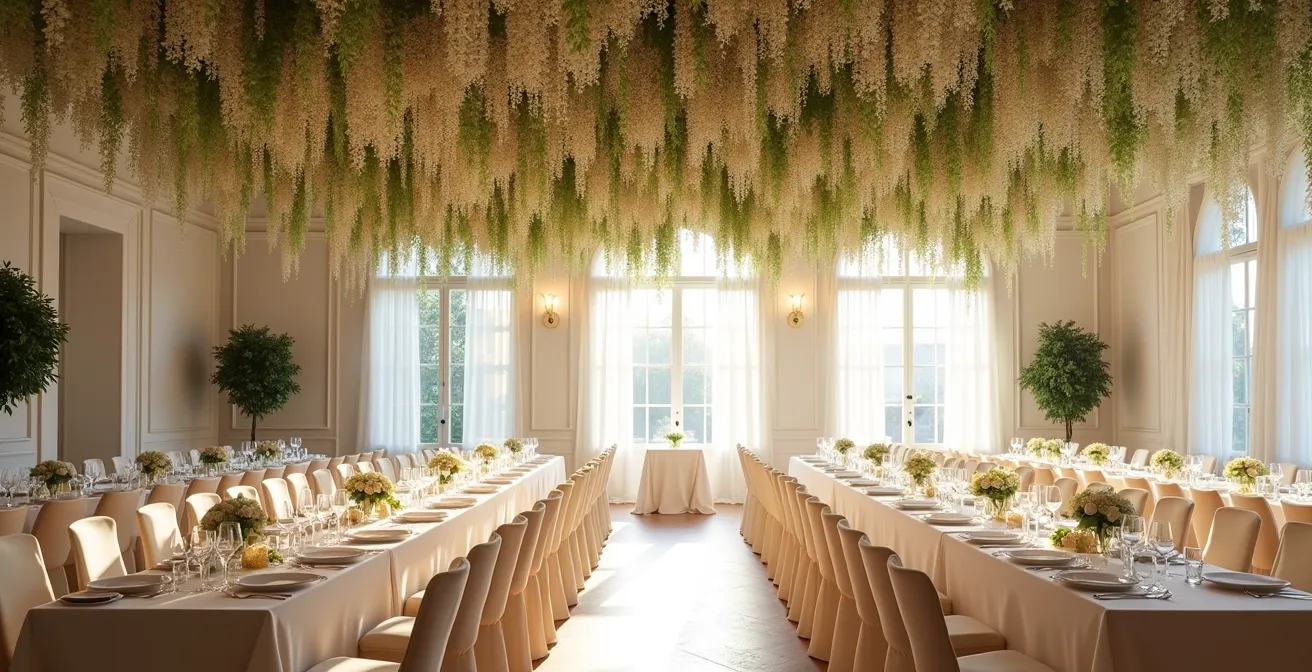
To manifest a truly magical wisteria ceiling, you must think like a set designer, focusing on botanical illusion and atmospheric engineering, not just hanging flowers.
- The most believable wisteria clouds use high-end, fire-retardant artificial blooms, as they offer control, safety, and consistent beauty under lighting.
- Achieving a lush, seamless canopy requires strategic layering of foliage and florals at specific densities to completely hide the underlying mechanics.
Recommendation: Prioritize structural safety and fire compliance by hiring professionals who understand load calculations and rigging; this is the non-negotiable foundation for your fantasy.
The vision is a potent one, whispered across social media and etched into the dreams of couples seeking a touch of otherworldly romance: a celestial ceiling of cascading wisteria, transforming a simple room into a scene from a beloved period drama or a forgotten fairytale. Many believe achieving this “Bridgerton” aesthetic is a simple matter of acquiring enough flowers. But as a creator of fantasy worlds, I can tell you the secret isn’t in the quantity of blossoms, but in the magic of their application. Creating a wisteria cloud that feels alive, that breathes with light and shadow, is an act of scenography—a performance of art and engineering.
The common approach of simply draping vines is where the illusion often falters, resulting in a display that looks decorative rather than immersive. The true artistry lies in crafting a believable botanical illusion. This requires a deeper understanding of material science, light physics, and the subtle engineering that supports the entire spectacle. It’s about orchestrating an atmosphere that transports your guests, making them feel as though they have stepped through a portal into your own personal enchanted forest. Forget what you think you know about floral decoration; we are about to enter the realm of atmospheric design, where every choice, from the texture of a petal to the angle of a light, contributes to the grand narrative of your day.
This guide will walk you through the very same principles a set designer uses to build a world from the ground up. We will explore the critical choice of materials, the science of creating density, the alchemy of color and light, and the essential safety protocols that make the magic possible. Prepare to transform your venue into a living, breathing work of art.
Summary: Crafting Your Ethereal Wisteria Canopy
- Why High-End Artificial Wisteria Is Often Better Than Fresh for Ceilings?
- How Dense Must Wisteria Be to Avoid Seeing the Mechanics?
- White, Purple, or Pink: Which Wisteria Shade Suits Candlelight Best?
- The Ceiling Height Requirement for Wisteria That Guests Won’t Hit
- How to Structure a Wisteria Entrance Tunnel for Maximum Guest Impact?
- How to Engineer Suspended Floral Installations Safely in Marquees?
- How to Design an Immersive Forest Theme Indoors Without Soil and Bugs?
- How to Transform a Generic Ballroom Into a Bespoke Venue With Production Design?
Why High-End Artificial Wisteria Is Often Better Than Fresh for Ceilings?
The romance of fresh flowers is undeniable, but when we ascend to the ceiling, the practical and artistic scales tip dramatically in favor of their artificial counterparts. Fresh wisteria is a fleeting, fragile muse; it wilts, it drops petals, its weight is unpredictable, and its season is short. For a suspended installation that must look perfect for hours under warm lights, these are insurmountable challenges. High-end artificial wisteria, however, is a set designer’s dream. It offers complete control over color, density, and form, allowing us to craft the perfect botanical illusion without the constraints of nature.
Beyond the artistic advantages lies a critical, non-negotiable factor: safety. Suspended materials in public spaces are subject to stringent fire codes. Many venues mandate that decorative elements meet specific safety criteria, and NFPA 701 certification is mandatory for flammable materials in most US public venues. Reputable artificial florals are often treated to be Inherently Fire Retardant (IFR), a property fresh flowers can never claim. This compliance is not merely a suggestion; it’s a legal requirement that protects your guests and your event from catastrophic risk.
The term “high-end” is key. We are not talking about the plastic-sheen flowers of the past, but of modern silk and polymer creations that are texturally and visually indistinguishable from the real thing from a distance. They hold their shape, they don’t attract insects, and they can be rigged with a precision and security that fresh, water-logged stems could never safely achieve.

Look closely at the texture and gradient coloring of premium silk wisteria. It’s this attention to detail that allows the flowers to interact with light in a believable, organic way, which is the cornerstone of a successful installation. Choosing high-quality artificials isn’t a compromise; it’s a professional decision that prioritizes beauty, consistency, and above all, safety.
How Dense Must Wisteria Be to Avoid Seeing the Mechanics?
The true magic of a wisteria ceiling lies in its apparent effortlessness, as if it grew there by enchantment. This illusion is shattered the moment a guest looks up and sees a grid, a hook, or a cable tie. The secret to maintaining the fantasy is achieving total visual coverage through strategic density and layering. This isn’t about cramming as many flowers as possible into a space; it’s a calculated process of building up texture and form to create a seamless, organic canopy.
Think of it as painting a sky. You start with a base layer and build upon it. Professional designers don’t just hang wisteria strands. They create a multi-layered system to ensure that from no angle can the underlying structure be seen. A sparse installation looks cheap and unfinished, instantly breaking the immersive spell you’re trying to cast.
Case Study: Professional Wisteria Ceiling Specifications
To achieve a truly lush and convincing effect, professional event designers often use a layered construction method. A typical commercial-grade wisteria ceiling panel starts with a base layer of artificial foliage, with leafy drops of about 20-25cm. This creates the foundational “canopy” that hides the rigging grid. A middle layer, sometimes including other flowers like silk roses, adds texture and breaks up the uniformity. Finally, the wisteria itself is layered on top, with cascading blooms measuring 35cm or more per square meter. This layering technique provides complete visual coverage while creating a sense of depth, movement, and realism.
The goal is to create a structure so dense and richly textured that the eye accepts it as a natural phenomenon. The density must be sufficient to hide not only the support grid but also any lighting cables or safety wires. It’s this meticulous approach to layering that separates a simple decoration from a truly transportive piece of environmental design. The wisteria shouldn’t just hang; it should feel like it has weight, history, and a life of its own.
White, Purple, or Pink: Which Wisteria Shade Suits Candlelight Best?
Color is emotion, and in the world of set design, light is the brush that brings color to life. The shade of wisteria you choose is not an independent decision; it is one half of a partnership, with your event’s lighting as the other. Candlelight, with its warm, low-temperature glow (around 1900 Kelvin), is a magical but tricky partner. It has the power to turn pristine whites into a sickly yellow and to swallow pale colors into the shadows.
To make your wisteria “sing” under candlelight, you must understand this interplay. Pure white wisteria, while seeming classic, is often the most challenging choice for a candlelit evening. It can reflect too much of the warm light, appearing yellowed or dingy in photos and in person. Conversely, a very dark purple might absorb too much light, disappearing into a dark mass overhead and losing its delicate detail.
The key is to select colors that have the depth and undertones to work with warm light, not against it. This is where the artistry of color selection becomes a science:
- For candlelight (1900K): Choose deeper purples and warm pinks. These richer tones have enough saturation to hold their own color identity and won’t be completely “yellowed” by the warm light. They will glow with a moody, romantic intensity.
- For mixed lighting (e.g., candles and DJ lights): Select versatile ivory or cream tones. Unlike stark white, ivory has a natural warmth that adapts beautifully to both warm and cool temperatures, preventing it from looking jarring when the lighting changes.
- For photography: Medium-tone colors, like a soft lavender or a dusty rose, are often ideal. According to lighting specialists at suppliers like CV Linens, these hues maintain their detail under a camera flash without being washed out or appearing too dark.
Think of your wisteria not as a static color, but as a canvas for light. The perfect shade is the one that will catch the flicker of each candle and transform the space into an ethereal, glowing wonderland, full of depth and romantic shadow.
The Ceiling Height Requirement for Wisteria That Guests Won’t Hit
An immersive experience should enchant, not annoy. The most beautiful wisteria cloud in the world loses its magic the moment a tall guest feels a synthetic vine tickle their head on the dance floor. Establishing the correct clearance height is a crucial piece of atmospheric engineering that balances visual impact with guest comfort and safety. As one planner noted from experience, you never want the decor to be “too close to their head when they stand (that would be annoying haha).” This simple sentiment hides a core design principle: the fantasy must not interfere with reality.
The minimum safe clearance height is not a single number but a calculation based on a few key factors. The industry-standard height for a doorway is 80 inches (6 feet 8 inches, or ~203 cm). This serves as our absolute lowest point for any major thoroughfare. However, for a truly comfortable and grand feeling, we must aim higher.
Here is the set designer’s rule of thumb for wisteria clearance:
- Establish the “Hero Height”: Identify the tallest likely person in attendance. In North America and Europe, planning for a guest who is 6’4″ (193 cm) and might be wearing shoes is a safe bet. We’ll call this our baseline: approximately 6’5″ (195 cm).
- Add the “Celebration Factor”: People don’t just stand at weddings; they dance, they raise their arms, they lift children. You must add a buffer for celebratory motion. A minimum of 1.5 to 2 feet (45-60 cm) above the Hero Height is essential over a dance floor or central gathering area.
- Calculate the Minimum Dangle Height: Hero Height (195 cm) + Celebration Factor (45 cm) = 240 cm (or roughly 8 feet). This means the very lowest tip of the longest wisteria tendril should be no lower than 8 feet from the floor in high-traffic areas. Over dining tables, you can be slightly more aggressive, but you must still allow for guests to stand up comfortably without touching the installation. A clearance of 7.5 feet over tables is a reasonable minimum.
Therefore, your venue’s ceiling must be high enough to accommodate the installation’s mechanics *plus* your desired wisteria length *plus* this 8-foot clearance. If your ceiling is only 10 feet high, a dense, deeply cascading wisteria cloud is simply not feasible. It is a game of vertical space, and respecting these minimums ensures your immersive forest remains a wonder, not a nuisance.
How to Structure a Wisteria Entrance Tunnel for Maximum Guest Impact?
A wisteria ceiling is an immersive statement, but a wisteria *tunnel* is a narrative journey. It is the portal from the mundane world to the magical one you have created. The goal here is not just to decorate a walkway but to craft a moment of transition and revelation. As a set designer, this is one of my favorite tools: controlling the guest’s field of vision to build anticipation before a grand reveal.
The impact of an entrance tunnel is built on two principles: compression and release. You guide your guests through a slightly more enclosed, densely decorated space (compression), so that when they emerge into the main reception area, the sense of openness and grandeur is dramatically amplified (release). It’s a classic trick of theatre and landscape design.
To achieve this, the structure must be designed to draw the eye forward. Professional designers create this magical ambiance with floating wisteria arrangements that guide guests, not just hang above them. These ethereal installations add depth, drawing the eye upwards and forwards to create an immersive experience. The structure should feel abundant, wrapping around the guests to make them feel as though they are passing through a secret garden hedge.
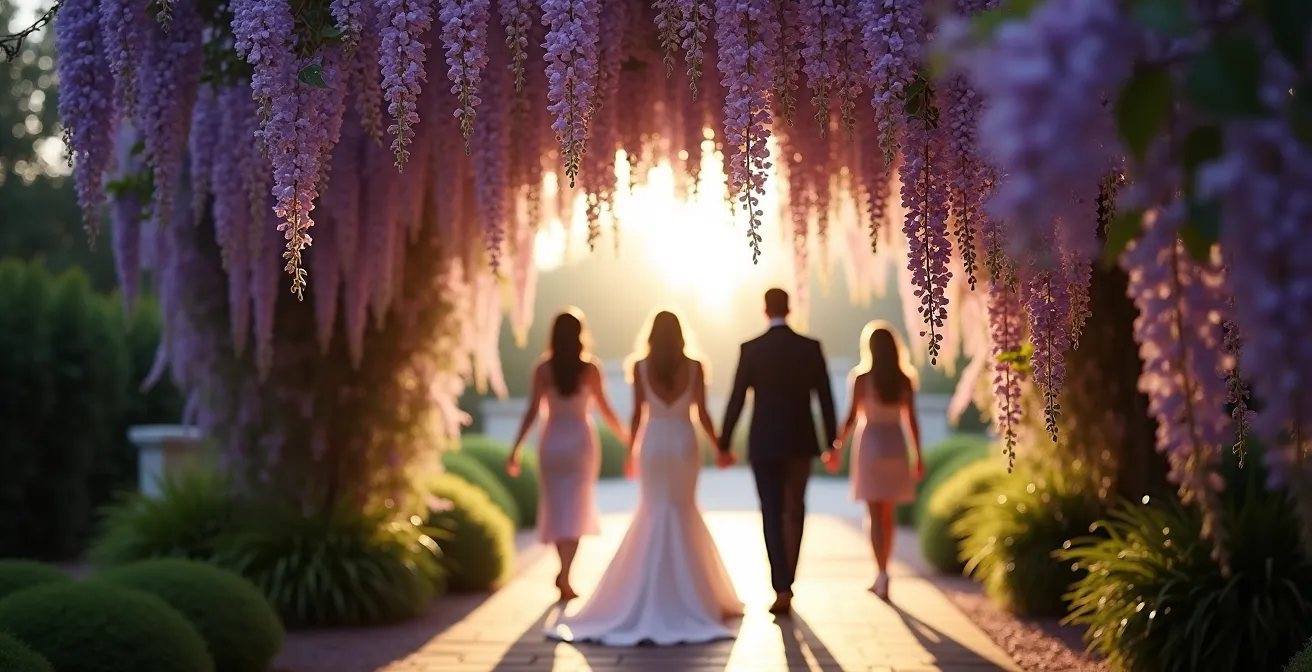
Lighting is your primary storytelling tool here. The tunnel should start slightly dimmer at the entrance, with light that gradually brightens as guests move through it. This pulls them towards the destination and mimics the natural experience of walking out from under a dense forest canopy into a sunlit glade. Tiny, warm fairy lights woven through the wisteria can act as “breadcrumbs” of light, guiding the way and adding to the enchantment. The combination of dense floral structure and a progressive lighting scheme creates a powerful psychological effect, ensuring your guests don’t just walk into your reception—they *emerge* into it, with a sense of wonder already sparked.
How to Engineer Suspended Floral Installations Safely in Marquees?
A marquee or tent presents a unique and challenging stage for a suspended floral fantasy. Unlike a ballroom with fixed steel beams, a marquee is a temporary structure, a fabric skin stretched over a metal skeleton. While beautiful, its structural integrity is finite and highly susceptible to external forces like wind. Engineering a heavy floral installation in this environment requires an even higher level of diligence and expertise. The dream can quickly become a disaster if not handled with professional care.
The first and most important rule is that you are not just hanging decor; you are rigging a significant, heavy load. The combined weight of the wisteria, foliage, support grid, and lighting can easily run into hundreds of pounds. Furthermore, marquee safety standards mandate that all materials, from the tent fabric itself to the decor hung within it, meet stringent fire certifications like CPAI-84 or NFPA 701. There is no room for error or amateur attempts.
A professional rigging team will never attach a significant load to the tent fabric itself. They work directly with the marquee’s structural frame—the trusses and support poles. They must obtain the load-bearing specifications from the marquee rental company to understand exactly how much weight each point can safely hold. This is a complex calculation of physics, not a matter of guesswork.
Your Action Plan: Marquee Rigging Safety Protocol
- Obtain structural load-bearing plans from the marquee company before any installation planning.
- Calculate the distributed load across multiple truss points (never concentrate weight on a single point).
- Use only rated rigging hardware: GAC-Flex cables, certified shackles, safety wires, and professional truss clamps.
- Factor in dynamic forces: wind shear against the tent fabric can add up to 30% to the static load of your installation.
- Account for condensation weight: moisture from temperature changes can collect on the installation and add significant, unexpected weight overnight.
Hiring a certified and insured professional rigger is not an optional luxury when working in a marquee; it is a fundamental necessity. They are the unseen artists who ensure your floating garden of dreams remains safely in the air, allowing you and your guests to dance below with perfect peace of mind.
How to Design an Immersive Forest Theme Indoors Without Soil and Bugs?
Transforming an indoor space into an enchanted forest is the ultimate act of world-building. The goal is to move beyond mere decoration and create a multi-sensory environment that convinces guests they’ve been transported. The absence of soil, water, and insects is not a limitation but a liberation, allowing us to perfect the fantasy without the mess of reality. The wisteria ceiling is your canopy, the most crucial element in this transformation.
As designers, we use ceiling drapes of cascading wisteria to envelop the space in a sea of blooms, creating a romantic and immersive experience. But a true forest is more than just its canopy. To build the theme, you must engage other senses. The dense floral ceiling can actually help by muffling sound, reducing the cavernous echo of a large room and creating a more intimate, hushed atmosphere, much like a real forest. You can enhance this with a subtle, high-quality forest scent (think damp earth and moss, but the pleasant version) or a gentle, ambient soundscape of nature sounds played at a barely-perceptible level.
Wisteria symbolizes romance and longevity in many cultures, making it emotionally resonant
– Alibaba Wedding Guides, How to Choose the Best Wisteria Wedding Party Decoration
This emotional resonance is what we are tapping into. The wisteria is not just a flower; it’s a symbol. To complete the forest floor, use lighting gobos to project dappled leaf patterns on the walls and floor, mimicking sunlight filtering through trees. Incorporate natural wood elements, moss, and ferns in your table centerpieces. The key is to create layers of sensory input that all support the central “forest” narrative. By pairing the stunning visual statement of the wisteria ceiling with subtle lighting and sound, you ensure guests feel as though they are dining and dancing beneath a truly living canopy.
Key Takeaways
- Prioritize Safety: Always use certified fire-retardant artificial florals and professional riggers for any suspended installation.
- Master the Illusion: Create density and use layering to completely hide all mechanical supports for a believable, magical effect.
- Design with Light: Choose wisteria colors based on how they will interact with your venue’s specific lighting, especially the warm glow of candles.
How to Transform a Generic Ballroom Into a Bespoke Venue With Production Design?
A generic ballroom, with its patterned carpet, standard-issue chandeliers, and neutral walls, is not a liability; it is a blank canvas. This is the ultimate challenge and joy for a production designer: to take an anonymous space and infuse it with a unique identity and soul. The wisteria cloud is a spectacular tool in this transformation, but it is most powerful when it is part of a holistic design strategy that addresses the entire room.
The goal is to either hide or integrate the room’s existing features into your new world. That dated chandelier doesn’t have to be an eyesore; it can become the heart of a suspended floral cloud, with wisteria appearing to magically grow from it. That busy carpet can be completely covered with a temporary dance floor or neutral carpeting, instantly changing the room’s foundation. This is not just decorating; this is architectural illusion.
A full transformation relies on a few key techniques:
- Wall Treatments: Use pipe and drape systems with inherently fire-retardant fabric to hide unattractive walls or create new, more intimate “rooms” within the larger space.
- Lighting: Lighting is the fastest way to change a room’s mood. Use uplighting on your draped walls to wash them with color, and use pin-spotting to highlight your gorgeous centerpieces, drawing guests’ attention to the beauty you’ve created.
- Acoustics: Heavy draping doesn’t just look luxurious; it also absorbs sound, reducing echo and creating a more pleasant and intimate auditory experience for your guests.
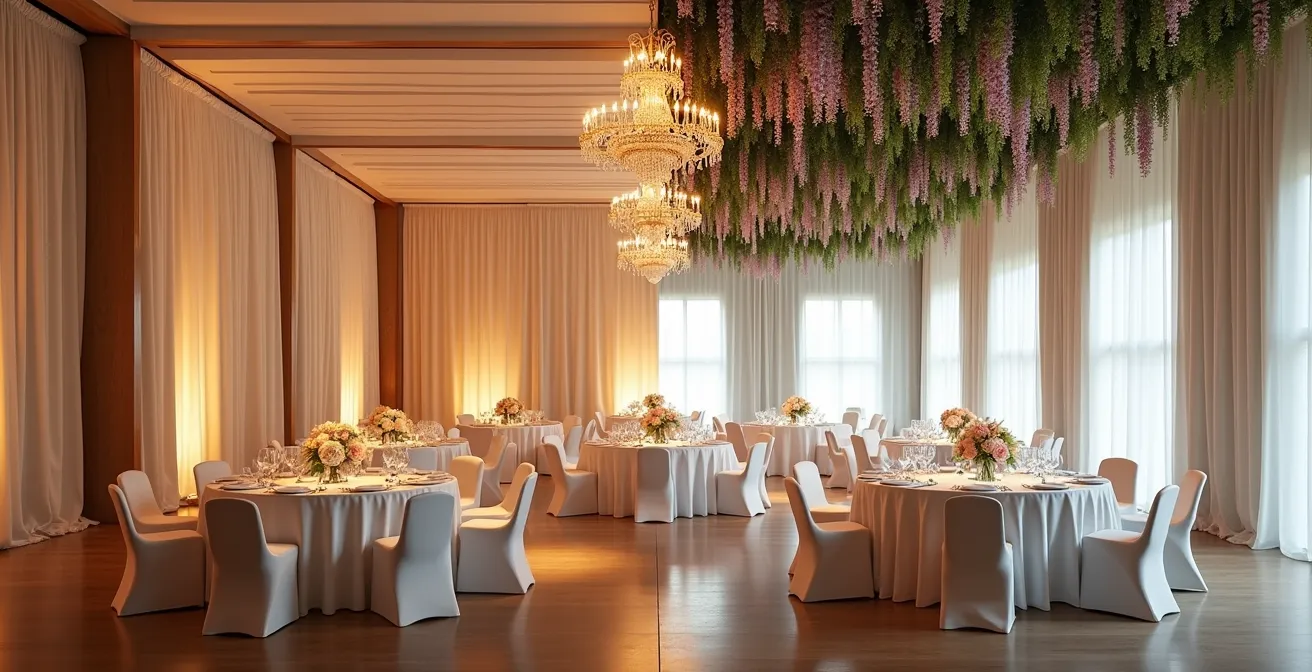
By layering these elements—a new ceiling with the wisteria cloud, new walls with draping, a new floor with temporary covering, and a new atmosphere with strategic lighting—you are not just putting decorations in a room. You are building a new reality. You are creating a bespoke venue, a temporary autonomous world where every detail works in harmony to tell the story of your celebration. This is the true power of production design.
Your wedding day is your own personal stage. By applying these principles of production design, you can ensure that the setting is just as breathtaking and memorable as the story unfolding within it. Begin today to envision the world you want to create.