
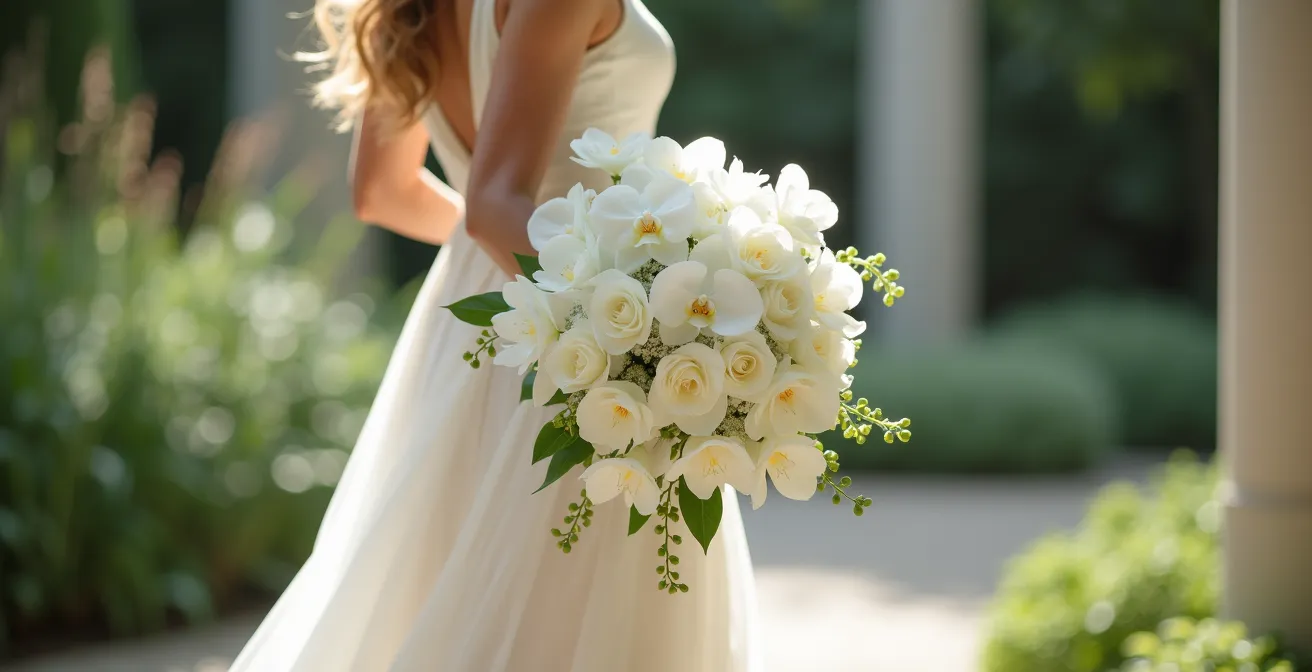
The secret to a stunning cascading bouquet is treating it as a structural extension of your silhouette, not just a floral accessory.
- Proportion is paramount; the bouquet’s scale must create a harmonious vertical line with your body and dress, not overwhelm it.
- Ergonomics and material integrity are non-negotiable, from how you carry the weight to preventing pollen stains on delicate fabrics.
Recommendation: Use these principles to guide the conversation with your florist, ensuring your bouquet is an intentional work of art that enhances your total bridal look.
Choosing a cascading bouquet can feel like a high-stakes decision. You envision that dramatic, romantic waterfall of blooms, but a voice of doubt whispers—will it overwhelm my dress? Will it look awkward on my frame? Many brides default to simple advice like “match the bouquet to the theme” or simply pick their favorite flowers, but this approach misses the fundamental point. A bouquet is not merely an accessory; it is a key architectural element of your bridal look, capable of either enhancing or disrupting your entire silhouette.
The conversation often stops at aesthetics, touching on color palettes or flower types. But the true artistry lies in the unseen mechanics: the physics of proportion, the ergonomics of how you’ll carry it for hours, and the material science of preventing a stray fleck of pollen from ruining a priceless gown. We move beyond the simple idea of matching and into the realm of creating true proportional harmony.
But what if the key wasn’t just about the bouquet’s size, but about its engineering? What if the secret to a flawless look was understanding how wired flowers create movement, how a specific holding technique prevents fatigue, and why the right attachment method is a crucial detail for preserving delicate fabrics? This is the perspective of a bridal stylist.
This guide will deconstruct the cascading bouquet, transforming it from a source of anxiety into a powerful tool for elevating your silhouette. We will explore the critical balance of scale, the practicalities of handling its weight, the unseen dangers of pollen, and the expert techniques that make a cascade truly dance as you walk down the aisle.
By understanding these foundational principles, you can confidently collaborate with your florist to design a cascade that is not just beautiful, but a perfectly calibrated extension of you and your gown. Explore the sections below to master every detail.
Summary: A Stylist’s Guide to Cascading Bouquets and Dress Silhouettes
- Why a Petite Bride Should Avoid Large Waterfall Bouquets?
- How to Carry a Heavy Cascade Bouquet Without Arm Fatigue?
- Magnet or Pin: Which Attachment method Saves Delicate Suit Fabrics?
- The Pollen Mistake That Can Ruin a White Wedding Dress Instantly
- How Wired Flowers Create Movement That Traditional Stems Cannot?
- Why Hand-Tied Posies Are the Best Choice for Relaxed Bridal Parties?
- Why Garden Roses Are the Superior Alternative to Peonies for Romance?
- How to Select Bridal Party Gifts That Won’t End Up in a Goodwill Bin?
Why a Petite Bride Should Avoid Large Waterfall Bouquets?
The single most important rule in bridal styling is proportional harmony. A cascading bouquet, by its nature, creates a strong vertical line. For a petite bride, an oversized cascade can visually cut the body in half, making you appear shorter. The goal is to elongate your frame, not overwhelm it. The bouquet’s width should never exceed the width of your hips, as this creates a horizontal block that disrupts the flow of your silhouette, especially in photographs.
Instead of a voluminous, wide cascade, a petite bride should opt for a more slender, “teardrop” or petite cascade style. These maintain the beautiful downward trail without adding excessive bulk. The key is in the visual weight, not just the physical size. Floral design guidelines suggest that, for balance, petite brides should opt for bouquets measuring 15-20cm (6-8 inches) in width. This ensures the focus remains on you and your gown, with the bouquet acting as a graceful accent.
The way you hold the bouquet also impacts proportion. It should be positioned at your belly button. Holding it too high conceals your waistline, while holding it too low can make your arms look unnaturally long. Slender trailing elements like jasmine vine or amaranthus are preferable to wide, heavy blooms like peonies, as they create movement and length without adding visual weight. Think of the bouquet as the final brushstroke that completes a masterpiece, not a heavy frame that dominates it.
How to Carry a Heavy Cascade Bouquet Without Arm Fatigue?
The stunning visual of a lush cascade comes with a practical challenge: weight. A large, densely packed bouquet can lead to significant arm and wrist fatigue, causing your posture to slump and your smile to tighten as the day wears on. The key to carrying it with grace is not muscular strength, but a proper ergonomic carry. Instead of gripping the handle tightly with your hand and straining your wrist, the weight should be distributed along your forearm.
This technique involves creating a cradle with your arm. Hold the bouquet’s handle, but let the bulk of its weight rest on your forearm, which should be held parallel to the ground. This shifts the center of gravity from your wrist to a much stronger support system, allowing you to carry it for hours without discomfort. This small adjustment makes a world of difference in your comfort and your photographs, ensuring you look relaxed and natural, not strained.
The image below demonstrates the correct hand and arm positioning for the forearm cradle technique, showing how the bouquet’s weight is supported by the arm rather than the wrist.

As you can see, this method allows for a secure but relaxed hold. Some forward-thinking florists even address this issue at the design stage. The Floral Design Institute, for instance, has showcased a “convertible” cascade technique. They create a main hand-tied bouquet and a separate, wired trailing piece. The pieces are combined for the ceremony and can be separated later, giving the bride a lighter, more manageable bouquet for the reception. This is an excellent option to discuss with your florist if you’re planning for a very large cascade.
Magnet or Pin: Which Attachment method Saves Delicate Suit Fabrics?
While the bride’s bouquet is held, boutonnieres and corsages for the wedding party require attachment, and the chosen method can have irreversible consequences for delicate fabrics. A traditional pin, while secure, can leave permanent holes or snags in materials like silk charmeuse, fine lace, or satin. For groomsmen wearing rented suits or anyone in a high-end garment, this is a significant risk. The modern, fabric-safe alternative is a strong floral magnet.
Magnets eliminate the need to puncture the fabric entirely. One magnet is incorporated into the boutonniere by the florist, and the other is placed inside the lapel to hold it securely in place. However, not all fabrics are equal, and the choice between a pin and a magnet depends on the material’s weight and weave. A heavy wool tweed can easily handle a pin and may require a very strong magnet, whereas delicate tulle would be shredded by a pin but is perfect for a lightweight magnet.
The following table, based on common knowledge among floral professionals, provides a risk assessment for different fabrics, helping you make an informed decision with your florist.
| Fabric Type | Pin Risk | Magnet Risk | Recommended Method |
|---|---|---|---|
| Silk Charmeuse | High – permanent holes | Low | Strong magnet |
| Tulle | High – tears easily | Low | Light magnet |
| Wool Tweed | Low | Medium – needs strong magnet | Either option |
| Satin | Medium – visible marks | Low | Magnet preferred |
| Lace | High – snags threads | Low | Magnet or floral glue |
To ensure there are no day-of surprises, a thorough consultation with your florist is essential. You must go beyond simply choosing the flowers and discuss the technical application of all personal florals.
Your Pre-Wedding Florist Attachment Checklist
- Fabric Test: Have you pre-tested the proposed attachment method on a sample of the actual garment fabric?
- Contingency Plan: What is your backup plan if the magnet proves too weak for the fabric’s weight on the wedding day?
- Delicate Solutions: Do you have experience using floral glue for extremely delicate materials like illusion lace or tulle?
- Live Demonstration: Can you demonstrate exactly how to attach and remove the boutonniere or corsage without damaging the fabric?
- Emergency Kit: Will you provide an emergency kit with extra pins and magnets for the bridal party coordinator?
The Pollen Mistake That Can Ruin a White Wedding Dress Instantly
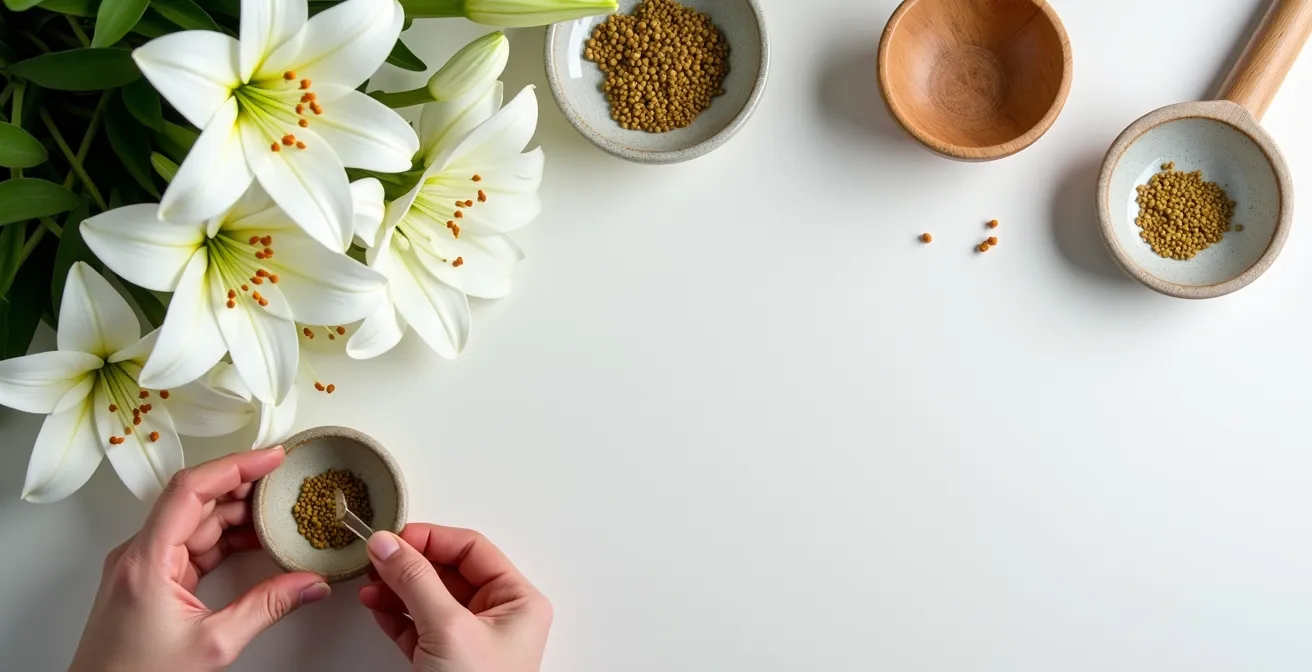
Beyond proportion and weight, the very material integrity of the flowers themselves poses a risk to your gown. The most common and devastating mistake is overlooking pollen. Certain flowers, while beautiful, are loaded with pigmented pollen that can transfer onto a white or light-colored dress with the slightest brush. Stargazer and Asiatic lilies are the most notorious offenders, their vibrant orange pollen being exceptionally difficult to remove.
A professional florist will always take preventative measures. This involves meticulously removing the anthers (the pollen-bearing parts) from every lily before it’s even considered for an arrangement. Flowers like roses and orchids are naturally low-pollen or pollen-free, making them much safer choices. However, another risk to consider is color bleeding from dyed flowers (like blue orchids) or intensely saturated natural blooms, which can leach color if they become damp.
The image below shows a florist carefully de-pollinating a white lily, a crucial step in preparing flowers for a wedding bouquet to prevent stains.
To be completely safe, you should discuss a “dress-safe” floral palette with your florist. This includes not only low-pollen flowers but also ensuring all fresh-cut stems are properly sealed to prevent green chlorophyll from seeping out and staining the ribbons or your hands. An experienced florist will be proactive about this, but it’s a crucial question to ask.
Case Study: The Day-Of Floral Stain Emergency Kit
According to professional florists at Beverly Hills Florist, every bridal party should be equipped with a specific emergency kit for floral stains. The absolute rule is to never use water or rub the stain, as this permanently sets it into the fabric fibers. Instead, the kit should contain: a soft, dry brush to gently flick away loose pollen; and white artist’s chalk or powder, which can be lightly applied to absorb the oils and color of a fresh stain, camouflaging it for photos. This kit should be kept with the maid of honor or wedding planner at all times.
How Wired Flowers Create Movement That Traditional Stems Cannot?
Each flower and leaf is individually wired, allowing it to move independently, catch the light, and create an ethereal, dancing effect as the bride walks.
– Leanne Kesler, Floral Design Institute Tutorial
The magic of a truly breathtaking cascade lies in its movement. This is not an accident of nature but the result of a meticulous technique known as wiring. While a traditional hand-tied bouquet relies on the natural stems for structure, a high-end cascade is a work of floral engineering. This technique is what elevates the bouquet from a simple bunch of flowers to a piece of kinetic artistry.
In this process, a florist removes the bulky natural stem from each individual bloom and piece of foliage, replacing it with a slender, flexible wire. This has several profound advantages. First, it dramatically reduces the bouquet’s overall weight and bulk. Second, it gives the florist complete control over the placement and angle of every single element, creating the perfect shape. Most importantly, it imbues the bouquet with life.
Unlike rigid stems clumped together in a foam holder, which can be stiff and prone to snapping, wired flowers can be positioned to “float” away from the main bouquet. They tremble and sway with the bride’s movements, catching the light and creating a dynamic, airy effect. This method provides superior individual bloom support, making the flowers more resistant to wilting or breaking. While some florists can create beautiful, loose cascades with a hand-tied spiral method, the wiring technique is what allows for the most gravity-defying and ethereal designs.
Why Hand-Tied Posies Are the Best Choice for Relaxed Bridal Parties?
The same principles of proportion and visual weight that apply to the bride’s bouquet are equally important for the bridal party. The bridesmaids’ bouquets should complement, not compete with, the main event. While you have a magnificent, flowing cascade, the best choice for your bridesmaids is often a simpler, more understated hand-tied posy. This creates a clear and beautiful visual hierarchy in your group photographs.
A posy is a small, round bouquet, typically held in one hand. It provides a touch of floral beauty without adding bulk or a competing shape. This is particularly effective for more relaxed, modern weddings where the bridesmaids’ comfort is a priority. A lightweight posy is easy to carry, set down, and manage throughout a long day of photos, mingling, and dancing. It ensures the bridesmaids look elegant and feel comfortable, not burdened by a large arrangement.
The size difference is intentional and strategic. As a general rule, bridesmaid bouquets typically measure half to two-thirds the size of the bridal bouquet. For instance, if your cascade has a main body of 12-14 inches, their posies might be in the 6-8 inch range. According to wedding experts at Just Bloom’d Weddings, this smaller scale is also perfect for mothers and grandmothers. This deliberate difference in scale ensures that in every photo, your elaborate cascade remains the undisputed focal point, drawing all eyes to the bride.
Why Garden Roses Are the Superior Alternative to Peonies for Romance?
Peonies have long been the symbol of bridal romance, but their notoriously short seasonal window and delicate structure can make them a risky choice for a cascade. For a superior combination of romance, reliability, and structure, the modern bride should look to garden roses. Varieties bred by growers like David Austin offer the same lush, multi-petaled romance as a peony but with far greater structural integrity.
Professional florists often prefer garden roses for cascading designs because they provide robust stems and a diverse range of head sizes, which are ideal for creating a flowing, dimensional shape. As noted in professional florist guides, varieties like the creamy ‘Patience’, the peachy ‘Juliet’, or the soft pink ‘Charity’ are workhorses in cascade design. Their stems are stronger and less prone to drooping than top-heavy peonies, which can wilt or flatten in a gravity-dependent waterfall arrangement. Crucially, garden roses offer year-round availability, freeing you from the restrictive late-spring window of peonies.
Beyond the structural advantages, garden roses offer a level of sensory complexity that peonies cannot match. As one wedding florist expert from Just Bloom’d Weddings explains:
Garden roses provide a complex spectrum from myrrh to fruity to classic tea rose, allowing a bride to layer scent into her day.
– Wedding Florist Expert, Just Bloom’d Weddings
This allows you to weave a personal scent story into your wedding, creating an immersive experience. By choosing garden roses, you are not sacrificing romance; you are choosing a smarter, more resilient, and more versatile path to achieving that lush, romantic aesthetic.
Key Takeaways
- Prioritize Proportional Harmony: Your bouquet’s width should not exceed your hips, and its length should create a vertical line that elongates, rather than shortens, your frame.
- Master the Ergonomic Carry: Support the bouquet’s weight on your forearm, not your wrist, to prevent fatigue and maintain a relaxed, elegant posture all day.
- Demand Material Integrity: Discuss pollen-safe flowers, fabric-safe attachments (like magnets), and sealed stems with your florist to protect your gown and your wedding party’s attire.
How to Select Bridal Party Gifts That Won’t End Up in a Goodwill Bin?
The same thoughtfulness that goes into designing your perfect bouquet should extend to thanking the people standing beside you. The most common mistake with bridal party gifts is choosing one-size-fits-all items that feel impersonal. To select gifts that are cherished rather than discarded, shift your mindset from “uniform” to “uniquely personal.” The key is to treat each gift as an individual expression of gratitude.
Instead of identical items, consider a central theme with personalized execution. The wedding florals themselves provide a perfect theme. For instance, you can gift each person something that reflects a key flower or scent from their bouquet. Wedding planners increasingly recommend this personalization strategy. Just as each bridesmaid has a unique personality, their gift should reflect their individual tastes. This shows you see them as individuals, not just as part of the wedding decor.
This approach ensures the gift has lasting meaning. For example:
- For the art lover: A high-quality framed botanical print of the primary flower in their bouquet.
- For the homebody: A luxury candle or perfume featuring the main scent notes from the wedding florals, like rose or jasmine.
- For the book lover: A special edition of a favorite book with a flower from their bouquet pressed inside.
- For the experience seeker: A gift certificate for a local floral arranging workshop.
By personalizing the gift within a cohesive theme, you give something that is both a beautiful reminder of your shared day and a genuinely thoughtful present tailored just for them. It’s an investment in acknowledging their unique contribution to your life and your wedding.
Now that you are armed with a stylist’s perspective, the next step is to initiate a detailed and informed conversation with your floral designer. Use this knowledge to ask specific questions about proportion, technique, and materials to co-create a cascading bouquet that is a true work of art.