
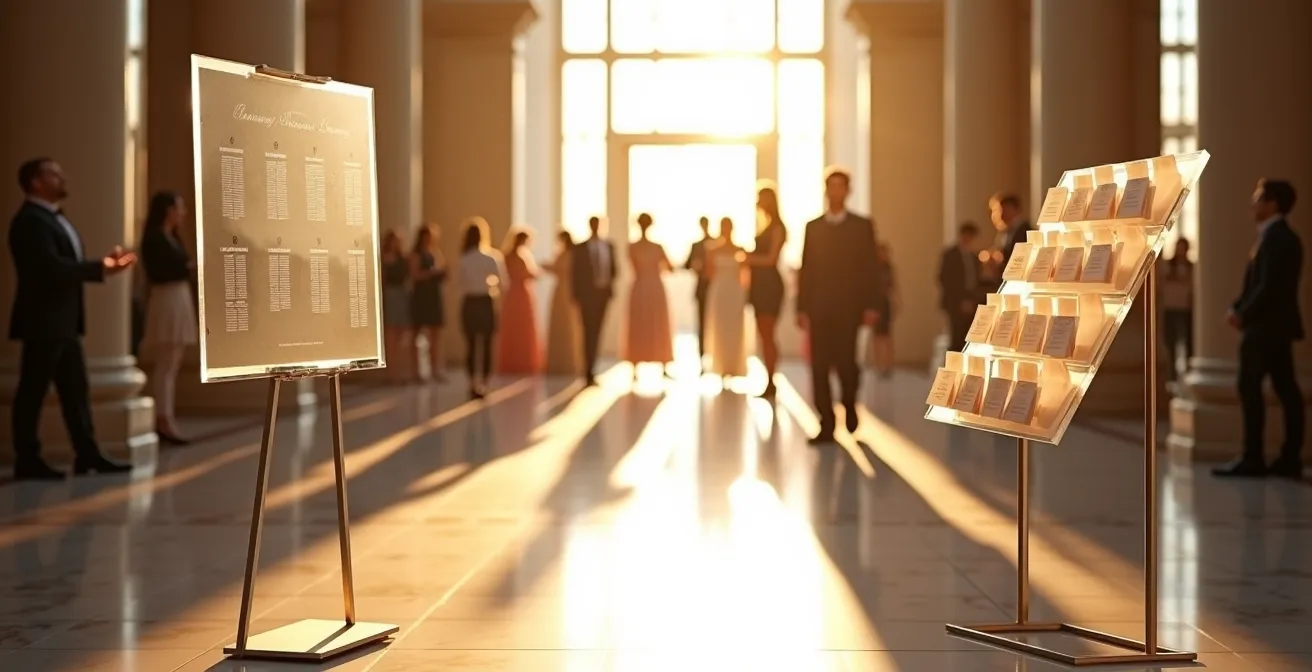
The fastest method to seat 150 guests is not an aesthetic choice; it’s a solved logistical problem where reducing guest search time is the primary variable.
- A decentralized, alphabetical escort card system minimizes guest cognitive load and creates a robust, parallel processing environment.
- Single-point-of-failure systems like large seating charts create inevitable bottlenecks, increasing wait times and guest frustration, especially when variables like lighting and reflections are introduced.
Recommendation: Implement a well-organized escort card system to achieve a complete guest transition from cocktail to dinner in under 15 minutes.
The transition from cocktail hour to the dinner reception represents the single largest coordinated movement of people during a wedding. For a party of 150 guests, this moment holds the highest potential for a significant bottleneck, turning celebratory energy into a frustrating queue. Many couples approach the choice between escort cards and a seating chart as a matter of aesthetics or tradition. They debate the elegance of a large, calligraphed mirror versus the charm of individual cards. This perspective, however, fundamentally misdiagnoses the problem.
The core challenge is not one of decor, but of information retrieval and fluid dynamics. Viewing the guest transition through a logistical lens reveals a different set of priorities: throughput, search time complexity, system integrity, and cognitive load. The conventional wisdom often fails because it prioritizes the visual appeal of the system over its operational efficiency. It focuses on the object itself, not the process it is meant to facilitate.
But what if the key to a seamless transition was not in the beauty of the display, but in the mathematical efficiency of its design? This analysis abandons aesthetic debate to treat the seating process as the logistical operation it is. We will dissect the variables that govern guest flow, from font size to environmental factors, to provide a data-driven answer. By optimizing each component of the seating system, it is possible to engineer a process that moves 150 guests to their seats smoothly, quickly, and without a single moment of confusion.
This article will deconstruct the seating process into its critical logistical components. By examining each phase, from display security to delegation protocols, we will build a case for the most efficient system to manage guest flow and ensure your reception begins on schedule and without friction.
Summary: The Definitive Guide to Guest Seating Logistics
- How to Secure Escort Cards for an Outdoor Cocktail Hour?
- Why You Should Always Organize Escort Cards Alphabetically, Not by Table?
- How to Turn Escort Cards Into Meaningful Guest Favors?
- How to Handle Last-Minute Cancellations With Printed Escort Cards?
- The Font Size Mistake That Frustrates Elderly Guests
- How to Arrange Cocktail Tables to Encourage Mixing Between Families?
- How to Maintain Control While Delegating 90% of the Decisions?
- The Reflection Mistake That Makes Mirror Seating Charts Unreadable
How to Secure Escort Cards for an Outdoor Cocktail Hour?
An outdoor escort card display introduces an uncontrolled variable: weather, specifically wind. A system that fails under environmental pressure is a failed system. Therefore, ensuring the physical integrity of your escort card display is the first logistical checkpoint. The goal is to create a setup that is resilient to gusts of wind without sacrificing accessibility or aesthetic. This requires a shift from thinking about display as decoration to engineering it for stability.
The principles of aerodynamics and weight distribution apply. Lightweight cards on a flat table are maximally vulnerable. The solution is to either increase the weight of the card-and-holder unit or change the display’s orientation relative to airflow. For instance, attaching cards to heavier objects like stones, shells, or other small favors serves a dual purpose of stability and gifting. Alternatively, using a clothesline or ribbon system with secure clips turns each card into a pendulum, which is more resistant to being carried away than a flat object.
Spatial planning is also critical. Placing display tables too close together can create a wind tunnel effect, exacerbating the problem. To ensure both stability and adequate guest flow, venue planning experts recommend a 42-60 inches spacing between outdoor display tables. This creates sufficient buffer for both wind and human traffic. A well-engineered outdoor display will feature:
- Weighted Holders: Utilize card holders with a low center of gravity or attach cards directly to weighted items.
- Sheltered Zones: Position the display in a naturally sheltered area or use portable screens to create a windbreak.
- Secure Attachments: If hanging cards, use clips or ties that provide a firm grip, spaced adequately to prevent tangling.
- Strategic Orientation: Place tables perpendicular to the prevailing wind direction to minimize the surface area exposed to direct force.
- Contingency Planning: Always have a backup set of cards stored in a secure, weatherproof container. This is not just a precaution; it’s a core component of a resilient system.
By treating wind as a predictable force rather than an unforeseen accident, you maintain the operational integrity of your seating system. The objective is to make the display robust enough that it requires zero intervention during the event, freeing up personnel for other tasks.
Why You Should Always Organize Escort Cards Alphabetically, Not by Table?
This is the most critical variable for optimizing guest throughput. Organizing escort cards by table number is a common but profound logistical error. It forces a linear search where each guest must scan every card until they find their name. For 150 guests, this creates a high-friction bottleneck. The correct method is to organize cards alphabetically by last name. This transforms the guest’s task from a slow, sequential scan into a rapid, targeted search.
From a data processing perspective, a non-alphabetical arrangement has a search time complexity that approaches O(n), where ‘n’ is the number of guests. An alphabetized system, however, operates on a principle similar to a binary search, with a complexity closer to O(log n). Guests intuitively know where their last name falls in the alphabet, allowing them to ignore large sections of the display and focus on a small, relevant subset. For large events, wedding planning professionals strongly recommend that any event with over 150 guests requires alphabetical ordering to ensure efficient searching and prevent queues.
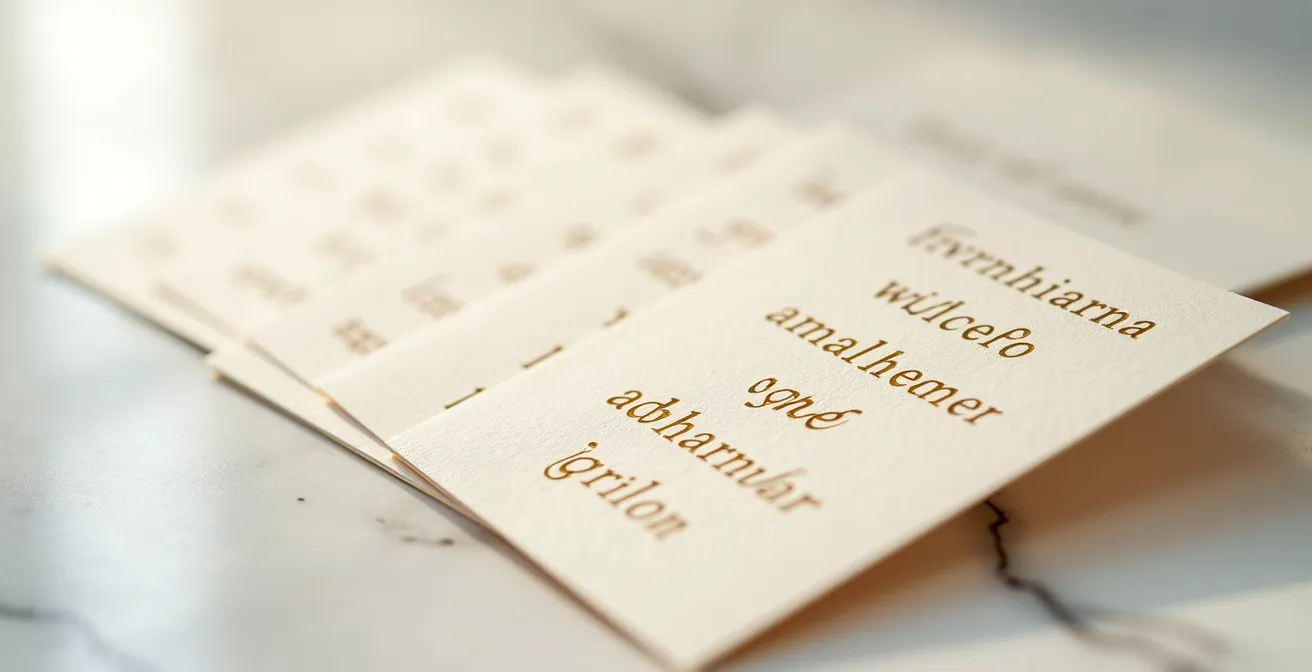
This organizational method decentralizes the search process. With a single large seating chart, all 150 guests are trying to access one information point. With alphabetized escort cards, the display is effectively partitioned into 26 smaller, independent sections. Multiple guests can search for their names simultaneously in different sections (one in ‘B’, another in ‘M’, a third in ‘S’) without interfering with one another. This parallel processing is the key to high throughput.
The historical context for assigned seating, as noted by planners like Sandra Hadley of Planning Forever Events, was to prevent guests from feeling left out in large, open-seating weddings. By ensuring guests have an assigned table, you provide social structure. By organizing the path to that information alphabetically, you provide logistical efficiency and remove the primary point of friction in the transition.
How to Turn Escort Cards Into Meaningful Guest Favors?
The concept of combining an escort card with a guest favor is a direct application of logistical efficiency: consolidating two separate processes into a single, streamlined action. Instead of managing a seating system and a favor distribution system, you create one unified point of contact for the guest. This reduces the number of “stations” a guest must visit, a key step in simplifying overall event flow. The expert insight that “escort cards don’t have to actually be cards” is pivotal. It reframes the escort card as a piece of information that can be attached to any object.
This approach transforms a purely functional item into a component with added value. The physical object—the favor—serves as the weighted, stable base for the seating information, directly solving some of the challenges discussed in securing an outdoor display. For example, using mini honey jars or small bottles of olive oil as the escort “card” provides inherent stability against wind while also delivering the favor. The guest picks up one item that serves two functions: it tells them where to sit, and it’s their take-home gift.
To execute this effectively, the object chosen must be easily transportable from the display to the dinner table. The guest’s name and table number must be clearly and securely affixed to the item. The goal is to increase efficiency, not to create a new problem of guests juggling cumbersome objects. The most successful implementations involve:
- Tagging Functional Items: Attaching a well-designed tag with the guest’s name and table number to a practical favor like a bottle opener or a wine stopper.
- Inscribing Durable Materials: Using calligraphy on elegant, durable surfaces like marble tiles, agate slices, or wooden coasters that guests are encouraged to take.
- Creating Interactive Elements: Designing small envelopes as the escort card, containing the table number and a personal thank-you note inside, thus combining information with a moment of personal connection.
- Leveraging Technology: Incorporating a QR code on the favor’s tag that links not only to the table number but also to a personalized digital message or photo gallery.
This multi-function approach is the hallmark of sophisticated event logistics. It demonstrates an understanding that every element of the guest experience can be optimized for efficiency, flow, and impact. It’s not just a “cute” idea; it is a smarter way to manage multiple event components.
How to Handle Last-Minute Cancellations With Printed Escort Cards?
A key measure of any logistical system is its fault tolerance—its ability to adapt to unexpected changes without catastrophic failure. Last-minute guest cancellations are a predictable disruption. A rigid, monolithic seating chart is extremely brittle in this scenario; a change requires a complete, often impossible, redesign. A modular system of individual escort cards, however, is inherently resilient and adaptable.
Handling a cancellation with an escort card system is a simple act of removal. The card for the absent guest is pulled from the alphabetical display. This action takes seconds and has no impact on the other 149 guests’ ability to find their information. This modularity is a critical advantage. To prepare for this inevitability, wedding planning expert Mindy Weiss advises that all card preparation should begin at least three weeks before the wedding, allowing a buffer for printing and organizing, but the final execution requires a day-of protocol for adjustments.

The inverse scenario, a last-minute addition, is also manageable with the right preparation. A pre-assembled “emergency kit” is not an optional extra; it is a required component of a professional seating plan. This kit should contain blank cards matching the design of the main set and appropriate writing implements. A designated individual with legible handwriting (or calligraphy skills) can create a new card in moments, integrating the new guest seamlessly into the existing alphabetical system. The key is to have a pre-defined protocol that can be executed without involving the couple on the day of the event.
Your Action Plan: Last-Minute Seating Change Protocol
- Pre-Event Preparation: Procure 10-15 blank escort cards and matching envelopes that are identical to the primary set. Designate a day-of coordinator or a trusted person with clear handwriting as the “Scribe” for any changes.
- Immediate Action upon Notification: Upon learning of a cancellation, the Scribe’s first task is to locate and remove the guest’s card from the display. For an addition, the Scribe uses the emergency kit to create a new card.
- System-Wide Communication: Immediately notify the catering captain of the change in headcount for the specific table to adjust place settings and meal counts. This prevents an empty chair or a missing spot.
- Information Consistency Check: If an MC or DJ will be making announcements, ensure their list is updated. This prevents the awkwardness of calling a name for a guest who has cancelled.
- Table Optimization Review: If multiple cancellations occur at the same table, assess the possibility of consolidating guests to avoid a sparsely populated table. This decision should be made by the designated coordinator, not the couple.
This protocolized approach turns a potential crisis into a routine administrative task. It demonstrates the superior resilience of a modular escort card system over a monolithic seating chart, proving its worth from a risk management perspective.
The Font Size Mistake That Frustrates Elderly Guests
An efficient seating system is one that is accessible to 100% of its users. A common point of failure is readability, a factor that disproportionately affects guests with visual impairments, particularly the elderly. Choosing a font for its aesthetic appeal (e.g., a delicate, swirling script) at the expense of legibility introduces significant friction into the system. This increases the “cognitive load” for every guest and can bring the process to a complete halt for some, creating a bottleneck.
The core principle is that information must be easily decodable under real-world conditions. As event planning professionals emphasize, cards must be legible in the potentially dim, ambient lighting of a cocktail hour, and from a reasonable distance. A guest should not have to squint, get extremely close, or borrow a phone’s flashlight to read their own name. This is a failure of design.
A data-driven approach to font selection removes subjectivity. Legibility is a measurable attribute, governed by font size, weight, and the contrast between text and background. While there is no single universal standard, professional accessibility guidelines provide a strong starting point. Testing your card design under conditions that mimic the venue’s lighting is a critical, non-negotiable step. An effective accessibility checklist for escort cards includes:
- Font Size Test: A minimum of 14-point font for guest names is recommended, with 12-point as the absolute minimum for table numbers.
- Contrast Ratio: The contrast between the text color and the card background should be at least 4.5:1, the standard for web accessibility which applies equally well to print. Black text on a white or cream card is optimal.
- Real-World Simulation: Test a sample card in low lighting to confirm it remains readable. What looks clear on a bright design screen can become illegible in a candlelit room.
- Display Height: The display itself should be positioned at a comfortable viewing height, typically between 42 and 48 inches from the floor.
- Sufficient Lighting: The display area must be intentionally and adequately lit. Relying on ambient room light is a recipe for failure; use dedicated spotlights or well-placed, safe candles.
By prioritizing legibility, you reduce the average time each guest spends at the display, thereby increasing the overall throughput of the system. This is not merely a courtesy to older guests; it is an optimization that benefits everyone.
How to Arrange Cocktail Tables to Encourage Mixing Between Families?
The arrangement of furniture during cocktail hour is not a passive act of decoration; it is the active design of a guest flow system. The primary goal of this phase is to facilitate smooth movement towards the seating display and bar, while the secondary goal is to encourage interaction. Poorly planned table placement can create dead zones, chokepoints, and an overall sense of congestion that hinders both objectives.
To analyze this, think of the space as a system of channels and nodes. The “channels” are the pathways for guests to move, and the “nodes” are points of interest: the bar, food stations, conversational groupings (tables), and the eventual exit towards the seating display. Your goal is to create wide channels and strategically placed nodes. As a baseline, venue planning guidelines specify approximately 1,800 square feet are needed for a comfortable 150-guest sit-down dinner; the cocktail space requires similarly calculated attention to square footage per person to avoid crowding.
To encourage mixing, the arrangement must break up natural social clusters and invite movement between them. This can be achieved by:
- Creating Varied Seating/Standing Options: Use a mix of high-top cocktail tables (which encourage standing and transient conversation) and a few small, low-seated lounge areas. This caters to different energy levels and encourages movement between zones.
- The “Triangle” Method: Place the three most important nodes—the bar, a major food station, and the seating display—in a wide triangle that spans the space. This forces guests to traverse the area to get what they need, creating opportunities for chance encounters along the way.
- Avoiding Symmetrical Grids: A rigid grid of tables feels formal and static. An organic, slightly irregular placement feels more like a natural gathering, making it easier for guests to drift from one group to another.
- Perimeter and Center Strategy: Place most of the high-top tables around the perimeter of the room, leaving the central area more open. This creates a clear “racetrack” for circulation and prevents a traffic jam in the middle of the space.
Ultimately, a well-designed cocktail space “nudges” guests into behaving in a way that benefits the event’s flow. Just as a professional DJ is essential for controlling the flow of a large reception, the physical layout is your silent coordinator, guiding guests, preventing bottlenecks, and setting the stage for an efficient transition to dinner.
How to Maintain Control While Delegating 90% of the Decisions?
Effective delegation is not abdication; it is a system of control based on clear directives and defined outcomes. For a complex, time-sensitive operation like a wedding seating transition, attempting to micromanage every detail is a guaranteed path to failure. The key is to delegate the execution of tasks, not the core strategy. You must maintain control of the “what” and “why” while entrusting a reliable team with the “how.”
The cornerstone of this system is a master directive—a simple, clear document that outlines your strategic intent. This isn’t a 20-page manual; it’s a one-page “Seating Philosophy” document that your coordinator or designated lead can use as their north star. This document should not contain a list of tasks, but rather a set of non-negotiable outcomes. This shifts the focus from process to results, empowering your team to problem-solve within a defined framework.
This delegation framework allows you to retain high-level control while offloading the cognitive burden of tactical execution. An effective framework should include:
- A One-Page Seating Philosophy: A concise document stating your primary goals. For example: “Our top priority is a fast, seamless transition for all guests, with special attention to accessibility for our elderly relatives.”
- 3-5 Non-Negotiable Outcomes: These are the key performance indicators (KPIs) of the operation. Examples: “The total transition from cocktail to dinner must take less than 15 minutes.” or “No guest should report feeling confused or lost while finding their table.”
- Clear Escalation Protocols: Define what constitutes an emergency that requires your attention versus a problem your delegate is empowered to solve. Example: “You are authorized to make any changes to table assignments except for moving guests at the head table.”
- Strategic Task Allocation: Delegate tasks to the most appropriate parties. For example, allowing parents to arrange the seating for their own tables of friends is an effective way to delegate while also giving them a sense of involvement and ownership.
By establishing this command and control structure, you are not losing control. You are multiplying your effectiveness by building a system that can operate efficiently and autonomously, leaving you free to focus on the experience rather than the execution.
Key Takeaways
- Alphabetical ordering of escort cards is the single most important factor for maximizing guest throughput and minimizing search time.
- A system’s integrity—its ability to withstand wind, poor lighting, and last-minute changes—is a primary measure of its logistical soundness.
- Escort cards offer superior modularity and flexibility, making them inherently more resilient to the predictable disruptions of a live event than a monolithic seating chart.
The Reflection Mistake That Makes Mirror Seating Charts Unreadable
The mirror seating chart represents the peak of the aesthetic-over-functionality dilemma. While visually striking and popular for its “insta-worthy” appeal, it is a high-risk system fraught with potential points of failure. The primary failure mode is glare and reflection. The very property that makes a mirror a mirror also makes it an exceptionally poor medium for conveying critical information in a dynamic environment.
A mirror reflects everything: the light sources in the room, the guests standing in front of it, and the general commotion of the cocktail hour. This creates significant visual noise that competes directly with the names written on its surface. A guest attempting to find their name is forced to filter out these reflections, dramatically increasing their cognitive load and search time. In bright daylight or a room with multiple, shifting light sources (like uplighting or DJ lights), the chart can become completely unreadable, creating a hard stop bottleneck for the entire guest population.
While proponents note that mirrors can be interactive and reduce waste as the ink is removable, a logistical analysis must weigh these minor benefits against the significant operational risks. A comparative analysis of materials reveals the mirror’s inherent weaknesses.
| Material | Visibility | Setup Ease | Cost |
|---|---|---|---|
| Mirror | Low in bright light | Easy – lean against wall | Medium (rental) |
| Acrylic | High – anti-glare options | Easy – lightweight | High |
| Wood | High contrast possible | Moderate – heavier | Medium |
| Fabric | Excellent readability | Complex – needs frame | Low-Medium |
As this comparative data from event professionals shows, materials like acrylic (with anti-glare options) or even simple fabric offer far superior visibility. The choice of a mirror subordinates the primary function of the object (to inform) to its secondary function (to decorate), a classic logistical mistake. The risk of a total system failure due to unreadability is simply too high to justify the aesthetic gain. For a seating system to be effective, its function must dictate its form, not the other way around.
In conclusion, the data is clear. When the objective is to move 150 guests from one location to another with maximum efficiency and minimum friction, a well-designed escort card system is mathematically superior to a large-format seating chart. By applying logistical principles—optimizing for search time, ensuring system integrity, reducing cognitive load, and building in fault tolerance—you can engineer a transition that is as smooth and seamless as the rest of your carefully planned event. To ensure a seamless guest transition, the next logical step is to design your seating logistics based on these data-driven principles.