
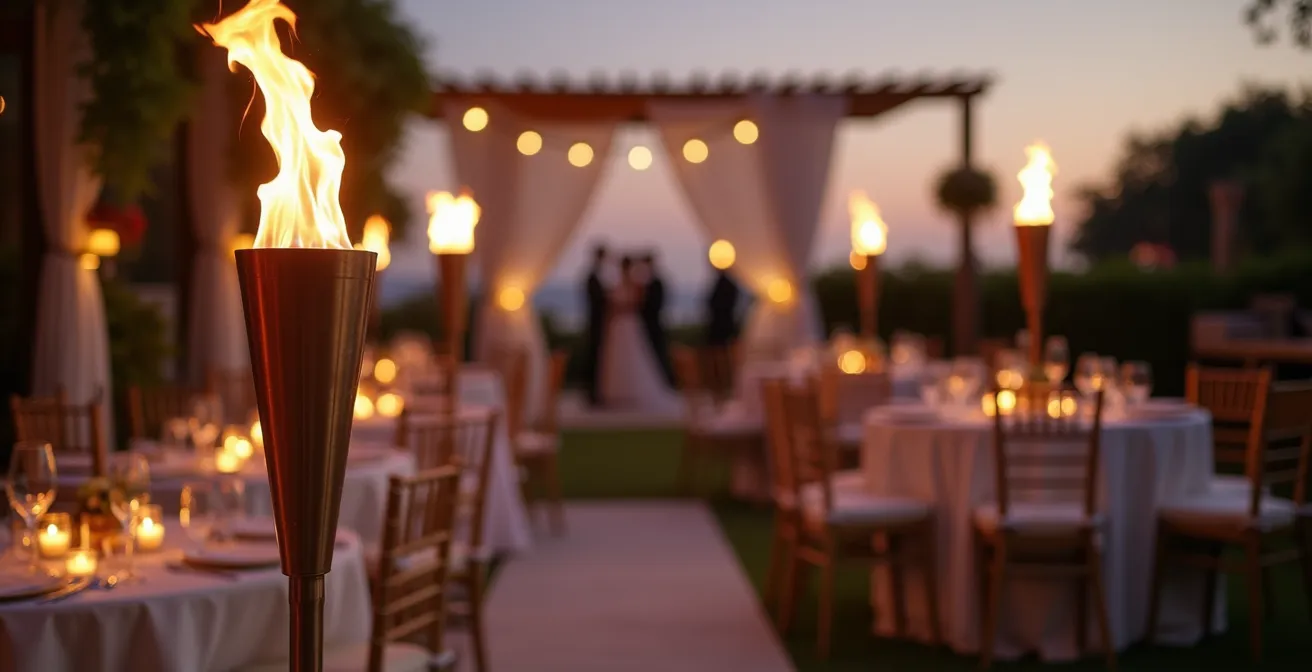
Citronella torches are not the charming, budget-friendly pest solution for a high-end wedding; they are an aesthetic liability that compromises guest comfort and safety.
- Cheap fuels create unpleasant smoke and soot that can ruin expensive decor and irritate guests.
- Their effective pest-repelling range is minimal, requiring a density that creates a significant and often underestimated fire hazard.
Recommendation: Prioritize professional pest treatments scheduled days in advance and invest in superior, safer lighting options like copper torches with clean-burning fuel or strategic uplighting.
The vision of an outdoor wedding is often one of romance under the stars, with guests mingling in a beautifully lit garden or terrace. But this idyllic picture is quickly shattered by a single, persistent reality: biting insects. In the quest for a pest-free evening, many couples are drawn to what seems like an easy, atmospheric solution: the humble citronella torch. They appear to offer a dual benefit—ambient light and mosquito repellent—all wrapped in an affordable, rustic package. This leads to the common advice to simply ring the event space with bamboo tiki torches.
However, from a design and guest experience perspective, this is a critical misstep. The reliance on cheap torches is an aesthetic and logistical liability. But what if the key to a truly elegant and comfortable outdoor event wasn’t just about fending off bugs, but about integrating pest control and lighting with genuine sophistication? The real solution lies not in adding more smoky torches, but in fundamentally rethinking the approach to ambiance, safety, and effectiveness. It’s about understanding why certain elements look high-end while others look cheap, and making choices that elevate, rather than detract from, your carefully planned decor.
This guide deconstructs the myth of the simple citronella torch. We will analyze the critical factors of placement, material choice, fuel quality, and fire safety. More importantly, we will explore superior alternatives and design principles that deliver a truly luxurious and pest-free experience, ensuring your wedding is memorable for its beauty, not for its smoky, bug-bitten reality.
To navigate this critical aspect of your wedding decor, this article breaks down the essential considerations for achieving an elegant and safe ambiance. Explore the sections below to make informed decisions.
Summary: Deconstructing the Myth of the Wedding Torch
- How to Position Torches So Smoke Doesn’t Blow Into Guests’ Faces?
- Stylish Copper Torches vs. Bamboo Tiki: Upgrading the Look
- The Fire Hazard Zone Required Around Open-Flame Torches
- Why Clean-Burning Fuel Is Worth the Extra Cost Over Standard Oil?
- How Close Do Torches Need to Be to Actually Repel Anything?
- Real Trees vs. Fabricated Trunks: Which Is Feasible for a One-Day Event?
- Why Uplighting Works Best on Textured Brick or Stone Walls?
- How to Design Boho Installations That Look High-End Instead of Messy?
How to Position Torches So Smoke Doesn’t Blow Into Guests’ Faces?
The single greatest failure of torch placement is ignoring the primary complaint they generate: olfactory intrusion. The acrid smell of burning oil and the plumes of smoke are not atmospheric; they are irritants that can ruin the taste of food and wine, trigger allergies, and force guests to move. The goal is not just to place torches, but to create a scent-free, smoke-free zone where your guests are. Professionals, like those at Esperanza Ranch, understand this, opting to place citronella sources along the *perimeter* of an event, far from seating, to create a boundary rather than an immersive cloud.
Achieving this requires a strategic, almost military-style approach to placement. It begins a day before the event by checking weather patterns to predict wind direction. On the day, a simple test with a ribbon or a smoke source can confirm airflow, allowing for last-minute adjustments. This isn’t a “set and forget” decor element; it’s an active environmental factor that must be managed.
To do this effectively, follow a clear sequence of operations:
- Check Weather Apps: Monitor predicted wind speed and direction 24 hours before the event.
- Establish an Upwind Perimeter: Position all torches on the upwind side of the main reception and dining areas, maintaining a distance of at least 15-20 feet from any guest seating.
- Create a Buffer Zone: If possible, use strategically placed, quiet fans to create a gentle air current that pushes smoke away from guest areas.
- Conduct a Live Test: Two hours before guests arrive, light one torch and use a ribbon or observe the smoke to confirm it is drifting away from, not into, the event space.
- Designate a Monitor: Assign a staff member or a “torch marshal” to monitor wind shifts during the event and be prepared to move or extinguish torches if the wind changes.
This level of planning separates a thoughtful event from an amateurish one. The comfort of your guests depends on treating torch smoke not as a minor inconvenience, but as a primary problem to be solved through intelligent design.
Stylish Copper Torches vs. Bamboo Tiki: Upgrading the Look
The choice between bamboo and metal torches is not merely a practical one; it is a declaration of aesthetic intent. Cheap bamboo tiki torches scream “backyard barbecue,” not “elegant wedding.” Their disposability, splintered texture, and often-uneven construction immediately lower the perceived value of your decor. They are an aesthetic liability. For a couple investing in fine linens, floral arrangements, and formal attire, introducing a cheap, flammable stick into the environment is a jarring design contradiction.
The alternative, copper torches, represents a significant upgrade in both form and function. Copper possesses a warm, reflective quality that complements candlelight and evening ambiance. It patinas beautifully over time, suggesting permanence and quality. A copper torch is a piece of hardware, an architectural element that integrates into a sophisticated rustic-luxe or modern theme. It signals an investment in quality, and because of their durability, they can be resold or reused, offsetting their higher initial cost.
The financial difference is clear, but the visual and conceptual gap is even wider. While rental costs for decor are a factor, this is one area where splurging has a disproportionate impact on the overall look. The following table breaks down the practical differences, but the core choice is stylistic: do you want your wedding to feel temporary and casual, or intentional and upscale?
| Feature | Copper Torches | Bamboo Tiki |
|---|---|---|
| Purchase Cost | $50-$100 per torch | $15-$30 per torch |
| Rental Cost | $15-$25 per torch/day | $5-$10 per torch/day |
| Best For | Rustic-luxe, modern themes | Tropical, bohemian events |
| Durability | Can be reused/resold | Single-use typically |
| Visual Impact | Elegant, upscale | Casual, festive |
Ultimately, opting for copper is an editorial choice. It demonstrates a commitment to a cohesive, high-end aesthetic where every element, including functional ones like lighting, has been thoughtfully considered and curated.
The Fire Hazard Zone Required Around Open-Flame Torches
The romantic flicker of an open flame is dangerously deceptive. In a wedding environment, it’s not just a light source; it’s a calculated risk. The primary danger isn’t the torch tipping over—it’s its proximity to flammable materials, namely, the guests themselves. Fire safety experts warn that small open flames are major sources of clothing ignition, with dresses and flowing garments being particularly vulnerable. A guest turning quickly, a gust of wind blowing a chiffon sleeve, or someone stepping back without looking can lead to a catastrophic incident in seconds.
This is why a non-negotiable safety perimeter is not a suggestion, but a requirement. Think of each torch as having concentric circles of risk. Anything within a three-foot radius is in a “no-go” zone for people and flammable materials. A wider six- to ten-foot radius should be considered a “caution” zone, clear of drapery, dried floral arrangements, and any temporary structures.
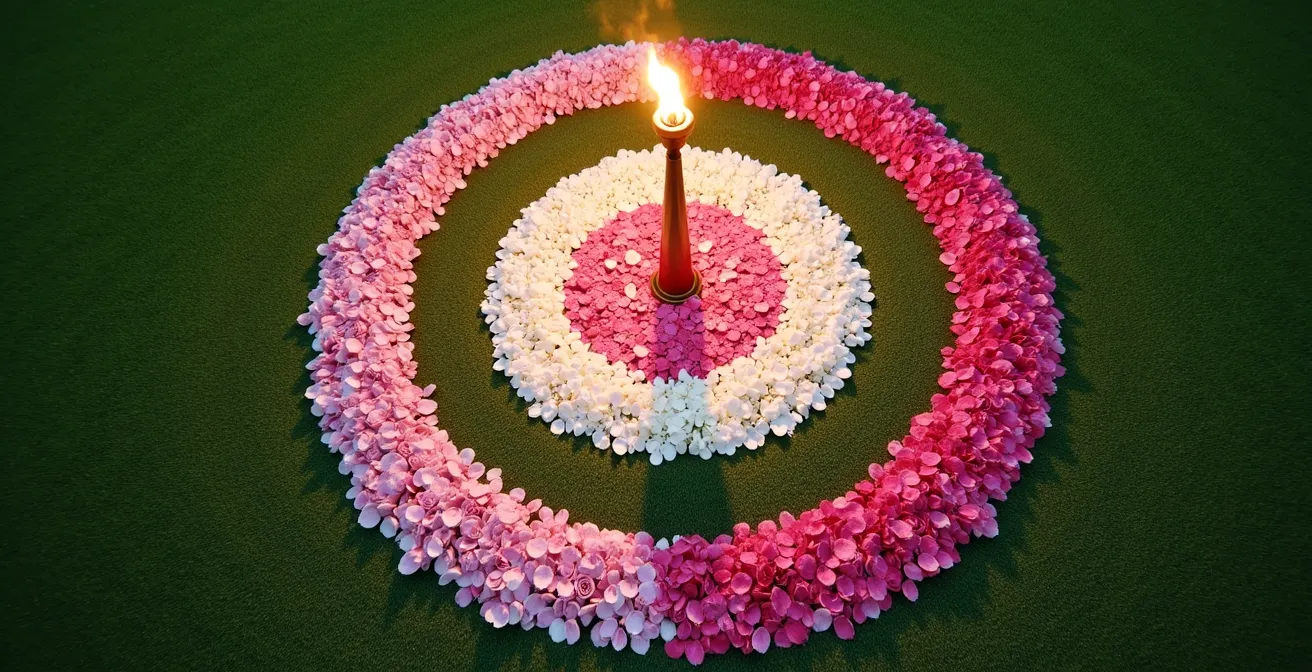
As the image metaphorically illustrates, these zones must be respected. To enforce this, a clear safety protocol is essential. It’s not enough to simply place the torches and hope for the best. Key safety measures must be actively implemented:
- Material Awareness: Be hyper-aware of highly flammable wedding materials like tulle, organza, large amounts of hairspray, and dried florals. Keep them far from any flame.
- Secure Installation: Ensure every torch is driven at least 6-8 inches into firm ground or secured in a heavy, stable stand that cannot be easily knocked over.
- Minimum Clearance: A strict minimum of a 6-foot clearance must be maintained between any part of the torch and any fabric, including tablecloths, chair backs, and decor.
- Emergency Preparedness: A dedicated, sober staff member must be assigned as a safety monitor, with clear knowledge of the location and operation of a fire extinguisher.
Ignoring these protocols is negligent. The aesthetic benefit of a flickering flame is instantly negated by the potential for serious injury. Safety must be the absolute first consideration, dictating placement long before aesthetics are even discussed.
Why Clean-Burning Fuel Is Worth the Extra Cost Over Standard Oil?
The fuel you choose for your torches is as important as the torches themselves. Opting for cheap, petroleum-based tiki fuel is a classic false economy. While it may save a few dollars per bottle, it extracts a heavy price in aesthetics and guest comfort. This type of fuel is notorious for producing thick, black smoke and soot. This isn’t just visually unpleasant; the soot particles will settle on everything nearby—crisp white tablecloths, floral centerpieces, and even your guests’ attire. It creates a dirty, grimy film that undermines the entire decor.
Clean-burning fuels, typically based on paraffin oil, are engineered to avoid this exact problem. As the experts at Firefly Fuel note, the “gold standard” fuel should be odorless, smokeless, and sootless. This is what you are paying for: the absence of negative side effects. According to their analysis, high-quality clean-burning paraffin fuel is over 30% more efficient and produces noticeably less smoke and soot. This efficiency means it not only burns cleaner but can also last longer, partially offsetting the higher initial cost.
Case Study: The Hidden Cost of Cheap Fuel
A venue owner shared a cautionary tale with Firefly Fuel after using standard petroleum-based oil: “We have (formerly) beautiful copper tiki torches that have so much soot on them, that we just put them in the farthest part of the yard. Too bad. The copper was beautiful, and I know they won’t patina now.” This demonstrates how cheap fuel can permanently damage expensive decor fixtures, turning a beautiful investment into an eyesore.
The choice is simple. If you have invested in elegant copper torches, using cheap fuel is an act of self-sabotage. It’s like buying a couture gown and washing it with harsh detergent. The extra cost for clean-burning fuel is not a luxury; it’s insurance for your overall aesthetic investment and a fundamental component of guest comfort.
How Close Do Torches Need to Be to Actually Repel Anything?
Here is the most inconvenient truth about citronella torches: their effectiveness as a pest repellent is wildly overestimated. The pleasant idea of a “perimeter of protection” is largely a myth. Citronella’s active compounds only work in the immediate vicinity of the flame, in the plume of smoke and heat. For a guest to benefit, they would need to be sitting directly in the path of the smoke—the very thing strategic placement seeks to avoid. To create a genuinely effective anti-mosquito barrier using only torches, they would need to be spaced every 3-5 feet, creating a dense, smoky, and dangerously flammable wall of fire.
This “perimeter of failure” highlights a core misunderstanding of their function. Torches are, at best, a minor supplemental tool, not a primary pest control solution. Professional pest control services, like Mosquito Joe, recommend a multi-faceted approach, using torches or candles as just one layer alongside more effective measures like pest-repelling plants (lavender, mint) and, most importantly, professional-grade yard treatments.
The most effective strategy has nothing to do with what happens on the day of the wedding, but what happens before. Pest control experts advise that the optimal time for a professional yard treatment is 3-4 days before the event date. This allows the treatment to take full effect, eliminating insect populations at the source, rather than feebly trying to wave them away with a smoky stick. This is the only way to ensure guests are truly comfortable and not spending their evening swatting at bugs.
Relying on torches for pest control is planning for failure. The real solution is to budget for professional services. The torches can then be used sparingly, far from guests, for their intended purpose: as a purely decorative, ambient light source.
Real Trees vs. Fabricated Trunks: Which Is Feasible for a One-Day Event?
Creating an enchanted forest look indoors is a popular but logistically demanding goal. The central question often becomes: real or fake? Bringing in large, real potted trees offers unparalleled authenticity, but it is a heavyweight operation. A single 8-foot ficus can weigh hundreds of pounds, requiring a specialized crew, dollies, and access for a transport truck. They are fragile, shed leaves, and demand significant setup and teardown time, making them a costly and complex choice for a single-day event.
Fabricated trunks, on the other hand, are built for the event industry. They are lightweight, durable, and designed for rapid installation. This is where high-end design gets clever: the “hybrid” approach. By using realistic fabricated trunks as the structural base and then dressing them with fresh, real branches (like eucalyptus or olive), you achieve the best of both worlds. You get the authentic look and scent of real foliage without the immense weight and logistical hassle of a full tree.

This strategy offers maximum visual impact for minimal logistical strain. The table below outlines the stark differences in feasibility for a standard wedding timeline and budget.
| Factor | Real Trees | Fabricated Trunks |
|---|---|---|
| Weight | 200-500 lbs per tree | 20-50 lbs per trunk |
| Setup Time | 2-3 hours with crew | 30-60 minutes |
| Maintenance | Requires water, may shed | No maintenance needed |
| Transport | Requires truck/loading dock | Fits in SUV/van |
| Cost | $200-500 per tree rental | $75-200 per trunk rental |
For a one-day event, the choice is clear from a practical standpoint. The fabricated trunk, enhanced with real greenery, provides a far more efficient, cost-effective, and controllable solution without sacrificing the high-end, naturalistic aesthetic.
Why Uplighting Works Best on Textured Brick or Stone Walls?
Uplighting is a transformative tool in event design, but its effectiveness is entirely dependent on the surface it illuminates. Aiming a powerful light at a flat, white, drywall surface is a waste of its potential. The light simply hits the wall and creates a harsh, one-dimensional splash of color. It can look cheap and dated, like a 1990s school dance. The magic of uplighting is unlocked when it interacts with texture.
Brick, stone, aged plaster, or even heavily paneled wood provide a three-dimensional canvas. When light is aimed up these surfaces at a grazing angle, it catches on the countless edges, bumps, and crevices. This creates a beautiful interplay of light and shadow, highlighting the natural character of the material and adding immense depth and visual interest to the space. The wall is no longer just a boundary; it becomes a feature, a piece of dynamic art. As the lighting experts at Rent For Event explain, this technique infuses “depth and drama into the space,” transforming the venue.
By infusing depth and drama into the space, uplighting transforms the venue, creating an ambiance that seamlessly intertwines with the celebration. It draws attention to key elements and ensures an even distribution of light, adding sophistication.
– Rent For Event, Wedding Uplighting Cost Guide
This effect is a core principle of architectural lighting design. A flat surface reflects light, but a textured surface *plays* with it. This is why venues with inherent character—historic lofts with brick walls, old barns with wooden beams, or chateaus with stone facades—are so sought after. They provide the perfect canvas for dramatic lighting. Investing in a professional lighting package, where uplighting can cost between $350 to $630, is only worthwhile if you have the right surfaces to work with. If your venue is a modern ballroom with flat walls, your lighting budget is better spent on other elements like pin-spotting tables or gobo projections.
Key Takeaways
- Ditch cheap bamboo torches; their smoke, soot, and fire risk create an aesthetic and safety liability.
- Invest in superior materials like copper torches with clean-burning paraffin fuel to protect your decor and guest comfort.
- The most effective pest control is a professional yard treatment 3-4 days before the event; torches are not a viable primary solution.
How to Design Boho Installations That Look High-End Instead of Messy?
The “bohemian” aesthetic is one of the most misunderstood and poorly executed themes in wedding decor. Too often, it devolves into a messy, cluttered collection of macrame, pampas grass, and mismatched rugs. The difference between a high-end boho look and a messy, DIY-esque attempt lies in three principles: intention, quality, and restraint. A truly luxurious bohemian design is not about throwing random rustic elements together; it is a highly curated and edited composition.
Quality of materials is non-negotiable. It’s the difference between hand-knotted macrame made from natural cotton and a cheap, mass-produced polyester wall hanging. It’s the choice of real linen for draping instead of synthetic sheer fabric. These material choices have a tangible effect on how the decor hangs, reflects light, and feels. Furthermore, a high-end look relies on creating depth through layering. This is especially true for lighting, where a sophisticated boho design might incorporate everything from string lights and candles to chandeliers, with lighting installations costing from $1,000 to $4,000 to achieve this layered effect.
Perhaps the most crucial element is restraint, or the use of “negative space.” A messy installation fills every corner. A high-end installation allows elements to breathe, creating focal points. This is often achieved through intentional asymmetry, where a single, large, dramatic element (like a floral moon gate) is balanced by a smaller, carefully placed cluster of items on the other side. It feels balanced but not rigidly symmetrical, which is the essence of the free-spirited boho vibe.
Action Plan: Achieving a High-End Boho Aesthetic
- Practice Intentional Asymmetry: Balance large, dramatic elements with several smaller, deliberately placed items to create visual interest without perfect symmetry.
- Invest in Quality Materials: Prioritize natural, tactile materials. Choose hand-knotted macrame, real linen or raw silk, authentic wood pieces, and professionally dried florals.
- Incorporate Varied Textures: Combine different natural textures (e.g., smooth wood, fluffy pampas grass, rough jute) to create depth and a rich sensory experience.
- Create Negative Space: Resist the urge to fill every inch. Leave empty space around your key installations to let them stand out and make a stronger impact.
- Layer Lighting at Multiple Heights: Use a combination of overhead string lights, mid-level chandeliers or pendants, and low-level candles or floor lanterns to build a warm, dimensional ambiance.
By focusing on these design principles, you can elevate a bohemian theme from potentially chaotic to effortlessly chic, ensuring it reflects a sophisticated and curated vision.
Elevate your wedding decor beyond the ordinary. Make informed, sophisticated choices that prioritize both impeccable aesthetics and an unforgettable guest experience by focusing on quality and professional execution over cheap, ineffective shortcuts.