
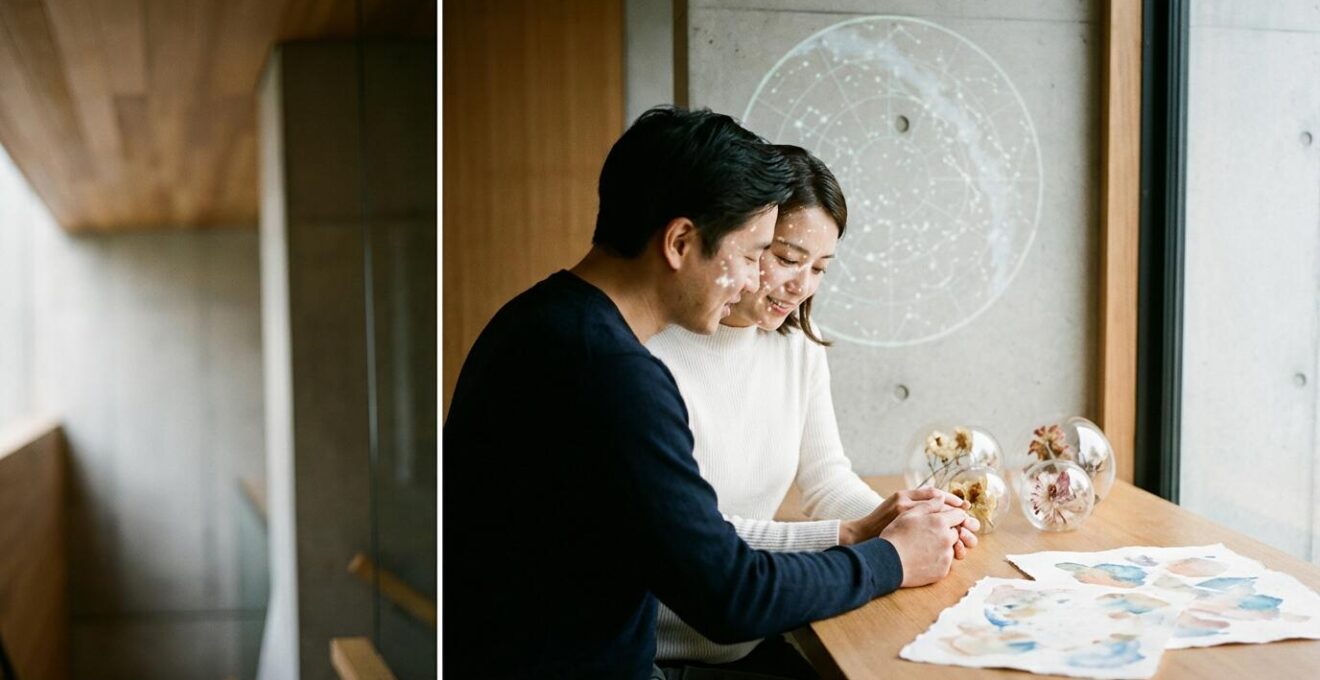
The common advice to ‘pick a color palette’ is the fastest route to a generic wedding; a truly bespoke theme is an experiential narrative excavated from your shared story.
- Authentic themes are born from abstracting personal memories and emotions into a sensory language of texture, light, and symbolism.
- The goal is not to “brand” your wedding with literal icons, but to weave a subtle design leitmotif through key moments, creating an atmosphere that feels like you.
Recommendation: Begin by auditing your relationship for meaningful moments, symbols, and feelings—before you even think about looking at a color swatch or a Pinterest board.
You’ve spent years building a story that is entirely your own. The inside jokes, the shared glances, the quiet moments that define you as a couple. Yet, when it comes to planning your wedding, the pressure mounts to filter that unique narrative through a generic lens. You scroll through endless images of ‘rustic chic’ or ‘modern minimalist’ weddings, fearing that your day will become a beautiful but impersonal copy of someone else’s. The most common advice—to start with a color palette or a pre-defined style—often exacerbates this problem, forcing your rich, complex story into a flat, two-dimensional box.
This approach mistakes decoration for design. It prioritizes aesthetics over atmosphere, objects over emotion. But what if the process was inverted? What if, instead of choosing a theme, you learned to *excavate* one from the very fabric of your relationship? The secret to a wedding that is both sophisticated and deeply personal lies not in what you choose, but in what you translate. It’s about creating an experiential narrative—an environment that allows your guests to feel the essence of your love story, rather than just look at it.
This guide is designed to be your creative compass. We will move beyond the superficial and explore a more meaningful process of theme creation. We’ll deconstruct how to identify your unique symbols, balance timelessness with modern trends, and orchestrate a sensory journey for you and your guests. It’s time to stop decorating and start storytelling.
Summary: Crafting a Wedding Theme That’s Authentically You
- Why Relying Solely on a Color Palette Is a Design Mistake?
- How to Identify Your Signature Symbols for a Truly Bespoke Wedding?
- Modern Trends vs. Timeless Style: Which Should Dictate Your Theme?
- The “Theme Park” Effect: When Personalization Goes Too Far
- How to Unveil Your Theme Progressively From Invite to Exit?
- How to Achieve a Modern Aesthetic Without Your Wedding Feeling Cold?
- Modern vs. Bohemian: How to Merge Opposing Styles into “Mod-Boho”?
- Is a Full-Service Planner Worth the Investment for Weddings Under 150 Guests?
Why Relying Solely on a Color Palette Is a Design Mistake?
The desire for a deeply personal wedding is no longer a niche preference; it’s the expectation. In fact, recent wedding industry data reveals that 68% of couples expect tailored décor, menus, and timelines. Yet, the most common starting point—choosing two or three colors—is fundamentally at odds with achieving this level of personalization. A color palette is a component of a theme, not its foundation. Starting with color is like choosing the font for a novel before you’ve written the story; it’s arbitrary and restrictive.
When you begin with “sage green and dusty rose,” every subsequent decision is filtered through that narrow lens. The flowers, the linens, the stationery—they all become about matching, not meaning. This approach flattens your unique narrative into a purely aesthetic exercise. It ignores the texture of your memories, the light of your shared experiences, and the emotional core of your partnership. A truly bespoke theme doesn’t start with what something looks like, but with what it *feels* like. The colors should emerge naturally from the story, not dictate it from the outset.
The alternative is a “story-first” approach. This method involves a deliberate excavation of your relationship’s defining elements to build a rich, sensory world. It’s a shift from being a decorator to being a curator of atmosphere, ensuring every element, including the final color palette, is imbued with genuine significance.
Your Action Plan: The Story-First Design Process
- Document Your Narrative: Before pinning a single image, write down your key relationship milestones, inside jokes, and most meaningful shared moments. What places, songs, or objects define you?
- Identify Core Emotions: For each milestone, identify the emotions and values it represents. Is it adventure, comfort, intellectual connection, or quiet intimacy? This is your emotional blueprint.
- Extract a Sensory Language: Translate these feelings into textures, patterns, and symbols. “Comfort” might become velvet and candlelight; “adventure” could be represented by topographic lines or a compass motif.
- Allow the Palette to Emerge: Let the colors surface naturally from these deeper elements. The deep blues and golds of a trip to Lisbon, the earthy tones of a favorite hiking trail—these are your authentic colors.
- Test Against Your Story: As you make design choices, ask: “Does this reflect our core story?” not “Does this match our color scheme?”. This is your ultimate filter for authenticity.
How to Identify Your Signature Symbols for a Truly Bespoke Wedding?
Once you’ve mined your love story for its core emotions, the next step is to translate those abstract feelings into a tangible design language. This is the art of symbolic abstraction: identifying signature symbols that can act as a subtle, recurring thread—a design leitmotif—throughout your wedding day. These are not logos to be stamped on every surface, but rather elegant, personal easter eggs for your guests to discover.
A signature symbol is rarely literal. If you had your first date at an observatory, the symbol isn’t a cartoon rocket ship; it’s the pattern of a specific constellation, the deep indigo of the night sky, or the architectural lines of the building. This process of abstraction is what elevates a theme from potentially kitschy to effortlessly sophisticated. It’s the difference between a “travel-themed” wedding with passport invitations and a wedding that evokes a sense of worldly elegance through vintage map textures, compass-rose motifs on a wax seal, and a globally inspired menu.
Consider the example of one couple who defined their relationship by “hiking and quiet moments.” Working with their planner, they developed an ‘Alpine Minimalism’ theme. This abstract concept was translated into concrete design elements: sleek mountain silhouettes in the stationery, natural wood textures on the tables, and a color palette inspired by the soft light of dawn on mountain peaks. The feeling of ‘quiet’ was conveyed through clean lines and ample negative space. It felt personal and profound without a single hiking boot in sight.
The image below illustrates this journey from a literal idea to an abstract, textural expression. It shows how a simple starting point can be refined into layers of sophisticated design elements that tell a story through touch and sight.
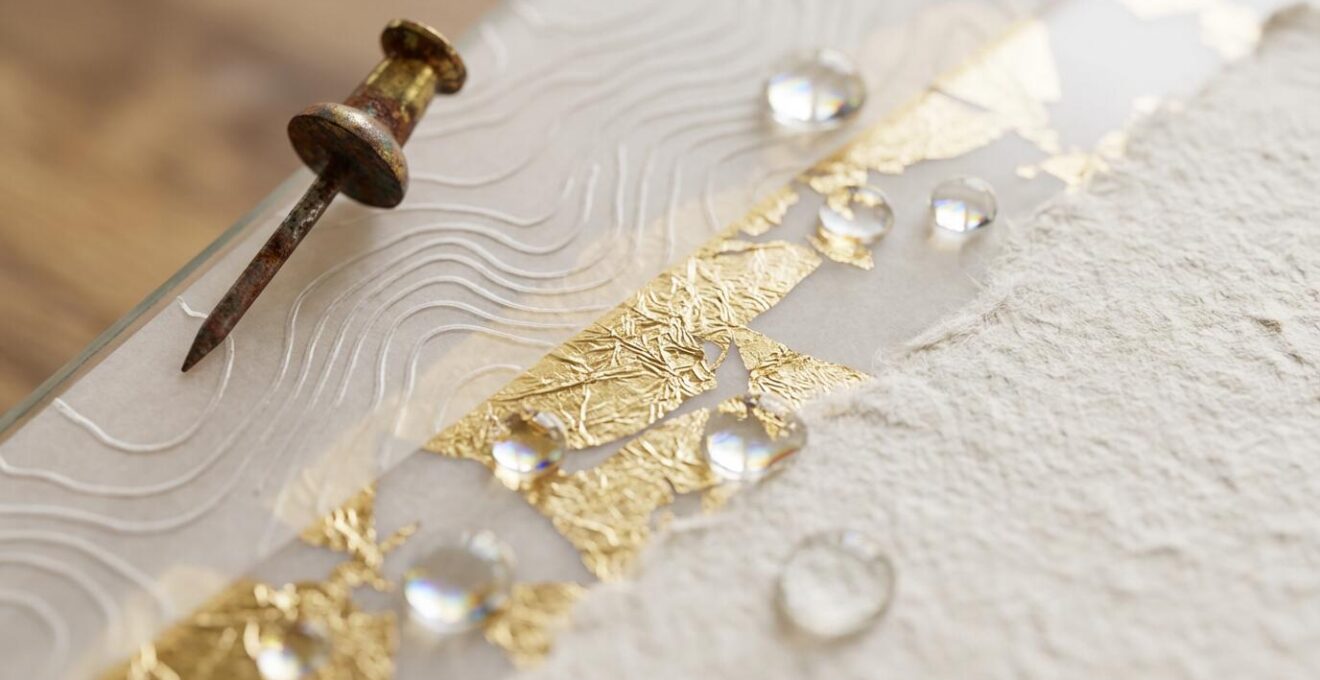
This layering of meaning creates a rich, immersive experience. It invites guests into your world, allowing them to connect with your story on a deeper, more emotional level. Your symbols become part of the atmosphere, felt as much as they are seen, creating a day that is unmistakably, authentically yours.
Modern Trends vs. Timeless Style: Which Should Dictate Your Theme?
The tension between creating a wedding that feels current and one that won’t look dated in photos ten years from now is a common concern. Should your design be guided by the clean lines and aesthetics trending on social media, or by a more timeless style rooted in your personal story? The most artful answer is not to choose one over the other, but to blend them. Your timeless style is the ‘what’—the core narrative—while modern trends are the ‘how’—the execution.
Your timeless foundation is your story. It’s the non-negotiable part of your theme because it’s authentically you. This is where personal interests come into play. As research from the Wedding Planner Institute reveals, 44% of men incorporate hobbies and personal interests into their wedding, grounding the event in genuine passions. Whether it’s a love for mid-century jazz, a passion for botany, or a shared history of sailing, these elements are your stylistic anchors. They are timeless because they are part of your identity.
Modern trends, on the other hand, should be seen as the tools you use to express that timeless story in a fresh and sophisticated way. Trends in typography, floral design, lighting, and guest experiences can prevent your personal theme from feeling dated or overly literal. As Carly Katz-Hackman, a partner at Pinch Food Design, observes, the context of today’s visual culture is key.
Because Gen Z has grown up in the age of social media, aesthetics plays an even bigger role. Every detail, from tablescapes to menus, is curated with shareability and personal expression in mind.
– Carly Katz-Hackman, Partner of Pinch Food Design
This doesn’t mean your wedding should be a performance for social media. It means that the contemporary expectation is for high-level curation. You can tell your timeless story of “a love for classic literature” not with stacks of dusty books, but through modern calligraphic quotes on handmade paper, a deconstructed floral arrangement inspired by a Dutch still life, and an immersive, candlelit atmosphere. The story is classic; the execution is modern and visionary.
The “Theme Park” Effect: When Personalization Goes Too Far
In the pursuit of a deeply personal wedding, there’s a fine line between a sophisticated narrative and what can only be described as the “theme park” effect. This happens when personalization loses its subtlety and becomes literal, repetitive branding. It’s the ‘Gatsby’ wedding where every surface is covered in art deco patterns, or the ‘travel’ wedding where globes and maps are so ubiquitous they lose all meaning. The theme becomes a costume rather than an atmosphere, overwhelming the guests and cheapening the very story you’re trying to tell.
The antidote to this is to think in terms of a design leitmotif, not a logo. A leitmotif is a recurring element that is subtle, sophisticated, and integrated with purpose. It appears in a few high-impact places, creating moments of discovery and connection rather than shouting for attention. For example, instead of printing your custom monogram on napkins, menus, and signage, you might use it once, beautifully, as a custom wax seal on the invitations, and then echo its circular shape in the charger plates or a round ceremony arch.
This approach respects your guests’ intelligence and allows them to piece the story together. It’s about creating ‘aha!’ moments—when a guest notices the constellation from your invitation subtly projected onto the dance floor, or recognizes the floral motif from the ceremony arch delicately embroidered on the corner of a linen napkin. The following table, inspired by principles from wedding experts at publications like Green Wedding Shoes, illustrates the crucial difference between a sophisticated leitmotif and the risk of literal labeling.
| Approach | Subtle & Sophisticated | Literal & Tacky Risk |
|---|---|---|
| Visual Elements | Abstract patterns inspired by your story | Logo or icon stamped on everything |
| Frequency | 3-4 key touchpoints throughout the day | Every surface and item branded |
| Guest Experience | Discovery moments and ‘easter eggs’ | Overwhelming repetition |
| Example | Constellation pattern on dance floor only | Stars on napkins, plates, favors, signs |
True personalization is about quality, not quantity. It’s the art of restraint. By choosing a few key moments to express your theme with intention and beauty, you create a far more powerful and memorable experience than by covering every inch of your venue in a single idea.
How to Unveil Your Theme Progressively From Invite to Exit?
A truly visionary wedding theme isn’t a static backdrop; it’s a narrative that unfolds over time. Thinking like a creative director means orchestrating a sensory journey for your guests, where the theme is revealed progressively, building in richness and intensity from the moment they receive the invitation to their final farewell. This creates a cohesive and immersive experience that feels intentional and deeply engaging, rather than a collection of decorated rooms.
This journey has three distinct acts:
Act I: The Overture (The Invitation Suite). Your save-the-date and invitation are the first whispers of the story to come. This is not the place for a full reveal. Instead, it’s about setting a tone. It might be a subtle texture on the paper, a unique color palette, a carefully chosen turn of phrase, or a single abstract symbol used as a wax seal. It poses a question and builds anticipation, hinting at the atmosphere you’re creating without giving the whole plot away.
Act II: The Immersion (Ceremony & Cocktail Hour). As guests arrive, the theme becomes more present. The welcome sign might feature the modern typography from the invitation. The music playing pre-ceremony could be an instrumental version of a song that’s meaningful to you. The ceremony space itself should be a high-impact expression of your core emotional theme—whether that’s minimalist and serene, or lush and romantic. During cocktail hour, a signature drink named after a shared memory continues the story, and the leitmotif might appear subtly on cocktail napkins.
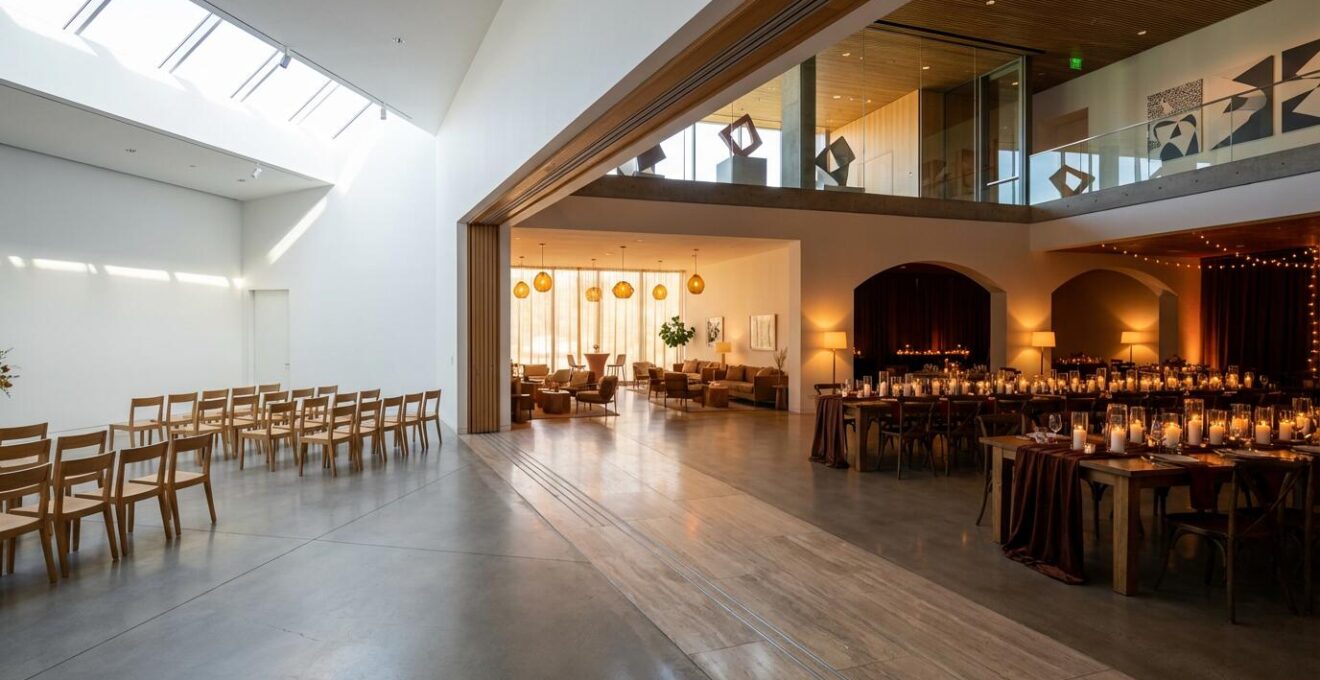
Act III: The Climax (The Reception & Exit). The reception is where all the narrative threads come together in their fullest expression. The lighting shifts to become more intimate and dramatic. The tablescapes bring the textures, colors, and symbols into full focus. The major design installation—be it a breathtaking floral ceiling or a custom dance floor—serves as the climax of the visual story. Even the exit should feel like a conclusion, with a favor that thoughtfully references the day’s theme, providing a final, tangible piece of your story for guests to take home.
How to Achieve a Modern Aesthetic Without Your Wedding Feeling Cold?
A modern aesthetic—with its clean lines, minimalist principles, and often monochromatic palettes—is undeniably sophisticated. However, it carries the inherent risk of feeling stark, impersonal, or cold. The fear is that in stripping away the clutter, you also strip away the soul. As a creative director, I can tell you the solution is not to add more *stuff*, but to infuse the space with deliberate warmth through texture, light, and organic touches.
Modern design is defined by what it lacks: ornamentation, excess, and visual noise. This creates a powerful canvas, but it needs to be “warmed up” with sensory details. The key is creating contrast. A successful modern wedding design is a masterclass in layering opposing textures to create depth and emotion. In one stunning example, a planner combated the perceived coldness of an industrial venue by pairing polished concrete tables with raw, un-dyed silk runners. The hard, cool surface was immediately softened by the organic, flowing textile. Similarly, placing plush velvet lounge furniture against an exposed brick wall, or using organic, handmade paper menus on a minimalist table setting, introduces a human, tactile element that invites guests in.
Lighting is your most powerful tool for atmospheric curation. A common mistake in modern spaces is using flat, single-source lighting with a cool temperature. Instead, you must paint with light. Use multiple, layered sources with a warm temperature (around 2700K) to create pools of intimacy. A strategic combination of amber uplighting on architectural features, hundreds of candles on tables, and perhaps a canopy of Edison bulbs can transform a minimalist hall into a warm, glowing sanctuary. The final touch is the inclusion of organic elements. This doesn’t mean overflowing florals that contradict the minimalist ethos. It means structured, architectural arrangements with a few wild, gestural stems, or the use of natural materials like unpolished stone, raw wood, and linen to ground the sleekness of metal and glass.
Modern vs. Bohemian: How to Merge Opposing Styles into “Mod-Boho”?
On the surface, modern and bohemian aesthetics seem like polar opposites. Modernism is about structure, clean lines, and curated minimalism. Bohemian style is about free-spirited eclecticism, layered textures, and organic abundance. Yet, some of the most compelling and personal wedding designs today are born from the fusion of these two worlds into a style often called “Mod-Boho.” This isn’t about meeting in the middle; it’s about creating a dynamic dialogue where each style highlights the best qualities of the other.
The secret to a successful Mod-Boho fusion is to use the modern aesthetic as the structural foundation and the bohemian elements as the soulful layers. As The Modern Groom’s editorial team notes, “The beauty of a minimalist theme is that it never goes out of style,” while for the “free-spirited couple, boho chic is all about laid-back vibes.” The fusion honors both impulses. You start with a clean, modern canvas: a neutral color palette (think whites, beiges, and blacks), sleek furniture, and a minimalist approach to space. This provides the order and sophistication.
Then, you intentionally “disrupt” that clean foundation with bohemian details. This is where you introduce texture, warmth, and personality. A minimalist table might be softened by a single, beautifully crafted macramé runner. A structured, modern gown could be paired with a wild, overflowing bouquet of pampas grass and dried florals. The table below shows how you can thoughtfully merge these opposing elements to create a cohesive and stylish new look.
| Element | Pure Modern | Pure Bohemian | Mod-Boho Fusion |
|---|---|---|---|
| Furniture | Sleek metal chairs | Moroccan floor cushions | Clean-lined furniture with textured cushions |
| Florals | Single-variety arrangements | Wild, overflowing bouquets | Structured vases with organic arrangements |
| Color Palette | Monochrome | Rainbow earthtones | Neutral base with strategic pops of terracotta |
| Textiles | Smooth linens | Layered tapestries | Minimalist tables with single macramé runner |
The result is a design that feels both curated and relaxed, intentional and effortless. It’s a sophisticated backdrop that still leaves room for personality, nature, and a touch of the untamed—a perfect reflection of a modern couple with a free spirit.
Key Takeaways
- Your wedding theme should be an “experiential narrative” derived from your love story, not a pre-selected style or color palette.
- Translate abstract emotions and memories into a sophisticated sensory language of texture, light, and subtle symbols—a process called symbolic abstraction.
- Use your personal story as the timeless foundation and modern trends as the tools for a fresh, sophisticated execution. Avoid the “theme park” effect by using a subtle design leitmotif instead of literal branding.
Is a Full-Service Planner Worth the Investment for Weddings Under 150 Guests?
There’s a persistent myth that full-service wedding planners are a luxury reserved for massive, six-figure weddings. For couples planning a more intimate celebration—under 150 or even 50 guests—the investment can seem unjustifiable. Why hire a planner when you have fewer tables to decorate and fewer RSVPs to track? This perspective, however, misses the fundamental value a planner provides, especially when the goal is a highly personalized, story-driven event. For smaller weddings, every detail is magnified, and a planner’s role shifts from logistical manager to creative director and budget strategist.
With fewer guests, the focus intensifies on the quality of the experience. An impersonal detail that might go unnoticed at a 300-person affair is glaringly obvious at a dinner for 60. A planner’s true ROI in this context is not just in saving you time, but in preventing costly design mistakes and ensuring your budget is allocated to high-impact narrative elements. As recent market analysis shows, with intimate events becoming more common— 37% of weddings now involve fewer than 50 guests—the value of professional curation is rising. A planner can guide you through the process of symbolic abstraction, sourcing the perfect artisan to create a custom element, and orchestrating the progressive reveal of your theme—tasks that go far beyond simple coordination.
Furthermore, the wedding planning industry is rapidly evolving with technology. Professional planners have access to digital tools, AR/VR planning experiences, and AI-driven platforms that enhance personalization and efficiency. This makes their expertise more accessible and impactful, even for smaller-scale celebrations. They can create a virtual mock-up of your tablescape to ensure the balance is right, or source a unique vendor from a global network that you would never find on your own. Ultimately, a planner is an investment in your story. For an intimate wedding, where the goal is a deeply personal and flawlessly executed atmosphere, their expertise is not a luxury—it’s the most valuable tool for turning your vision into a breathtaking reality.
Your love story is your greatest asset. By investing the time to translate it with intention, subtlety, and artistry, you can create a wedding day that not only looks beautiful but feels true. To begin this journey, start by auditing your own story and trust the authentic, powerful symbols that emerge.
Frequently Asked Questions about Modern Wedding Design
What lighting temperature creates warmth in modern spaces?
Use 2700K warm white bulbs rather than cool daylight (5000K+). Layer multiple light sources including candles, amber uplighting, and Edison bulbs to paint minimalist spaces with emotion.
How many statement pieces should a minimalist wedding include?
Follow the ‘one hero per space’ rule – one dramatic floral installation at ceremony, one art piece at cocktail hour, one stunning centerpiece style at reception. This creates impact without clutter.
Which textures work best in modern wedding design?
Mix hard and soft: concrete with linen, metal with wood, glass with velvet. Natural materials like raw wood, unpolished stone, and organic cotton prevent sterility.